
Yes, non-EU nationals can get a self-employed visa for Italy, but the visa itself is the easy part. The hard requirement is Italian: you must secure an official authorization for your specific activity, whether from the Chamber of Commerce, a professional board, or a local health authority, before any consulate will stamp your visa.
- Verdict: Approval is possible for freelancers, entrepreneurs, partners, artisans, and recognized artists who obtain the correct pre-visa authorization.
- Primary prerequisite: A valid authorization for self-employed work must exist before the consulate opens your visa file.
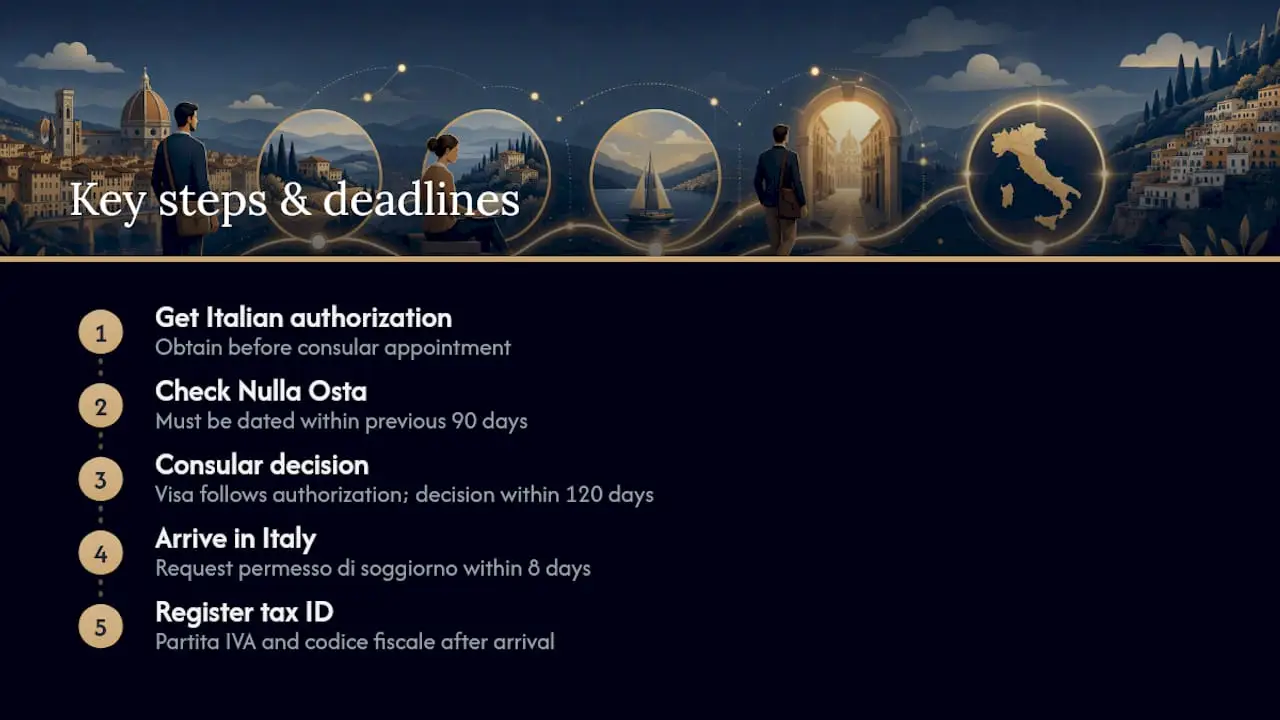
- Timeline snapshot: Consulates decide within 120 days of a complete application, and once you land in Italy, you have just eight days to apply for your residence permit.
Key Takeaways
An Italian self-employment visa only proceeds once you secure the correct Italian authorization, and the consular visa itself is the final, shorter step in the process.
| Point | Details |
|---|---|
| Authorization comes first | Secure your Nulla Osta or Chamber of Commerce approval before booking any consular appointment. |
| Watch document expiry dates | A Nulla Osta older than 90 days will typically get your file rejected at the consulate. |
| Know the residence permit application deadline | You must apply for your permesso di soggiorno within eight days of arriving in Italy. |
| Budget realistically | Expect up to 120 days for a consular decision and a set fee for the entry visa alone. |
| Get local help early | Mglawfirm assists with authorization coordination, consular filing, and post-arrival tax and VAT registration. |
Table of Contents
- What Is the Self Employed Visa Italy Process for Non-EU Nationals?
- Who Issues the Authorization Your Visa Depends On?
- What Documents Do You Need for the Self Employment Visa Italy Application?
- How Does the Application Process Actually Flow From Start to Finish?
- How Long Does It Take and What Does It Cost?
- Why Do Self Employment Visa Applications Get Refused?
- What Must You Do Once You Arrive in Italy?
- What Should You Actually Expect From This Process?
- How Mglawfirm Supports Your Self-Employment Visa File
- Where to Verify Official Rules Before You Apply
- Frequently Asked Questions
- Sources
What Is the Self Employed Visa Italy Process for Non-EU Nationals?
The Italian self employed visa exists for people who carry on a trade, practice a profession, work as a craftsperson, or hold executive roles in a company they own or co-own. That is the official definition, and it matters because Italian immigration law treats “unregulated” freelance work very differently from “regulated” professions like architecture, medicine, or law, which require enrollment in a professional order before you can even request authorization.
Categories that routinely receive approval include:
- Entrepreneurs whose activity serves Italy’s economic interest
- Independent professionals in unregulated fields (consultants, designers, writers)
- Partners or administrators in an existing Italian company
- Internationally recognized artists
- Artisans who bring capital or specialized craft skills
A graphic designer might get cleared through the Chamber of Commerce, a physiotherapist through the relevant professional board, and a restaurant owner through the local health authority (ASL) in addition to the chamber. The category you fall into determines which door you knock on first.
Who Issues the Authorization Your Visa Depends On?
This is where most applications stall, and it is not the consulate’s fault. The authorization step happens entirely in Italy, often before you have ever set foot there, and it requires you to identify the right authority for your specific activity.
The Chamber of Commerce handles company-related authorizations, local health departments cover food and hospitality businesses, and professional orders manage regulated fields like engineering or accounting. Here is the practical path:
- Identify the competent authority for your activity type.
- Request the required certifications, including registration in relevant registers.
- Obtain the Nulla Osta or equivalent institutional clearance where required.
- Compile the authorization packet and route it to the consulate handling your case.
Pro Tip: The single document most applications lack is a formal institutional endorsement, an actual Chamber of Commerce or professional board certification, not a self-prepared summary of your qualifications. Consulates want proof from the authority itself, not your interpretation of the rules.
What Documents Do You Need for the Self Employment Visa Italy Application?
Consular officers see the same missing items again and again. Prepare these before you book your appointment, not after.
- Completed visa application form and valid passport with at least two blank pages
- Recent ICAO-standard photos
- Your authorization or Nulla Osta, issued within the previous 90 days
- Chamber of Commerce “parametri di riferimento” declaration confirming your projected income meets the required threshold
- Proof of accommodation in Italy
- Travel health insurance valid for Schengen entry
- Proof of financial resources beyond the parametri figure
Activity-specific applicants need more. Entrepreneurs typically attach a business plan or signed contracts; company partners must show the destination business has been active for the required period; regulated professionals need their qualifications recognized by the relevant Italian board before filing.
Watch the dates closely. A Nulla Osta issued outside the permitted recent timeframe before your appointment is treated as expired, and consulates rarely make exceptions for a missed deadline.
Pro Tip: Label every document with a short cover sheet listing what it proves. An officer who can match your parametri declaration to your income proof in seconds is far less likely to request a second appointment.
How Does the Application Process Actually Flow From Start to Finish?
The sequence rarely changes, even though the paperwork inside each step varies by profession. Here is the order you will follow:
- Secure your Italian authorization through the Chamber of Commerce, professional order, or local health authority tied to your activity.
- Book a consular appointment in your country of legal residence and submit the complete visa file.
- Wait for the decision, which arrives within 120 days, and use the visa within 180 days of issue if approved.
- Enter Italy and immediately start the residence permit clock.
- Apply for your permesso di soggiorno at the post office (using the immigration kit) within eight days of arrival, then attend your Questura appointment.
- Register your business, obtaining a codice fiscale and, if required, a partita IVA.
If your category falls under an annual quota system (decreto flussi), availability that year can affect timing even after your authorization is approved, so check quota status before assuming a fixed calendar.
How Long Does It Take and What Does It Cost?
Budget for delays even when your file is clean. Consulates have up to 120 days to decide, and residence permits generally run for up to two years once granted, with renewal requests due at least 60 days before expiry.
- Entry visa fee: typically a set fee required by Italian consulates
- Residence permit fees vary depending on the duration of the permit (short, medium, or long-term)
- Additional postal and administrative charges apply on top of these figures
Regional Questure sometimes run discretionary checks that add weeks, so plan your entry date with a buffer rather than booking flights the day your visa clears.
Why Do Self Employment Visa Applications Get Refused?
Most refusals trace back to the same handful of gaps, and nearly all of them are preventable.
- Expired or missing Nulla Osta: file an authorization older than 90 days and expect a rejection.
- Weak proof of income: a personal estimate instead of an official parametri declaration rarely satisfies the consulate.
- No Chamber of Commerce or board confirmation: self-certification is not a substitute for institutional endorsement.
- Inadequate accommodation proof: a vague statement of intent to find housing is not enough.
- Mismatched translations: documents lacking notarized Italian translations get flagged for clarification, adding weeks.
If your case involves a regulated profession, proof of funds across multiple jurisdictions, or a contested authorization, bringing in legal assistance at the authorization stage, not after a consular denial, usually saves the most time.
What Must You Do Once You Arrive in Italy?
The eight-day countdown starts the moment you land, and it applies regardless of how straightforward your case was. Head to the Post Office immigration kit first, then attend your scheduled Questura appointment with your passport, visa, photos, and authorization documents in hand.
- Submit your permesso di soggiorno application within eight days of entry.
- Register with the local anagrafe (municipal registry) once your stay is confirmed long-term.
- Request your codice fiscale, which you will need for nearly every subsequent transaction.
- Register for partita IVA if your activity requires VAT registration.
- Enroll with INPS or the relevant professional pension fund where applicable.
Tax registration timing matters more than most applicants expect. Waiting too long to register with the Agenzia delle Entrate can create retroactive liability questions, so many self-employed arrivals get local tax guidance in their first week rather than their first month.
What Should You Actually Expect From This Process?
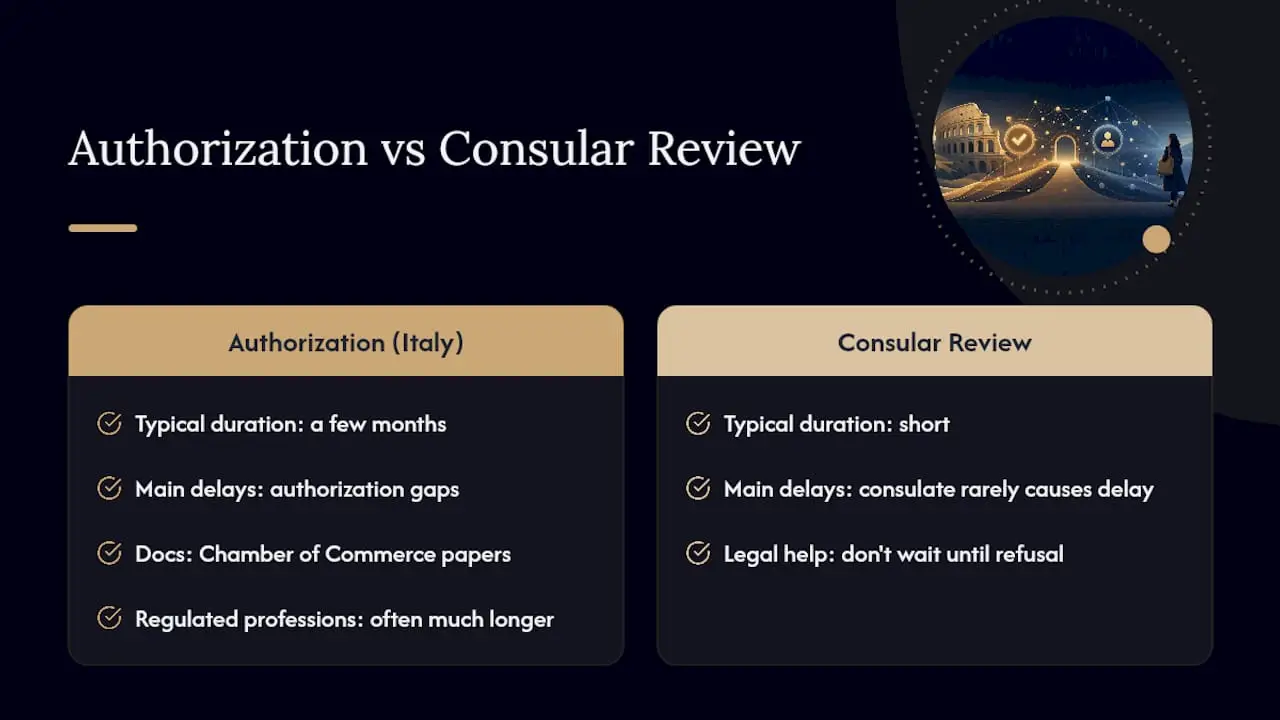
The consulate rarely causes the delay. Authorization gaps do, and applicants who assume the visa is the hard part usually discover the opposite once they start collecting Chamber of Commerce documents. A clean, unregulated freelance case can move in a few months; a regulated profession requiring board recognition often takes considerably longer. Involve a lawyer at the authorization stage, not after a consular refusal.
How Mglawfirm Supports Your Self-Employment Visa File
Mglawfirm gets you past the exact bottleneck that stalls most self-employment visa files: securing the right Italian authorization before you ever sit down with a consular officer. Instead of navigating the Chamber of Commerce, professional boards, and Questura on your own from abroad, you work with a multilingual team already embedded in Italy’s regulatory system.
Mglawfirm’s support typically covers authorization coordination with the competent Chamber of Commerce or professional order, preparation and translation of your consular packet, representation during your Questura appointment, and setup of your codice fiscale and partita IVA registration once you arrive. A common workflow starts with an authorization assessment, continues through visa filing, and carries through to your first tax registration, so you are not handed off between advisors at each stage.
If you are weighing a self-employment visa against other routes, such as Italy’s Golden Visa program, or you already know self-employment is your path and want your authorization request handled correctly the first time, book an initial case assessment with Mglawfirm’s immigration team before your consular appointment.
Where to Verify Official Rules Before You Apply
- The EU Immigration Portal’s Italy page for current authorization and visa rules
- Polizia di Stato’s guidance on self-employed foreign national procedures
- Your specific Italian consulate’s website, since document nuances vary by jurisdiction
- Your local Chamber of Commerce or professional order for activity-specific certification requirements
Frequently Asked Questions
Can a non-EU national really get a self-employment visa for Italy?
Yes, provided you fall into an eligible category and secure the correct Italian authorization before your consular appointment. The visa itself follows the authorization; it doesn’t replace it.
What is the single biggest reason self employed visa Italy applications fail?
An expired or missing Nulla Osta. Consulates require this document dated within the previous 90 days, and a lapse forces you to restart that portion of the process.
How long does the Italy self employment visa process take overall?
Consulates issue a decision within 120 days of a complete filing, but the authorization stage in Italy, not the consular review, is usually the longer phase of the entire timeline.
Do I need a Partita IVA before I apply for the visa?
No. You register for partita IVA and request your codice fiscale after arrival, once you have your visa and have started the residence permit process at the Questura.
What happens if I miss the eight-day permesso di soggiorno deadline?
Missing it complicates your legal standing in Italy and can create problems for future renewals, so treat that deadline as fixed from the moment you land.
Sources
- Self-employed worker in Italy – Migration and Home Affairs
- Self-employed foreign nationals | Polizia di Stato
- Self-Employment Visa – Consolato Generale d’Italia Boston
- ENTRY VISA FOR “SELF-EMPLOYMENT” (eng_LAVORO-AUTONOMO.pdf)
