
Yes, both countries allow dual nationality. You can hold an Italian passport and a U.S. passport at the same time, and neither government requires you to renounce one for the other. What changed on March 27, 2025, is how many people can actually claim Italian citizenship by descent going forward.
Decree-Law 36/2025, converted into Law 74/2025, narrowed the automatic recognition of citizenship by descent, or jure sanguinis, for new administrative filings. If your consular appointment was confirmed or your application was already filed before 11:59 PM Rome time on March 27, 2025, you are grandfathered under the old rules. If not, you now face generational limits that likely cut off claims through great-grandparents.
Here is what to check first:
- Was your consular appointment confirmed, or your application filed, before the cutoff? If yes, you are protected under prior law.
- If no, do you have a parent or grandparent born in Italy who held only Italian citizenship at the relevant time?
- If your line runs through a grandparent or further back and doesn’t meet the new criteria, look at residency-based naturalization or marriage instead.
Key Takeaways
Eligibility for dual citizenship between Italy and the United States now depends primarily on whether your appointment or filing predates the March 27, 2025 reform cutoff.
| Point | Details |
|---|---|
| Check your cutoff status first | Verify whether your Prenot@Mi appointment or application was confirmed before 11:59 PM Rome time on March 27, 2025. |
| Descent claims now have limits | Parent and grandparent lines still qualify administratively; deeper ancestry generally requires residency or a court route. |
| 1948 cases need court, not consulates | Maternal-line claims predating the 1948 Constitution require a judicial petition, not a consular filing. |
| Naturalization dates can break claims | An ancestor naturalizing before the next generation’s birth is the most common cause of a rejected application. |
| MG Law supports the full process | Mglawfirm assembles documents, requests USCIS records, coordinates apostilles, and represents clients in court for complex or judicial cases. |
Table of Contents
- Who Qualifies for Dual Citizenship Italy USA After 2026?
- Which Path Fits: Descent, Marriage, or Residency?
- What Documents Do U.S. Applicants Need?
- Where Do You File: Consulate or Comune?
- How Long Does It Take, and What Does It Cost?
- What Tax and Legal Obligations Come With Dual Citizenship?
- Is Dual Citizenship Worth the Paperwork?
- What Mistakes Sink an Otherwise Valid Claim?
- How MG Law Helps U.S. Citizenship Claimants
- The Reform Rewards Preparation, Not Panic
- Get Expert Help With Your Italian Citizenship Claim
- Frequently Asked Questions
- Sources
Who Qualifies for Dual Citizenship Italy USA After 2026?
The reform didn’t eliminate jure sanguinis. It tightened it. Under the current framework, two categories of applicants remain viable through the administrative (consular or comune) route.
Parent born in Italy. If your Italian parent was born in Italy, you generally qualify, provided your parent held Italian citizenship and did not naturalize as a U.S. citizen before you were born (a distinction that matters enormously for pre-1992 cases). One added wrinkle from the 2025 reform: some parent-based claims now carry a residency condition requiring the Italian parent to have lived in Italy for at least two consecutive years at some point before the applicant’s birth. Confirm this against your family’s specific timeline with a qualified reviewer, since the exact application varies by case.

Grandparent born in Italy. This route survives, but only if your grandparent held exclusively Italian citizenship at the critical time (typically at the birth of the next generation in the line) and never naturalized elsewhere before that point. Claims resting on great-grandparents or more distant ancestors no longer qualify administratively.
Grandfathering works like this:
- Confirmed Prenot@Mi appointment booked before the cutoff: your case proceeds under the pre-reform rules.
- Application already filed with a consulate or comune before the cutoff: same protection applies.
- Nothing confirmed or filed by the deadline: you fall under the new, stricter generational limits.
1948 cases sit outside this entire framework. These involve women who transmitted Italian citizenship through the maternal line before the 1948 Constitution took effect, a scenario the old civil code didn’t recognize. Consulates do not handle these administratively. They require a court petition, typically filed in Rome, and they move on a judicial timeline rather than a consular one.
Which Path Fits: Descent, Marriage, or Residency?
Descent isn’t the only door into Italian citizenship, and for some applicants it isn’t the fastest one. Three routes exist, each with its own thresholds.
Jure sanguinis applicants file either at a consulate in the U.S. or directly at a comune in Italy if they’ve relocated. Consular filing suits Americans who plan to remain in the U.S.; comune filing suits those who’ve already established Italian residency, since local offices often move faster once you’re physically present.
Marriage to an Italian citizen (jure matrimonii) requires either two years of marriage while residing in Italy or three years if living abroad, cut in half if you have children together. You’ll also need to demonstrate B1-level Italian proficiency, verified through a recognized language exam.
Naturalization through residency works for anyone without qualifying ancestry. Non-EU nationals typically need ten years of legal residency, though descendants of Italian citizens who fall outside the jure sanguinis window sometimes qualify under reduced terms. You’ll need documented income and a clean criminal record.
| Route | Typical Requirement | Best Fit |
|---|---|---|
| Jure sanguinis | Qualifying parent or grandparent line | Confirmed ancestry within new limits |
| Marriage | 2 years in Italy / 3 years abroad, B1 Italian | Spouses of Italian citizens |
| Residency naturalization | ten years legal residency (sometimes reduced for descendants) | No qualifying ancestry |
The 2025 reform also opened a narrow reacquisition window for individuals who previously lost Italian citizenship under prior law, subject to conditions tied to when and why citizenship was lost. If you fall into this category, it’s worth a dedicated review rather than assuming the standard descent rules apply.
What Documents Do U.S. Applicants Need?
Every consular checklist starts in the same place: prove the unbroken chain from your Italian ancestor to you. Missing one link, one certificate, one apostille, can stall a case for months.
- Long-form civil records for every generation in the chain. Birth, marriage, divorce, and death certificates for you, your parents, and your qualifying ancestor. Consulates want long-form, not abstract, versions.
- Your ancestor’s Italian civil records, obtained from the comune of origin where possible.
- Naturalization records or a USCIS letter of no record. If your ancestor naturalized as a U.S. citizen before the next generation’s birth, that naturalization date matters enormously and can break an otherwise valid claim. If no naturalization occurred, you’ll need a USCIS letter confirming no record exists, often required in its original sealed envelope and covering every name variant your ancestor used.
- FBI Identity History Summary, apostilled and translated, required by most consulates as part of the standard background check package.
- Apostilles on every U.S.-issued document through the U.S. Department of State, plus certified translations into Italian, since requirements vary slightly by consulate.
Pro Tip: Order your FBI Identity History Summary and USCIS records early. Both can take weeks to arrive, and consulates in the U.S. often won’t schedule a document review appointment until you already hold them in hand.
If a record is genuinely unobtainable, some consulates accept affidavits or alternate documentation, but this should be confirmed with your specific jurisdiction before you rely on it.
Where Do You File: Consulate or Comune?
Jurisdiction depends on where you live, not where your ancestor was born. American applicants file with the Italian consulate that covers their state or region of residence, determined by the Consulate General of Italy’s jurisdictional maps.
- Consulate path: Book through the Prenot@Mi online booking system. A confirmed appointment date, not just a submitted request, is what counts for grandfathering under the March 27, 2025 cutoff.
- Comune path: If you’ve relocated to Italy and registered residency (AIRE if abroad, ANPR once resident in Italy), you file locally instead of through a U.S. consulate. Many applicants find comune processing faster once they’re on the ground.
- What to expect at the appointment: a document review, on-the-spot flagging of anything missing or improperly translated, and, if everything checks out, formal acceptance of your file for processing.
Prenot@Mi appointment slots fill up fast in high-demand jurisdictions, so a confirmed booking made well before you have every document ready is often the smarter play, as long as you understand it locks in your grandfathering status.
How Long Does It Take, and What Does It Cost?
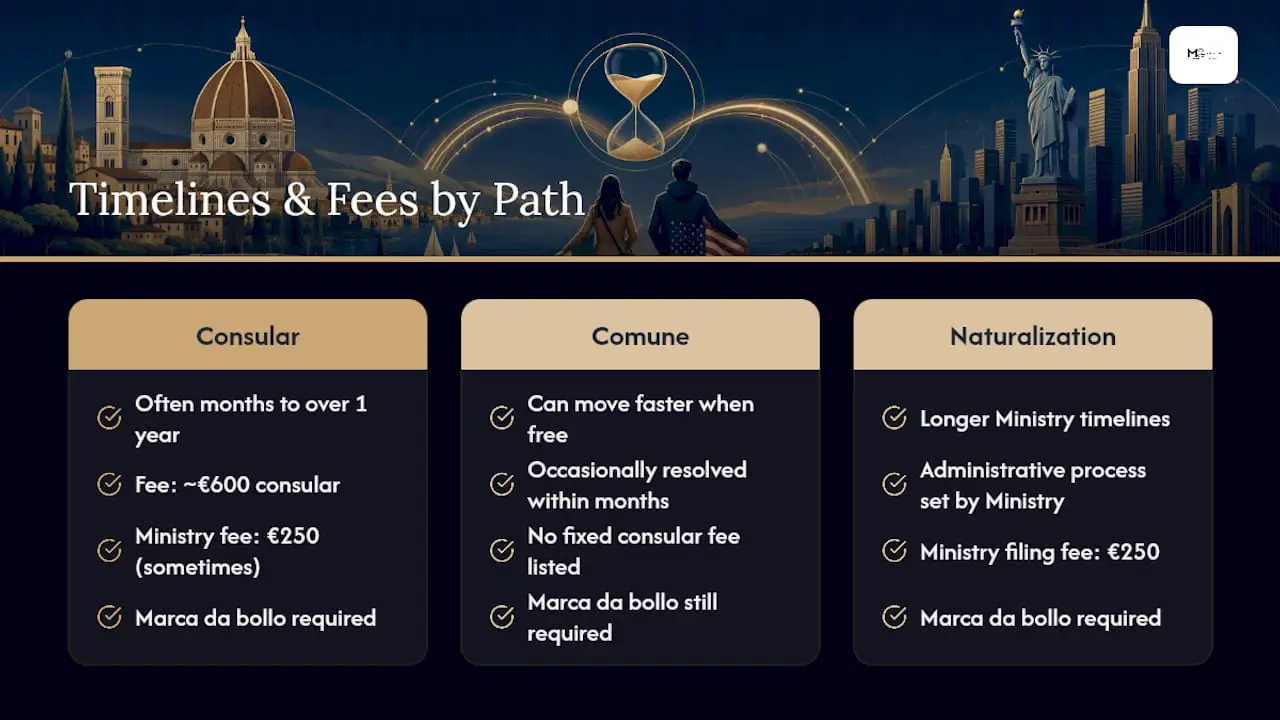
Processing timelines vary by path and jurisdiction. Consular jure sanguinis cases often take multiple months to over a year from confirmed appointment to decree, depending on consular workload. Comune-based recognition can move faster, occasionally within months, when local offices aren’t overwhelmed. Marriage and residency naturalization cases typically run on separate, longer administrative timelines set by the Ministry of Interior.
Fees vary by application type. The Consulate General of New York lists a consular fee around €600 for certain jure sanguinis submissions, separate from a Ministry of Interior filing fee of €250 that applies to some naturalization and residency cases. Expect an additional revenue stamp (marca da bollo), a small fixed administrative charge required on top of the main fee.
Delays usually trace back to three causes: missing or inconsistent naturalization records, translation errors, and plain consular backlog. If you’re racing a deadline, a confirmed appointment or an already-filed application is your strongest protection, and legal escalation is sometimes warranted when a consulate sits on a complete file without acting.
What Tax and Legal Obligations Come With Dual Citizenship?
Holding both passports doesn’t erase either country’s tax claim on you. The U.S. taxes citizens on worldwide income regardless of where they live, meaning you’ll keep filing Form 1040 annually, along with an FBAR (FinCEN 114) and FATCA Form 8938 if your foreign accounts cross the applicable thresholds.
Italy works differently: citizenship alone doesn’t trigger Italian taxes. Residency does. You become an Italian tax resident once you register residence there or spend more than 183 days in the country in a calendar year.
- Use your U.S. passport to enter and exit the United States; it remains your primary travel document there.
- Use your Italian passport for EU and Schengen travel, where it grants faster entry and eliminates visa questions entirely.
- Expect extra scrutiny from Italian banks under FATCA screening once you disclose U.S. citizenship.
- If you become Italian tax resident, you may gain access to Italy’s public healthcare system and social security coordination, worth reviewing with a tax advisor familiar with the Italy-U.S. treaty.
Is Dual Citizenship Worth the Paperwork?
An Italian passport opens EU-wide freedom of movement: the right to live, work, and study in any of the 27 EU member states without a visa or work permit. For a U.S. citizen, that’s a door the American passport simply doesn’t open.
Visa-free travel overlaps significantly between the two passports for short trips, so the practical gain shows up most in longer stays, work authorization, and EU healthcare access rather than tourism.
The trade-off is real, if manageable:
- Ongoing document maintenance (passport renewals in two countries, updated civil records)
- Continued annual U.S. tax filing regardless of where you live
- Additional bank compliance paperwork once foreign institutions flag your U.S. citizenship
Retirees relocating to Italy, remote workers wanting EU work rights, and families with children who’d benefit from EU university access tend to see the clearest return on the effort.
What Mistakes Sink an Otherwise Valid Claim?
The single most common application killer is an ancestor’s naturalization date landing before the next generation’s birth. Verify this precisely through USCIS or National Archives (NARA) naturalization records before you assume your line is clean.
- Pull naturalization records first, before gathering anything else, since this single date can end a claim regardless of how complete the rest of your file is.
- Document gaps with affidavits or genealogical evidence when a vital record genuinely doesn’t exist, rather than guessing or omitting the link.
- Save every Prenot@Mi confirmation email and screenshot, since proof of a booking made before the March 27, 2025 cutoff is what protects your grandfathered status if a dispute arises later.
- Escalate to court for 1948 and other exceptional cases, where administrative filing isn’t an option and experienced Italian counsel meaningfully improves outcomes.
Pro Tip: Don’t wait for a consular appointment slot to open before ordering your naturalization search. Backlogs in both systems can run in parallel, and starting one while you wait on the other saves months.
How MG Law Helps U.S. Citizenship Claimants
Mglawfirm works with American clients navigating exactly this process, with multilingual teams in Rome, Milan, Palermo, Ostuni, and Noto handling citizenship, tax, real estate, and immigration matters across Italy.
Services relevant to a jure sanguinis, marriage, or residency claim include:
- Full document assembly and chain-of-custody review before you book an appointment
- USCIS and genealogical record requests, including letters of no record
- Apostille and certified translation coordination
- Direct liaison with consulates and comuni on jurisdiction and scheduling
- Court representation for 1948 maternal-line cases and other judicial claims
Complex genealogy, a missing naturalization record, an approaching deadline, or a case that needs court filing are the four situations where handling this alone gets risky. If any of those apply to you, an initial case assessment is the logical next step.
The Reform Rewards Preparation, Not Panic
Most of the anxiety around the 2025 reform comes from applicants assuming the cutoff retroactively killed claims that were already filed. It didn’t. If your appointment was confirmed or your paperwork was in before March 27, 2025, you’re standing on solid ground under the prior rules.
Where the conventional advice falls short is in treating document gathering as a formality you handle right before your consulate appointment. In practice, the naturalization record, the one document most people assume they’ll find easily, is the one most likely to derail a case month into the process. Order it first, not last.
The reform also did something useful, if unpopular: it forced a wave of great-grandchild claimants to confront that residency and marriage routes were always viable alternatives, not fallback options. For readers whose ancestry no longer clears the new generational bar, that’s not necessarily a closed door. It’s a different door.
Get Expert Help With Your Italian Citizenship Claim
Sorting through USCIS letters, apostille requirements, and consular jurisdiction rules on your own is doable, but a single naturalization date error or a missed Prenot@Mi deadline can cost you months, or the claim itself. Mglawfirm reviews your family’s specific timeline against the post-2025 rules before you book anything, so you’re not discovering a gap in your documentation at the consulate window.
For cases involving 1948 maternal-line claims, missing naturalization records, or an approaching cutoff, Mglawfirm’s teams in Rome, Milan, Palermo, Ostuni, and Noto handle the document assembly, USCIS requests, and court representation directly. If you’re also planning eventual Italian residency, the firm’s tax residency guidance covers what changes once you’re no longer just a citizen on paper.
Start with an initial case assessment through MG Law’s citizenship practice page to find out exactly where your claim stands.
Frequently Asked Questions
Can I lose my U.S. citizenship by becoming an Italian citizen?
No. The United States has no law that strips citizenship from Americans who acquire a second nationality voluntarily. You keep both.
Does the 2025 reform affect people who already have Italian citizenship?
No. It applies only to new administrative recognition applications filed after the March 27, 2025 cutoff. Anyone already recognized as an Italian citizen is unaffected.
Do I need to speak Italian to claim citizenship by descent?
No language requirement applies to jure sanguinis claims. Language proficiency (B1 level) is required only for the marriage-based and residency naturalization pathways, not descent.
Sources
- Jure sanguinis recognition instructions — Consulate of Philadelphia (PDF)
- Citizenship information — Consulate General of Italy in New York
- Governo
Recommended
- Italian citizenship new law 2025 – MG Law
- Italian Citizenship by Descent Lawyer Guide (2026) | MG Law Firm
- taly-US Tax Treaty: Guide for US Expats 2026 | MG Law
- Italian Citizenship Lawyer for Foreigners | MG Law Firm
The information provided here is general in nature and does not replace professional assistance. Reading this content does not create a professional-client relationship.
