
If your spouse is an Italian or EU citizen, you apply for a Type D national visa for family reasons at the Italian consulate covering your place of residence, and you don’t need a Nulla Osta from the Sportello Unico per l’Immigrazione (SUI). If your spouse is a non-EU citizen legally residing in Italy, you follow the standard family reunification route, which does require that SUI Nulla Osta before any consular visa application. Either way, your first move today is the same: confirm the marriage is transcribed in Italy, or start that transcription immediately.
- EU/Italian sponsor: Type D visa for family reasons, no SUI Nulla Osta, marriage transcription required first.
- Non-EU resident sponsor: Standard family reunification, SUI Nulla Osta required before the consular stage.
- After arrival: File for your permesso di soggiorno within eight days, no exceptions.
Since June 1, 2024, a Type D visa for family reasons has been mandatory for anyone intending to settle permanently with an Italian or EU spouse. Entering as a tourist and hoping to “sort it out later” is a legal risk, not a shortcut, according to Ready Set Italia’s account of the 2024 rule change.
Key Takeaways
Spouses of Italian or EU citizens apply for a Type D national visa without an SUI Nulla Osta, while spouses of non-EU residents need that Nulla Osta first, and both must file for a permesso di soggiorno within eight days of arrival.
| Point | Details |
|---|---|
| Confirm your track first | EU/Italian sponsor means no SUI Nulla Osta; non-EU resident sponsor requires it before any consular step. |
| Transcribe the marriage early | Marriages must be officially transcribed in Italy before the visa process can move forward. |
| Watch document freshness | Marriage certificates older than six months are commonly rejected; apostille and translate on a tight timeline. |
| Meet the eight-day deadline | File for your permesso di soggiorno within eight days of entering Italy, no exceptions. |
| Get professional support for complex cases | Mglawfirm coordinates transcription, legalization, and Questura timing for denials, dependency claims, or tight deadlines. |
Table of Contents
- Who Qualifies for a Spouse Visa in Italy?
- What Documents Do You Need for the Spouse Visa Process in Italy?
- How Do You Apply for the Consular Stage of a Spouse Visa?
- What Happens After You Arrive in Italy?
- What Do Spouse Visas and Permits Cost, and How Long Do They Take?
- What Are the Most Common Reasons Spouse Visas Get Delayed or Denied?
- When Should You Bring in a Lawyer for Your Spouse Visa Case?
- How Do You Get a Nulla Osta from an Italian Municipality?
- How Do You Prove Financial Means and Housing for the Visa?
- Do You Need to Speak Italian for a Spouse Visa?
- How Long Is the Spouse Visa Valid, and How Do You Renew Your Permit?
- What Rights Does the Spouse Visa Give You in Italy?
- How Should You Prepare for Your Consulate Visa Interview?
- Why the “Simple” Spouse Visa Trips Up So Many Applicants
- How Mglawfirm Supports Your Spouse Visa and Broader Italian Legal Needs
- Where to Verify These Spouse Visa Rules Officially
- Sources
Who Qualifies for a Spouse Visa in Italy?
Italian immigration law, specifically D.Lgs. 30/2007, sets out exactly who counts as family for reunification and family-reasons purposes. Article 2 defines the core family unit, and Article 29 extends it to dependent relatives under specific conditions.
The following categories generally qualify:
- Spouse in a registered civil marriage, regardless of where the marriage took place, as long as it’s later transcribed in Italy.
- Registered civil partner, recognized under Italian civil union law with equivalent documentary standing to marriage.
- Minor children, including adopted children, of the sponsor or their spouse.
- Dependent adult children who cannot support themselves due to documented health conditions.
- Dependent parents who lack adequate support in their country of origin.
A registered, transcribed marriage is the cleanest path. De facto partnerships without formal registration face a much higher evidentiary bar and typically require proof of cohabitation, shared finances, and a genuine long-term relationship. Age, an intact (non-separated) marital status, and demonstrable dependency for extended family members are all checked closely at the consular stage.
What Documents Do You Need for the Spouse Visa Process in Italy?
Consulates work from a fixed checklist, and missing even one item stalls the whole file. Build your documentation around these categories before booking any appointment.
| Document category | Details and common pitfall |
|---|---|
| Marriage certificate | Must generally be recent; many consulates reject certificates older than six months. |
| Apostille or legalization | Foreign-issued vital records need an Apostille (Hague Convention countries) or consular legalization otherwise. |
| Certified Italian translation | A sworn or certified translation of the marriage certificate is mandatory, not optional. |
| Sponsor’s documents | Valid ID or passport, proof of Italian/EU citizenship or residence permit, and civil status extract. |
| Invitation letter | A signed statement from the sponsor confirming the relationship and purpose of the visit. |
| Passport | Valid well beyond the visa’s intended validity period, with blank visa pages. |
| Proof of accommodation | Lease, deed, or hospitality declaration matching the sponsor’s residence. |
Marriage transcription at the Comune (or through the consulate before departure) is the step people underestimate most. Until the marriage is officially recorded in Italy’s civil registry, the government has no legal basis to recognize your spousal relationship for immigration purposes, no matter how valid the marriage is elsewhere.
Pro Tip: Order fresh copies of your marriage certificate the same week you start your visa file. Apostilles and sworn translations take time, and a certificate that’s fine today can be too old by the time your consular appointment arrives.
For readers assembling foreign vital records from scratch, this immigration document checklist walks through the apostille and translation sequence in more detail.
How Do You Apply for the Consular Stage of a Spouse Visa?
The consular stage is where most files either move forward cleanly or stall for weeks. Follow this sequence:
- Identify the competent consulate. This is determined by your place of legal residence abroad, not your nationality.
- Book your appointment, often through a portal like Prenotami or the specific instructions listed on the consulate’s own website.
- Confirm whether you need a Nulla Osta. If your sponsor is an EU or Italian citizen, you skip the SUI step entirely. If the sponsor is a non-EU resident, the Nulla Osta from the Sportello Unico must be obtained first.
- Submit your complete file, including all originals and copies.
- Attend the interview, where consular officers verify the authenticity of your relationship and documents.
At the interview, expect questions on:
- How you met your spouse and the relationship’s timeline.
- Living arrangements planned in Italy.
- Financial support and housing evidence.
Visas issued for family reasons are commonly issued free of charge under Article 5 of D.Lgs. 30/2007, which surprises many applicants expecting a standard visa fee.
What Happens After You Arrive in Italy?
Getting the visa stamped in your passport is not the finish line. You must apply for your permesso di soggiorno within eight days of entering Italy. This isn’t a suggestion; it’s a hard legal deadline under Italian immigration procedure.
The practical steps look like this:
- Pick up the “kit giallo” (yellow kit) from a designated post office, or check whether your local Questura accepts direct submission.
- Complete the kit with your visa, passport copies, marriage certificate, and passport photos.
- Attend your scheduled Questura appointment for fingerprinting and document verification.
- Receive your permesso di soggiorno card, whose validity generally matches your sponsor’s own residence permit or citizenship status, according to the European Commission’s EU Immigration Portal guidance on family members in Italy.
Separately, register your residence (iscrizione anagrafica) at the Comune where you’ll be living. This step feeds directly into future benchmarks like continuous legal residence for Italian citizenship applications, so treat it as part of the same process, not an afterthought.
What Do Spouse Visas and Permits Cost, and How Long Do They Take?
Family-reasons visas issued to spouses of Italian or EU citizens are typically free of charge, a real cost advantage over other visa categories. The permesso di soggiorno, however, carries its own administrative fees once you’re in Italy.
Permesso di soggiorno costs run in tiers: around €40 for permits valid 3 to 12 months, €50 for 12 to 24 months, and €100 for long-term residence permits, according to the European Commission’s family member guidance. Add postal kit costs and a €16 revenue stamp on top.
Timelines vary by consulate and local Questura backlog, sometimes significantly:
- Consular visa processing can run from a few weeks to a couple of months depending on location.
- Questura appointments for fingerprinting may be scheduled weeks or months out in busier cities.
- Complete documentation submitted on the first attempt is the single biggest lever you control to avoid delay.
What Are the Most Common Reasons Spouse Visas Get Delayed or Denied?
Refusals rarely come from complicated legal issues. They come from paperwork mistakes that were entirely avoidable.
- Outdated marriage certificates. Certificates older than six months are a frequent rejection trigger at multiple consulates.
- Missing or incorrect apostille. Officials treat an absent or improperly applied Apostille as non-compliant, not merely incomplete, meaning the file gets rejected rather than flagged for correction.
- Uncertified translations. A translation without a sworn or certified stamp doesn’t count, even if it’s accurate.
- Weak housing proof. A vague statement of intent to find housing later won’t satisfy consular officers.
Use this quick pre-appointment checklist:
- Fresh marriage certificate, apostilled, translated, and certified.
- Sponsor’s ID and proof of citizenship or residence status.
- Signed invitation letter and accommodation proof.
- Financial evidence covering both spouses.
If your visa or permesso is denied, you generally have the right to an administrative appeal or, in some cases, judicial review before Italy’s Tribunale Amministrativo Regionale. Denials tied to complex dependency evidence or contested document authenticity are exactly when speaking with a lawyer stops being optional.
When Should You Bring in a Lawyer for Your Spouse Visa Case?
Most straightforward cases, an EU sponsor, a transcribed marriage, clean documentation, move through the system without a lawyer. Mglawfirm steps in most usefully when a case has layers: contested dependency claims for parents or adult children, a prior denial that needs an administrative appeal, cross-border legalization complications, or a timeline so tight there’s no room for a rejected document to cost you another six weeks.
Mglawfirm is a multilingual legal firm with offices in Rome, Milan, Palermo, Ostuni, and Noto, providing legal support across Italian immigration, citizenship, real estate, and tax matters. For spouse and family visa cases specifically, that means coordinated handling of document legalization, marriage transcription, and Questura scheduling, all managed by a team that works across the exact jurisdictions where these files get processed.
A file built correctly the first time rarely needs an appeal. The cases that end up in front of a lawyer are almost always the ones where a document gap surfaced too late to fix before the consular deadline.
Typical deliverables for a supported case include a full document audit before submission, direct liaison with the Comune for transcription, and representation if a denial needs to be challenged.
How Do You Get a Nulla Osta from an Italian Municipality?
The Nulla Osta only enters the picture when your sponsor is a non-EU citizen legally residing in Italy, not an Italian or EU citizen. In that scenario, the sponsor, not you, initiates the process, and it happens entirely inside Italy before any visa application begins abroad.

The sponsor submits the Nulla Osta request to the Sportello Unico per l’Immigrazione (SUI), the single desk for immigration matters housed within the local prefecture (Prefettura). This isn’t done at the Comune directly, though the Comune becomes relevant later for residence registration. The SUI request must include the sponsor’s valid permesso di soggiorno, proof of income meeting minimum thresholds, and proof of suitable housing that meets minimum space requirements set by regional health authorities.
Once the SUI reviews the file, and confirms the sponsor’s status and eligibility, it issues the Nulla Osta, which the sponsor then forwards to you. Only after receiving the Nulla Osta can you book your consular visa appointment abroad, since the consulate needs that document to process a standard family reunification visa request.
This sequencing catches people off guard constantly. Applicants assume they can start their consular file in parallel with the SUI review to save time. In practice, the consulate won’t process a family reunification file without the completed Nulla Osta in hand, so trying to move faster by skipping the sequence usually backfires into a longer wait, not a shorter one.
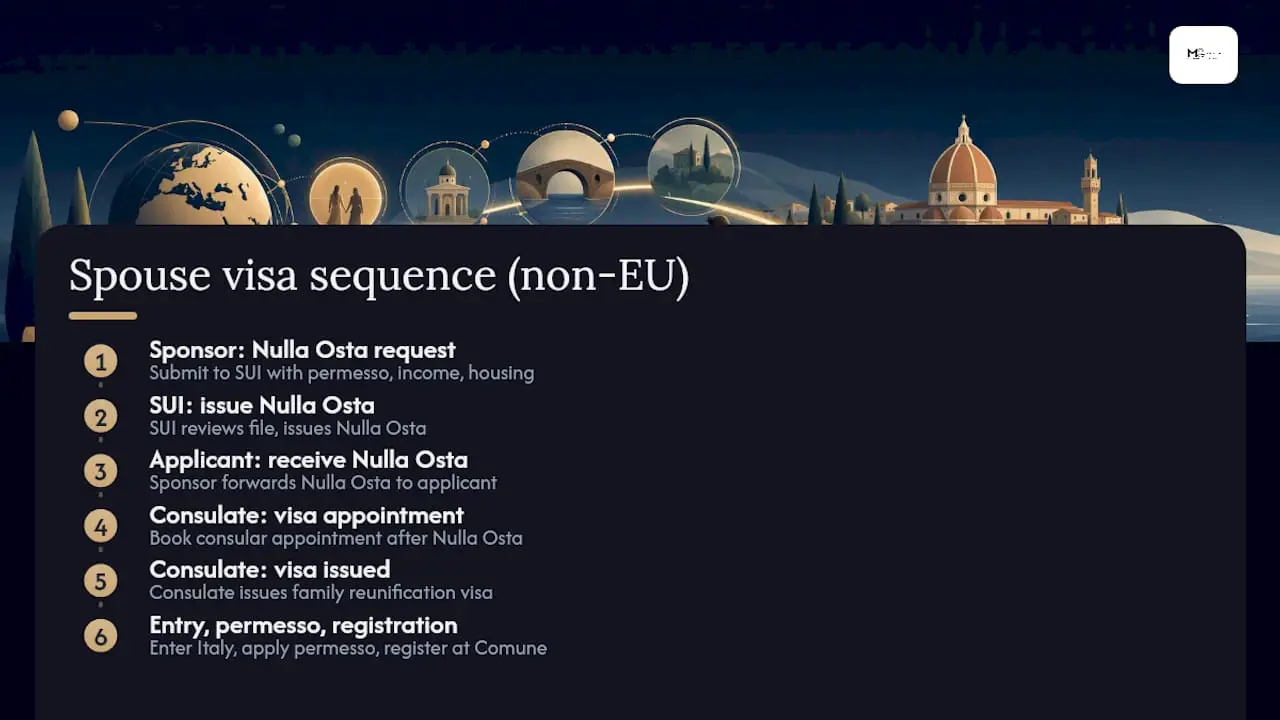
The distinction matters because it changes your entire procedural route. EU and Italian sponsors bypass the SUI step entirely, while non-EU resident sponsors cannot proceed without it. Confirm your sponsor’s exact legal status before assuming which track applies to you.
How Do You Prove Financial Means and Housing for the Visa?
Consular officers and the SUI, depending on your track, both want concrete evidence that you won’t become a burden on the Italian state and that you have somewhere legitimate to live. Vague assurances don’t move a file forward; documented figures and paperwork do.
For financial means, sponsors typically need to show income above a minimum threshold tied to the national social allowance level, adjusted upward for each additional family member being sponsored. Acceptable proof includes:
- Recent payslips or an employment contract showing stable income.
- Tax returns (dichiarazione dei redditi) from the past one to two years.
- Bank statements showing consistent balances, not a one-time deposit.
- For self-employed sponsors, business registration and profit documentation.
A single large transfer into a bank account right before applying rarely convinces reviewers. Officials look for a pattern of financial stability, not a snapshot engineered for the application.
For housing, you need to demonstrate the accommodation meets minimum space standards set by local health authority guidelines (idoneità abitativa), which vary somewhat by region but generally require a minimum square footage per occupant. Acceptable documents include:
- A signed lease agreement or property deed in the sponsor’s name.
- A certificate of habitability (certificato di idoneità abitativa) issued by the Comune, confirming the property meets size and safety standards.
- A formal hospitality declaration if you’ll be staying with a third party temporarily.
Property owners navigating the housing side of this process, especially those also considering a property purchase in Italy, benefit from understanding the legal verifications that go into confirming a property’s due diligence status before relying on it as visa-qualifying accommodation.
Do You Need to Speak Italian for a Spouse Visa?
No formal Italian language test is required to obtain the spouse visa or the initial permesso di soggiorno for family reasons. This surprises a lot of applicants who’ve read about language requirements tied to other Italian immigration categories.
The language requirement that does exist in Italian immigration law applies specifically to the long-term EU residence permit (permesso di soggiorno UE per soggiornanti di lungo periodo), which requires passing an Italian language test at A2 level or above, typically after five years of continuous legal residence. That test isn’t tied to the spouse visa itself or its early renewals; it comes into play only when you’re applying for long-term resident status down the line.
There’s also a practical integration expectation woven into Italian citizenship law, separate from the visa process itself. If your path eventually leads toward Italian citizenship through marriage, you’ll need to demonstrate Italian language proficiency at B1 level as part of that citizenship application, a requirement introduced under Italian citizenship legislation and confirmed through a certified language exam.
So the practical takeaway is a sequencing one: no language test blocks your spouse visa or your first permesso, but if citizenship is the eventual goal, start building genuine Italian proficiency early rather than treating it as a last-minute hurdle years down the line. Consulates and the Questura focus on your documentation and relationship evidence, not your spoken Italian, at this stage of the process.
How Long Is the Spouse Visa Valid, and How Do You Renew Your Permit?
The Type D national visa for family reasons issued to spouses of Italian or EU citizens carries 365-day validity with multiple entries, a change confirmed by Italian consular authorities effective June 1, 2024. That visa itself isn’t what you renew repeatedly. It’s your entry document into Italy, and its job ends once you convert it into a permesso di soggiorno at the Questura.
The permesso di soggiorno is the document with ongoing validity that actually needs renewal. Its duration generally tracks your sponsor’s own residence status. If your sponsor is an Italian citizen, your permesso for family reasons commonly runs for a set multi-year period before renewal. If your sponsor is a non-EU resident whose own permit has a shorter duration, your permesso is tied to that timeline and needs renewal alongside theirs.
Renewal itself follows a familiar pattern:
- File the renewal request at the Questura before your current permesso expires, ideally 60 days ahead.
- Bring proof the marriage remains valid and that you’re still cohabiting or maintaining the sponsoring relationship.
- Provide updated financial documentation if your original permesso required income evidence.
After five years of continuous, legal residence in Italy on a family-reasons basis, you become eligible to apply for the EU long-term residence permit, which carries indefinite renewal terms and fewer conditions attached to your spouse’s own status. That five-year mark is also the general benchmark relevant to eventual Italian citizenship through marriage, making consistent, uninterrupted residence registration at the Comune worth protecting carefully throughout this period.
What Rights Does the Spouse Visa Give You in Italy?
Once your permesso di soggiorno for family reasons is issued, you’re not in a legal gray zone anymore. You hold real, enforceable rights comparable to those of many other legal residents in Italy.
- Work rights. You can work in Italy, whether as an employee or self-employed, without needing a separate work permit tied to a specific employer.
- Healthcare access. You’re entitled to register with Italy’s national health service (Servizio Sanitario Nazionale), giving you access to a general practitioner and the broader public healthcare system on largely the same terms as Italian citizens.
- Freedom of movement within Italy. You can relocate between regions without needing to reapply for a new permit, though you must update your residence registration at the new Comune.
- Path toward long-term residence and citizenship. Time spent on a family-reasons permesso counts toward the residence requirements for both the EU long-term residence permit and, eventually, Italian citizenship by marriage.
What the spouse visa does not automatically grant is the right to bring in additional family members beyond your spouse without a separate reunification process for each of them, or automatic recognition of foreign professional qualifications, which usually requires a distinct recognition procedure through the relevant Italian ministry. Understanding these boundaries early saves you from assuming rights the permit doesn’t actually confer.
How Should You Prepare for Your Consulate Visa Interview?
The interview is where a well-prepared file gets confirmed, and a shaky one gets flagged for further review. Treat the booking and preparation stage with the same care you gave your documents.
Start by booking early. Many consulates, particularly in high-demand locations, have appointment slots weeks or months out, so book the moment your Nulla Osta arrives (if required) or the moment your documents are apostilled and translated.
In the days before your appointment:
- Reconfirm every document’s validity date, especially the marriage certificate; a certificate that was fine when you started the process might have aged past a consulate’s cutoff.
- Organize documents in the order listed on the consular checklist, with originals and copies clearly separated.
- Prepare to answer relationship questions clearly and consistently with your spouse’s own statements, since inconsistencies between spouses’ accounts are a common flag.
- Bring proof of the practicalities: where you’ll live, how you’ll support yourselves, and your travel history together if you have it.
During the interview itself, answer directly and avoid over-explaining. Consular officers process large volumes of family-reasons applications and are trained to spot rehearsed or evasive answers as easily as genuine ones. A calm, consistent, well-documented file speaks for itself far more persuasively than a nervous explanation ever will.
Why the “Simple” Spouse Visa Trips Up So Many Applicants
The conventional advice treats the spouse visa as the easy category, the one without a Nulla Osta, without a points test, without an employer sponsor. That framing isn’t wrong exactly, but it creates a dangerous complacency. The real risk in this category isn’t eligibility. It’s sequencing and document freshness.
Most denials I’ve seen discussed in consular guidance trace back to a handful of preventable errors: a marriage certificate that aged past a consulate’s six-month cutoff, an apostille skipped because someone assumed a translation alone would do, or an applicant who tried to run the SUI and consular stages in parallel instead of in order. None of these are hard problems. They’re timing problems, and timing problems are exactly what a step-by-step, Italy-specific playbook is built to prevent.
What I’d tell any applicant to prioritize first isn’t gathering documents, it’s confirming which track applies to them: EU/Italian sponsor versus non-EU resident sponsor. That single fact determines whether the Nulla Osta even enters the picture, and getting it wrong wastes months. Get the track right, then work backward from the Questura’s eight-day deadline, and the rest of the process becomes far more manageable than its reputation suggests.
— Living
How Mglawfirm Supports Your Spouse Visa and Broader Italian Legal Needs
Mglawfirm is the alternative to piecing together consular checklists and Comune procedures on your own, coordinating marriage transcription, document legalization, and Questura timing under one multilingual legal team across Rome, Milan, Palermo, Ostuni, and Noto. That matters most when your case isn’t the clean, single-document scenario the consular website assumes, contested dependency evidence, a prior denial, or a timeline where a rejected document means missing your planned move.
Beyond immigration, many spouses relocating to Italy end up navigating property purchases or tax residency questions in the same stretch of time, and Mglawfirm’s teams handle both under one roof. If you’re also weighing a property purchase alongside your visa process, a real estate lawyer can run the legal checks before you commit funds.
If your spouse visa case involves a denial, a complex dependency claim, or you simply want your file reviewed before submission, reach out to Mglawfirm’s immigration team to schedule a case assessment.
Where to Verify These Spouse Visa Rules Officially
- The European Commission’s EU Immigration Portal covers residence permit rules, costs, and the eight-day filing deadline.
- The Los Angeles Italian Consulate lists the official family-reasons visa document checklist.
This article is general information, not a substitute for advice from a qualified lawyer. Consult a qualified legal professional about your own circumstances before acting on anything here.
Sources
- EU Family Permit (Family Member Card) in Italy Explained – Italy Handbook
- Foreign Family Members of Italian and EU Citizens – Reintroduction of National Visa for Family Reasons – Ambasciata d’Italia Singapore
- Family member in Italy – Migration and Home Affairs – European Commission
Recommended
- EU Blue Card Italy 2026: Requirements,Salary, Process & FAQ
- Elective Residency Visa Italy 2026: Requirements & How to Apply
- Moving to Italy from the USA: Requirements 2026 | MG Law
- Golden Visa Italy 2025: Residency by Investment Explained – MG Law
The information provided here is general in nature and does not replace professional assistance. Reading this content does not create a professional-client relationship.
