
Yes, many Canadians of Italian descent can claim Italian citizenship by descent, but eligibility now hinges on specific generational rules tightened by the 2025 reform. Start by identifying the Italian-born ancestor in your line, then order two documents in parallel: the long-form Italian birth extract from their Comune of birth and an IRCC Search of Citizenship Records confirming whether and when that ancestor naturalized as a Canadian.
Everything else, apostilles, translations, and the consulate appointment, comes after you know your file is complete.
-
Confirm eligibility first. Check whether you qualify as a first- or second-degree descendant under the exclusive-citizenship rule before ordering paid records.
-
Order records in parallel. Request the Comune extract and the IRCC search at the same time; both take weeks to arrive.
-
Do not book Prenot@mi early. Reserve your consular appointment only once every document is apostilled and translated, since incomplete files are turned away at the counter.
Table of Contents
- What Are the Rules for Italian Citizenship Canada Applicants?
- How Do You Gather the Required Documents?
- How Does Prenot@mi Booking and the Consular Appointment Work?
- What Do Fees and Processing Timelines Look Like?
- What Are the Most Common Reasons Consulates Reject Applications?
- When Should You Consult MG Law for a Citizenship Case?
- Alternative Paths When Descent Doesn’t Apply
- Why Would a Canadian Actually Want an Italian Passport?
- Every Canadian Applicant’s Prep Checklist
- What Most Guides Get Wrong About This Process
- Get Professional Help With Your Citizenship File
- Sources
What Are the Rules for Italian Citizenship Canada Applicants?
Italian citizenship by descent runs on jure sanguinis, the principle written into Law no. 91/1992 that citizenship transmits through bloodline rather than birthplace. That statute has governed transmission for over three decades, but a Decree-Law effective March 28, 2025, and confirmed by Law no. 74 of May 23, 2025, added conditions that Canadian applicants cannot ignore.
Under the current rules, an applicant born abroad who already holds another citizenship (Canadian, in most cases here) can apply by descent only if they meet one of two tests. The Toronto Consulate specifies these as: being a first or second-degree descendant of an Italian citizen who held exclusively Italian citizenship at the time of the applicant’s birth, or qualifying under a two-year residency exception in Italy. This shift matters most for people whose Italian great-grandparent naturalized in Canada before the next generation was born, since naturalization can sever the transmission chain depending on the date.

That naturalization date is a critical factor in eligibility in most Canadian files. If your Italian-born great-grandfather naturalized in 1958 but your grandfather was born in 1952, the line generally stays intact. Reverse those dates and the claim usually breaks. Proving which scenario applies to your family requires documentary evidence, not family lore.
A few structural rules apply regardless of generation:
- You must apply to the Italian consulate holding jurisdiction over your Canadian address, not the office nearest a relative or the one with the shortest wait.
- Consulates will provide document checklists but will not evaluate your specific lineage before your appointment.
- Naturalization timing must be documented, not assumed. Family stories about “never becoming Canadian” are not accepted as proof.
If your Italian ancestry runs through a line that already naturalized before the next generation’s birth, your path likely runs through Italian residency or marriage rather than descent. That route is covered later in this guide.
How Do You Gather the Required Documents?
Consulates evaluate files against a fixed checklist, and the paperwork splits cleanly into two categories: what proves your own identity and lineage, and what proves your ancestor’s status in Italy and Canada.
Applicant documents typically include:
- Long-form birth certificate (not the wallet-size or short-form version)
- Marriage certificate, if applicable
- Divorce decree, if a prior marriage exists
- Valid passport
- Proof of Canadian residence
- Completed AIRE registration form (registry of Italians residing abroad)
Ancestor documents typically include:
- Italian birth extract issued directly by the Comune of birth
- Long-form marriage and death certificates
- Naturalization record or an IRCC Search of Citizenship Records establishing the exact naturalization date
Every Canadian civil document needs an apostille before an Italian consulate will accept it. In Canada, the issuing authority depends on the province: provincial governments handle apostilles for provincially-issued records like birth and marriage certificates, while Global Affairs Canada legalizes federal documents. Confirm which office issued your specific certificate before requesting the apostille, since sending it to the wrong authority costs weeks.
Once apostilled, every document needs a certified Italian translation. Some consulates will certify translations done in-house for a fee; others require translations completed and certified in advance by an accredited translator. Check your consulate’s own checklist rather than assuming the rule that applied to a friend’s file elsewhere.
| Step | Document | Where to Request |
|---|---|---|
| 1 | IRCC Search of Citizenship Records | Immigration, Refugees and Citizenship Canada |
| 2 | Italian birth extract (ancestor) | Comune of birth in Italy |
| 3 | Long-form provincial certificates | Provincial vital statistics office |
| 4 | Apostille | Provincial authority or Global Affairs Canada |
| 5 | Certified Italian translation | Accredited translator or consulate service |
Sequence matters. Order the IRCC search and the Comune extract first, since both carry the longest lead times, then request provincial long-forms, then apostille everything, then translate last.
How Does Prenot@mi Booking and the Consular Appointment Work?
Every consular application in Canada runs through Prenot@mi, the online portal that consulates use to release appointment slots. Applications are accepted in person only; mailed submissions are rejected outright at the Vancouver, Toronto, and Montreal offices alike.
- Confirm your jurisdiction. Your Canadian residential address determines which consulate you must use. A Torontonian cannot book through Vancouver to skip a wait list.
- Complete your file before booking. Appointment slots are limited, and some consulates cap how many citizenship cases they process in a given year, so a wasted slot on an incomplete file sets you back months.
- Watch for release windows. Consulates typically open new appointment batches on a schedule rather than continuously, and slots often fill within minutes.
- Attend in person with originals. Bring every apostilled, translated document, plus your Canadian ID and any prior consular correspondence.
- Understand what happens at the counter. Staff verify your documents, authenticate signatures, collect the consular fee, and submit your file. They do not evaluate lineage eligibility during this appointment.
Pro Tip: Do not treat Prenot@mi as a first step. Practitioners who work these files regularly report that meticulous document preparation, not early booking, is what actually prevents delays, since an incomplete file booked in month one often loses that slot entirely.
What Do Fees and Processing Timelines Look Like?
Consular fees are paid in Canadian dollars directly at the appointment, and they are non-refundable regardless of outcome. The fee schedule follows Article 7bis of the consular table of rights, which sets standard rates for citizenship-related services.
Bring exact funds. Most consulates accept cash or Canadian debit; credit cards and digital payment apps are frequently not accepted at the counter, and staff generally will not make change.
- Fee payment happens once, at submission, not in installments
- Cash and debit are the most reliable payment methods across Canadian consulates
- Some offices accept certified checks; confirm this on your specific consulate’s checklist
Processing timelines vary sharply by consulate and file quality. The Vancouver consulate notes that recognition can take up to 730 days depending on completeness, while other offices reference timelines closer to 36 months for complex or backlogged cases. A file with clean apostilles and translations moves faster than one requiring follow-up correspondence.
Once recognized, your citizenship gets transcribed into the registry of your ancestor’s Comune, and you must register with AIRE. Only after that Comune transcription is complete can you apply for an Italian passport.
What Are the Most Common Reasons Consulates Reject Applications?
Consulate officials consistently point to incomplete or improperly legalized documentation as the leading cause of rejection, not eligibility disputes. Most rejected files could have been approved with better preparation, not different ancestry.
| Rejection Cause | Fix |
|---|---|
| Missing or incomplete apostille | Confirm the correct issuing authority before requesting |
| Wallet-size citizenship card submitted | Request full IRCC Search of Citizenship Records instead |
| Wrong consulate jurisdiction | Verify jurisdiction against your Canadian address before booking |
| Name mismatches across documents | Request certified corrections or supporting affidavits |
| Missing divorce documentation | Obtain certified decree before submission |
- Reconcile name discrepancies by requesting a certified name-variation affidavit or amended civil record before your appointment.
- Order replacement long-form certificates well ahead of your Prenot@mi date; provincial offices can take weeks to process reissues.
- If civil records predate Italy’s civil registry, baptismal certificates or Curia-issued documents can substitute when properly legalized and confirmed by the Comune.
When Should You Consult MG Law for a Citizenship Case?
Most straightforward files, clear naturalization dates, intact Comune records, no jurisdictional ambiguity, can proceed without legal counsel. Complexity changes that calculation.
Cases that typically benefit from professional guidance include:
- Ambiguous or undocumented naturalization dates requiring an Access to Information request to IRCC
- Incomplete or destroyed Comune archives requiring direct research in Italy
- Records that predate civil registration, requiring Curia or Diocesan document retrieval
- Consular delays exceeding standard timelines, where legal remedies may apply
MG Law handles documentary research directly with Italian Comuni, prepares corrected registry entries where records conflict, and has tracked recent Court of Cassation rulings on consular delay that affect applicants stuck in processing backlogs. Ask any lawyer you consider for a clear scope of work, an estimated timeline, and whether fees are fixed or hourly before engaging.
Alternative Paths When Descent Doesn’t Apply
If your ancestor naturalized before the qualifying generation was born, descent is closed to you, but two other routes remain. Marriage to an Italian citizen allows an application after a set period of legal residence in Italy, or a shorter period if the couple has children together. Residency-based naturalization requires several years of continuous legal residence in Italy, documented through registration with the local Comune. Both paths run through different offices than the descent process and carry separate documentary requirements, so confirm eligibility with a legal advisor before restructuring your plans around either option.
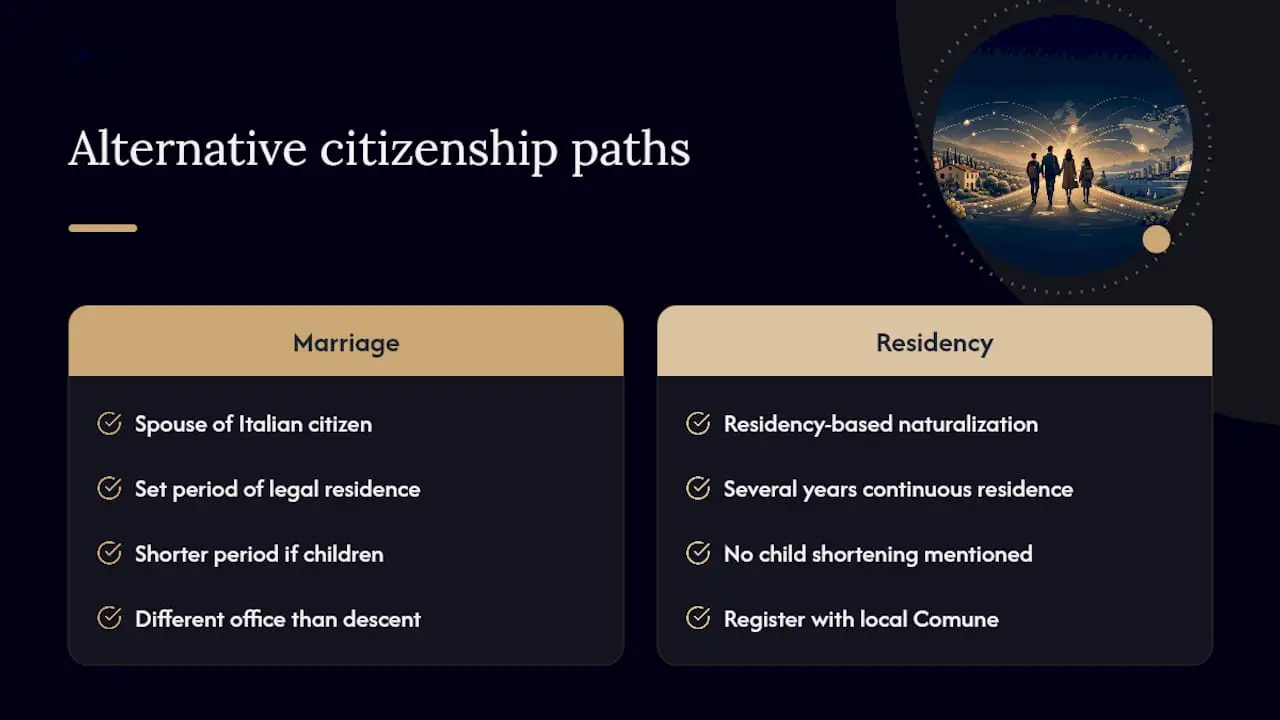
Even a firm “no” on descent is often the start of a different, viable application, not a dead end.
Why Would a Canadian Actually Want an Italian Passport?
Beyond sentiment, an Italian passport confers EU citizenship rights: the ability to live, work, and study anywhere in the European Union without a visa, plus access to Italy’s public healthcare system once residency is established. For Canadians with family property in Italy or plans to retire there part-time, citizenship also removes visa-renewal cycles that otherwise cap non-EU stays at 90 days within any 180-day period. It’s a practical asset, not just a symbolic one.
Every Canadian Applicant’s Prep Checklist
Getting Italian citizenship by descent right the first time comes down to sequencing records correctly and confirming jurisdiction before ever touching Prenot@mi.
| Point | Details |
|---|---|
| Eligibility depends on naturalization timing | Confirm whether your ancestor held exclusive Italian citizenship when the next generation was born. |
| Documents come before booking | Order the IRCC Search and Comune extract first, since both carry the longest lead times. |
| Apostille and translation are mandatory | Every Canadian civil document needs apostille and certified Italian translation before submission. |
| Jurisdiction is fixed by address | Apply only through the consulate covering your Canadian residence, never a faster-looking alternative. |
| Complex cases need specialized help | Firms like MG Law handle Comune research, registry corrections, and consular delay remedies when a file stalls. |
What Most Guides Get Wrong About This Process
Most advice aimed at Canadians treats Prenot@mi as the bottleneck. It isn’t. The real constraint is document completeness, and rushing toward an appointment before your file is airtight almost always backfires, since a rejected submission can cost you the slot and put you back in a competitive booking queue for months.
The conventional wisdom also underplays how much the March 2025 reform changed the math for people with naturalized ancestors. Family lore about “never giving up Italian citizenship” is not evidence a consulate will accept. If you take one thing from this guide, let it be this: order the IRCC Search of Citizenship Records before you do anything else, because that single document determines whether your entire claim stands or falls.
Where this gets genuinely difficult is the edge cases, missing Comune records, ambiguous naturalization paperwork, consulates sitting on files well past quoted timelines. That is exactly where a coordinated legal strategy in Italy outperforms a solo effort assembled from consulate PDFs and forum threads.
— Living
Get Professional Help With Your Citizenship File
Assembling apostilled, translated civil records across two countries while tracking a consulate’s shifting eligibility rules is where most Canadian applicants lose months, not at the appointment itself. MG Law works directly with Comuni across Italy to resolve missing or conflicting registry entries, handles Access to Information requests tied to ancestor naturalization dates, and prepares corrected filings when consular delays stretch past the timelines discussed above. That direct access to Italian municipal offices is the practical advantage over assembling a file entirely from Canada with no one on the ground to chase down a stalled Comune request.
If your family’s naturalization dates are unclear, your Comune records are incomplete, or a consulate has sat on your file well past its quoted timeline, request a case assessment before you spend another appointment slot on a file that isn’t ready.
This article is general information, not a substitute for advice from a qualified lawyer. Consult a qualified legal professional about your own circumstances before acting on anything here.
Sources
- Citizenship by lineage (Ius Sanguinis) – Consolato Generale d’Italia di Montreal
- Recognition of Italian citizenship by descent – Consolato Generale d’Italia Toronto
- Consolato Generale d’Italia in Vancouver — instructions and application form for recognition of citizenship by descent
- Citizenship – Ministero degli Affari Esteri e della Cooperazione Internazionale
Recommended
- Italian Citizenship by Descent: Best Rated Law Firms (2026 Guide)
- Italian Citizenship Lawyer for Foreigners | MG Law Firm
- Italian Citizenship Reform Referred to EU Court | 2026 Update
The information provided here is general in nature and does not replace professional assistance. Reading this content does not create a professional-client relationship.
