
If you own property in Italy and you are not a resident there, you almost certainly owe IMU on it. The tax is calculated from your property’s rendita catastale, not its market price, and split into two installments: an acconto due June 16 and a saldo due December 16. Your first move should be pulling your visura catastale and marking both payment deadlines on your calendar.
TL;DR:
- Non-resident property owners in Italy must calculate IMU based on the rendita catastale, revalued by 5%, multiplied by cadastral coefficients, then by the municipal rate.
- The standard IMU payment schedule splits into two installments due on June 16 and December 16, with rates often frozen at previous year’s levels if new rates are not published timely.
- Only primary residents with registered residency qualify for full IMU exemption; luxury property owners pay a reduced rate and fixed deduction instead of full exemption.
- Foreign owners should verify their property’s updated rendita, use the correct tributo codes, and consider professional help to avoid missed deadlines or miscalculations.
- Many non-residents fail to receive IMU bills and risk penalties if they do not proactively calculate and pay their tax on time.
Table of Contents
- What Is IMU Tax In Italy And Who Has To Pay It?
- How Do You Calculate IMU On An Italian Property?
- When Are The IMU Payment Deadlines And Installments?
- How Do You Pay IMU Tax From Abroad?
- What Exemptions And Reductions Reduce Your IMU Bill?
- What Happens If You Pay IMU Late Or Miss A Deadline?
- Worked Example: From Rendita Catastale To F24 Payment
- MG Law’s Practical Checklist For Foreign Property Owners
- Your Next Steps On IMU Compliance
- What Foreign Owners Get Wrong About IMU
- How Mglawfirm Handles IMU Calculation And Payment For You
- Where To Verify IMU Rules And Rates
- Sources
What Is IMU Tax In Italy And Who Has To Pay It?
What is IMU? IMU, short for Imposta Municipale Unica, is Italy’s municipal property tax. Every comune levies it on real estate within its borders, and each municipality sets its own rate within national limits, which is why two nearly identical apartments in different towns can carry different tax bills. The Ministry of Economy and Finance confirms this decentralized structure: IMU funds local services, and comuni retain broad discretion over the final aliquota applied to properties in their territory.
Liability falls on the soggetto passivo, the legally responsible party, which is not always the person whose name appears on the deed in a straightforward way. You owe IMU if you are:
- The full owner (proprietario) of the property
- A usufructuary or holder of a diritto di usufrutto, meaning you have the right to use and derive income from the property even if someone else holds bare ownership
- A long-term lessee under certain concession or leasing arrangements registered with the comune
- A surviving spouse assigned the marital home under Italian succession rules, even without full title
For Italian residents, a genuine prima casa, the primary residence where you actually live and hold your residenza anagrafica, is typically exempt from IMU entirely. This is where non-resident owners run into trouble. If you live abroad and your Italian property is a second home, a vacation apartment, or an investment unit, the prima casa exemption almost never applies to you, regardless of how often you visit or how attached you feel to the place.
There is one exception worth knowing: qualifying non-resident pensioners registered with AIRE (Anagrafe degli Italiani Residenti all’Estero) may access a reduced IMU treatment on a single property in Italy, subject to specific conditions. Outside that narrow case, AIRE registration alone does not create an exemption; it simply confirms your non-resident status for tax purposes.
Luxury-category properties face a different rule altogether. Homes classified under cadastral categories A/1 (signorili, or stately residences), A/8 (ville), and A/9 (castelli or palaces of historic value) never qualify for the full prima casa exemption, even for resident owners actually living in them. These owners instead get a reduced rate and a fixed €200 deduction, but IMU still applies. If you are shopping for a historic villa in Umbria, factor this in before you fall in love with the frescoes.
How Do You Calculate IMU On An Italian Property?
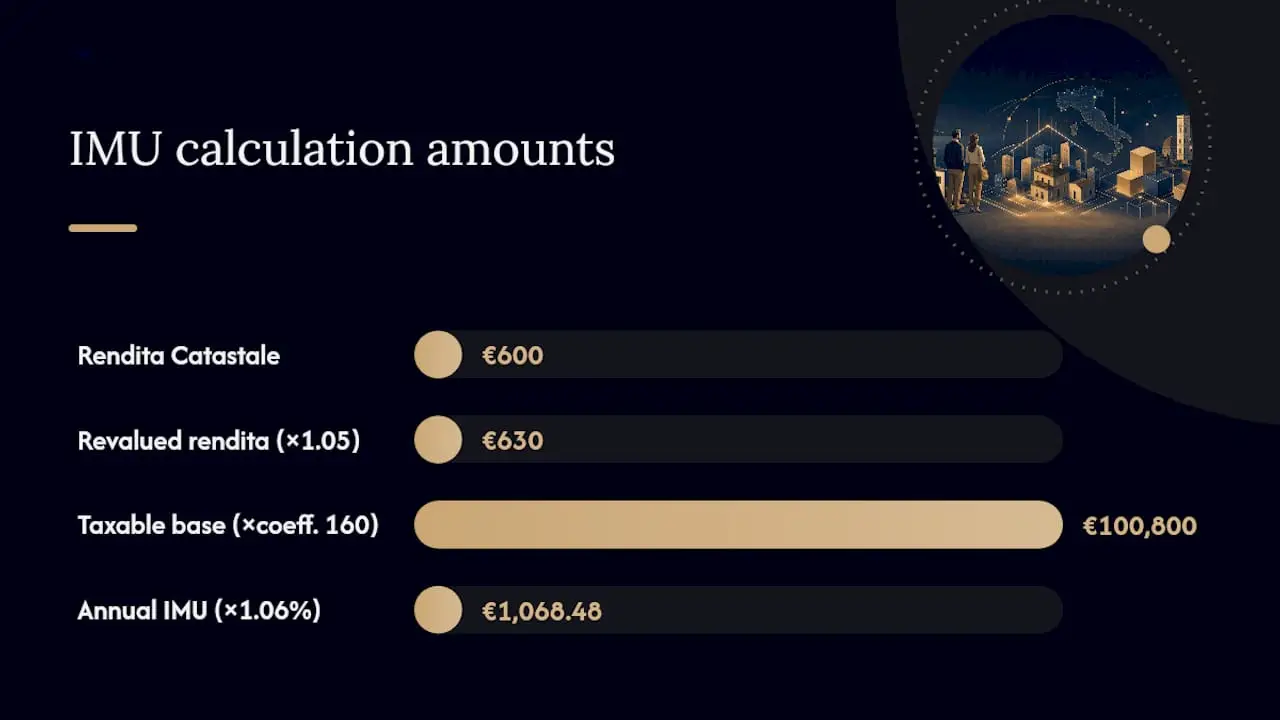
IMU calculation follows a fixed formula, and once you understand the four inputs, you can replicate it for any property in Italy. The CAF Public calculator confirms the standard method: take the Rendita Catastale, revalue it by 5%, multiply by the appropriate cadastral coefficient, then multiply by the municipal rate.
Step 1: Find your Rendita Catastale. This cadastral income figure is not your purchase price or market value; it is an administratively assigned value tied to the property’s category, size, and location. You retrieve it through a visura catastale, which you or a commercialista can request from the Agenzia delle Entrate’s cadastral database using the property’s foglio, particella, and subalterno references from your deed.
Step 2: Apply the 5% revaluation. Multiply the rendita catastale by 1.05. This uplift is baked into the national formula and applies uniformly, regardless of which comune you’re in.
Step 3: Apply the cadastral coefficient. Different property categories carry different multipliers, and this step causes the most confusion among first-time payers.
These common coefficients explain why a small retail unit and a similarly sized apartment can produce very different tax bases even with comparable rendita figures.
Step 4: Apply the municipal aliquota. Comuni express their rates in per-mille (‰) notation, meaning “parts per thousand” rather than percent. A rate of 10.6‰ equals 1.06%. National guidance places typical second-home rates in a band between roughly 0.46% and 1.14%, with many comuni settling near 0.86% as a working default before adjustments.
- Revalued rendita: €600 × 1.05 = €630
- Taxable base: €630 × 160 = €100,800
- Annual IMU: €100,800 × 1.06% = €1,068.48
Pro Tip: Always confirm the current rendita catastale before calculating. Comuni occasionally update classifications after renovations or subdivisions, and an outdated figure will throw off every downstream number.
When Are The IMU Payment Deadlines And Installments?
IMU is paid in two fixed installments each year, and missing either one triggers penalties regardless of whether the mistake was intentional.
- Acconto (first installment): due June 16. This payment typically uses the prior year’s municipal rates, since many comuni have not finalized their new delibera (rate resolution) by mid-June. A common shortcut is paying 50% of what you owed the previous year.
- Saldo (balance): due December 16. By this date, comuni have generally published their finalized rates for the year, so you recalculate the full annual amount using current figures and pay the difference between that total and what you already sent in June.
- Full-year option: You can pay 100% of the estimated annual IMU in June rather than splitting it, but if the comune’s rate changes before December, you will need to reconcile, either paying a small top-up or noting a credit for the following year.
- Watch for late-published rates: If your comune has not published its delibera by the acconto deadline, prior-year rates apply automatically for the first installment, with any adjustment absorbed into the December payment.
This structure catches many foreign owners off guard because it assumes local knowledge that non-residents simply don’t have by default: which year’s rate applies when, and whether your comune has actually published anything new. Municipal rate changes between June and December remain one of the more common causes of underpayment, particularly for owners who pay the full amount early and never revisit the calculation.
How Do You Pay IMU Tax From Abroad?
Italy gives you three practical channels for paying IMU, and which one works best depends heavily on whether you hold an Italian bank account.
- F24 form: This is the standard payment form used by Italian residents and anyone with a codice fiscale and access to Italian banking or home banking. You’ll need to fill in the correct tributo code, commonly 3918 for second homes and other non exempt residential units, or 3912 for luxury-category main residences under A/1, A/8, and A/9. The form also requires the comune’s cadastral code, the year of reference, and the calculated amounts for acconto or saldo.
- PagoPA: A growing number of comuni now accept IMU payment through Italy’s PagoPA online payment platform, which lets you pay by card or bank transfer directly through the municipality’s website without needing an F24 or Italian bank account.
- Bank transfer from overseas: If neither option is practical, you can request the comune’s IBAN directly from its ufficio tributi (tax office). The causale must include your codice fiscale, the tax year, the comune’s name, a property reference, and a clear indication that the payment is for IMU. Send proof of payment by email afterward, since comuni processing international transfers sometimes need documentation to match the payment to your file correctly.
Pro Tip: Never assume a bill is coming. The Ministry of Economy and Finance has confirmed that comuni do not routinely send personalized IMU invoices to non-resident owners, so waiting for paperwork that never arrives is one of the fastest ways to end up delinquent.
Given the codes, deadlines, and comune-specific quirks involved, many non-resident owners find it far more efficient to have a commercialista or a firm like Mglawfirm prepare and submit the F24 on their behalf, particularly when they own multiple properties across different municipalities.
What Exemptions And Reductions Reduce Your IMU Bill?
Not every property pays full IMU, and a handful of legitimate reductions can meaningfully lower your annual bill if you meet the conditions.
- Primary residence exemption: Available only when the owner holds actual residenza anagrafica (registered residency) at the property and genuinely lives there as their habitual home. Non-residents almost never qualify, since the exemption is tied to registered Italian residency, not citizenship or ownership duration.
- Luxury-category deduction: Properties in cadastral categories A/1, A/8, and A/9 don’t get the full exemption even when occupied as a primary residence, but resident owners in this situation apply a €200 fixed deduction against the calculated tax.
- Canone concordato reduction: If you rent your property out under a canone concordato agreement, a rent-controlled lease type negotiated through local tenant and landlord associations, you’re entitled to a 25% reduction on the IMU otherwise due. You’ll need the registered lease agreement on file to document eligibility if the comune ever asks.
- Pensioner and special-case reductions: Some non-resident pensioners registered with AIRE, along with certain other special categories, may access reductions up to 50% on a single Italian property, though eligibility rules vary and are worth confirming with a local advisor before you assume you qualify.
What Happens If You Pay IMU Late Or Miss A Deadline?
Missing an IMU deadline doesn’t trigger anything dramatic immediately, but the cost compounds the longer it goes unresolved.
- Standard penalty: Late or omitted IMU payments generally carry a statutory penalty plus daily interest that accrues from the original due date until you settle the balance.
- Ravvedimento operoso: Italy’s voluntary correction mechanism lets you fix a late or missed payment yourself, before the comune catches it, in exchange for a significantly reduced penalty. The earlier you self-correct, often within 14, 30, or 90 days depending on the delay, the smaller the reduction on the penalty rate.
- Enforcement timeline: If a payment goes unaddressed long enough, comuni can issue a formal avviso di accertamento (assessment notice), which typically arrives years after the missed deadline given municipal processing backlogs, but which then carries full penalties and interest with no voluntary-correction discount available.
- When to get help: If you’ve received an assessment notice, or you suspect a comune has recalculated your rendita catastale or category without your knowledge, get local legal advice before responding. Disputing an assessment involves specific procedural deadlines under Italian administrative law, and missing those is its own separate problem.
Worked Example: From Rendita Catastale To F24 Payment
Consider a two-bedroom apartment near Bologna held by a non-resident owner as a second home, with a rendita catastale of €750 in residential category A/2.
- Revalue the rendita: €750 × 1.05 = €787.50
- Apply the coefficient: €787.50 × 160 = €126,000 (taxable base)
- Apply the municipal rate: Assume the comune sets 1.06% for second homes: €126,000 × 1.06% = €1,335.60 annual IMU
- Split the payment:
| Installment | Due date | Amount |
|---|---|---|
| Acconto | June 16 | €667.— |
| Saldo | December 16 | €667.— (adjusted if rate changes) |
| Saldo | December 16 | €667.— (adjusted if rate changes) |
On the F24, this owner enters tributo code 3918 alongside the comune’s cadastral code and the year. If the comune raises its rate to 1.10% before December, the saldo recalculates against the new annual total of €1,386.00, meaning the December payment absorbs the €50.40 difference rather than the June figure being retroactively corrected.
MG Law’s Practical Checklist For Foreign Property Owners
Before your next IMU deadline, gather these documents so you (or your advisor) can calculate and pay correctly the first time; understanding what due diligence means for property buyers can help ensure you don’t miss any critical steps What does due diligence mean for property buyers?
- Visura catastale showing the current rendita catastale and property category
- Codice fiscale
- The comune’s delibera (rate resolution) for the current year, or last year’s rate if the new one isn’t published yet
- IBAN and payment instructions from the comune’s ufficio tributi, if paying by bank transfer
- Proof of prior payments, in case the comune requests reconciliation history
Straightforward cases, a single second home with a stable rendita and no rate disputes, are often manageable on your own or with a local commercialista. Mglawfirm typically gets involved when ownership is more complex: shared ownership among heirs, properties held through a trust or foreign entity, unresolved succession matters, or a comune enforcement action that requires formal legal representation.
Pro Tip: If you inherited an Italian property and aren’t sure whether the cadastral records were ever updated in your name, resolve that before your next IMU cycle. Paying under the wrong owner’s details is a common and avoidable error.
Your Next Steps On IMU Compliance
There is no automatic bill coming. IMU compliance is the owner’s responsibility, and the comune’s silence does not mean you owe nothing. Three things to do this week: pull your rendita catastale, run the calculation above for your property, and calendar June 16 and December 16. If any part of that feels uncertain, Mglawfirm can walk through it with you directly.
What Foreign Owners Get Wrong About IMU
The single most common mistake isn’t miscalculating IMU. It’s assuming someone will tell you what you owe. Foreign owners routinely wait for a bill that Italian comuni simply don’t send to addresses abroad, then discover months later that interest has been accruing the whole time.
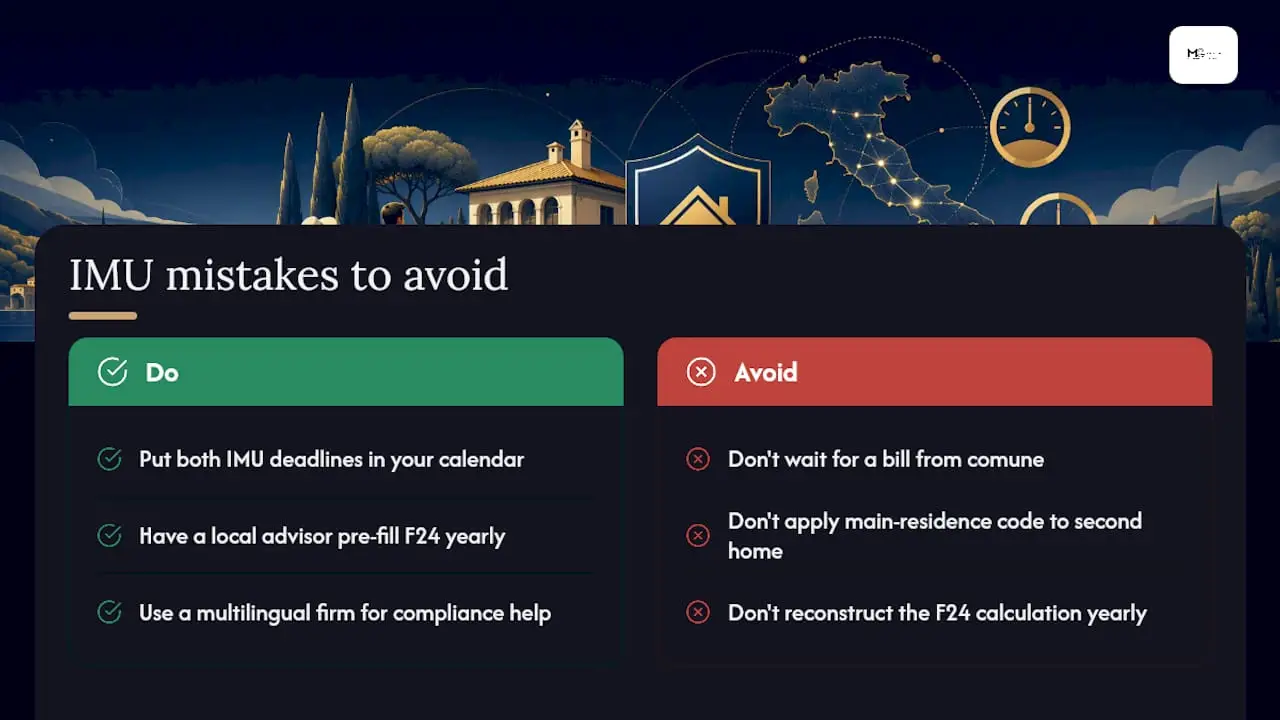
The second mistake is using the wrong F24 tributo code, usually applying the main-residence code to a property that legally qualifies as a second home. That mismatch can flag your payment for review even when the amount itself is correct.
Prevention is almost boring in its simplicity: put both deadlines in your calendar the day you close on a property, and have a local advisor pre-fill your F24 each year rather than reconstructing the calculation from scratch. Mglawfirm’s multilingual team handles exactly this kind of recurring compliance work for clients who would rather not track Italian municipal delibera timing from another country.
— Living
How Mglawfirm Handles IMU Calculation And Payment For You
Mglawfirm is the alternative to piecing together IMU calculations from forum posts and outdated blog guides. Our team calculates your exact IMU liability from your rendita catastale, prepares and files your F24 with the correct tributo codes, and represents you directly with your comune’s ufficio tributi if a rate dispute or enforcement notice ever comes up. That last part matters more than it sounds: a non-resident owner arguing with a municipal office in a second language, over the phone, rarely ends well.
To get started, we typically need your visura catastale, codice fiscale, and the comune’s current delibera, the same checklist covered above. From there, we handle the math, the filing, and the deadlines. If you’d rather not track two payment dates and a shifting municipal rate every year, visit our property tax page for foreign buyers to arrange an assessment of your specific property and ownership structure.
Where To Verify IMU Rules And Rates
- Ministry of Economy and Finance: national IMU framework and municipal rate limits
- Agenzia delle Entrate: IRPEF context and non-resident income tax rules
- Your comune’s official website: published delibera and current-year aliquote
- Mglawfirm’s non-resident property tax guide: practical compliance steps for foreign owners
This article is general information, not a substitute for advice from a qualified financial advisor. Consult a qualified financial professional about your own circumstances before acting on anything here.
Sources
Recommended
- Can Foreigners Avoid IMU Tax in Italy?
- Property Taxes in Italy for Non Residents – A Guide for Investors
- Buying Property in Italy: Legal Risks and Tax for Foreign Investors
The information provided here is general in nature and does not replace professional assistance. Reading this content does not create a professional-client relationship.
