
If you operate two or fewer distinct units as short-term rentals during the tax year, you can stay in the private locazioni brevi regime and keep using cedolare secca under the 21%/26% split. Beyond two units, the activity is presumed entrepreneurial. Three moves matter right now: confirm your unit count, register every property in the BDSR for a CIN, and reconcile any 21% ritenuta withheld by booking platforms in your tax return.
TL;DR:
- Owners must accurately count their short-term rental units before listing a third property to avoid automatic reclassification as an enterprise activity.
- Registering each property in the BDSR to obtain a CIN is mandatory before the first booking in 2026, with immediate display on listings and property plates.
- Running more than two units disqualifies the use of cedolare secca, requiring a transition to a full tax regime with higher administrative and tax reporting obligations.
- Platform withholding taxes and guest reporting to the Questura increase audit risk, making detailed reconciliation and accurate record-keeping essential.
- Municipal and condominium restrictions can add layers of legal hurdles that owners must verify before starting or expanding short-term rentals.
Table of Contents
- Short Term Rentals Italy: What Changed for 2026
- What Is Cedolare Secca and How Does the 2026 Split Work?
- How Do You Get a CIN Through the BDSR Portal?
- When Does a Short-Term Rental Become an Entrepreneurial Activity?
- Daily Compliance: Guest Reporting, Safety, and Local Taxes
- Why Audit Risk Is Rising and How to Stay Ahead of It
- Overview of Short Term Rental Market Trends and Popular Destinations in Italy
- Legal Distinctions Between Short-Term Rentals and Other Accommodation Types
- Zoning and Municipal Rules Beyond CIN Registration
- Best Practices for Guest Communication and Property Management
- Common Compliance Failures and What They Cost You
- Guidance on Contracts and Terms of Stay for Guests
- MG Law’s Perspective: Three Owner Scenarios in 2026
- How MG Law Helps With CIN Registration and Tax Strategy
- Sources
Short Term Rentals Italy: What Changed for 2026
The rules governing short term rentals Italy has relied on for a decade shifted meaningfully this year. Owners who once ran three, four, or five apartments through the simple locazioni brevi framework now face a hard ceiling: two units per tax year, full stop. Cross that line and the Agenzia delle Entrate treats your activity as a business, not a private letting arrangement.
Here is the immediate action plan for the next 30 days.
- Count your units. Tally every distinct property you intend to list this tax year, including any managed under a family member’s name if you control the booking calendar.
- Gather your BDSR documents. You need a current visura catastale, agibilità or a technical self-certification, title documents, your codice fiscale, planimetry, and proof of insurance.
- Get SPID access and register. Apply through the BDSR portal, obtain your CIN, and display it on every listing and physical plate.
- Set up bookkeeping. Track gross corrispettivi, platform withholdings, stay dates, and signed contracts in one ledger.
- Check local rules. Confirm condominium bylaws and your municipality’s tourist tax obligations before your first 2026 booking.
| Action | Deadline | Where |
|---|---|---|
| Confirm unit count | Before first 2026 booking | Internal records |
| Submit BDSR application | Before listing goes live | BDSR portal |
| Obtain and display CIN | Upon BDSR approval | Property listing + physical plate |
| Register Alloggiati Web | Before first guest arrival | Questura portal |
| Set up bookkeeping for ritenuta | Ongoing, monthly | Accounting system |
What Is Cedolare Secca and How Does the 2026 Split Work?
Cedolare secca is a substitute flat tax applied directly to your gross corrispettivo from short-term rentals, with no deductions for costs like cleaning, commissions, or maintenance. That last point trips up a lot of owners: the tax base is the full booking revenue, not net profit.
A reduced 21% rate applies, but only to one unit that you designate in your tax return. If you run two units, one gets the reduced rate and the other gets 26%. Cross the two-unit threshold and cedolare secca disappears entirely; the presumption of enterprise takes over.
The savings compound faster on your top earner.*
There is a wrinkle that catches even experienced owners off guard. When a platform like a booking intermediary handles payment collection, it must apply a 21% withholding on the gross corrispettivo as an advance payment, not a final settlement. You still owe the difference (or claim a credit) when you file, and the intermediary’s Certificazione Unica needs to match your own records exactly.
Tax advisors increasingly warn that the math behind this decision has gotten more complicated than a simple rate comparison. Deciding how many units to allocate to short-term use now requires weighing your marginal IRPEF bracket against the administrative cost of a partita IVA.
| Factor | Stay in cedolare secca (≤2 units) | Move to enterprise (>2 units) |
|---|---|---|
| Tax base | Gross corrispettivo, no deductions | Net profit, costs deductible |
| Applicable rate | 21% (one unit) / 26% (others) | IRPEF brackets or IRES/IRAP if incorporated |
| Administrative burden | Low, no partita IVA needed | Higher, requires VAT registration, bookkeeping |
| Withholding reconciliation | Required against 21% ritenuta | Different reporting obligations apply |
Run the comparison before you list a third property. Once the presumption of enterprise applies, there is no opting back into cedolare secca for that tax year.
How Do You Get a CIN Through the BDSR Portal?
Getting your Codice Identificativo Nazionale is a documentation exercise more than a legal one, but the paperwork has to be exact. Here is the sequence that actually works.
- Confirm eligibility first. Your unit should fall under cadastral category A1 through A11, excluding A10 (offices), and hold a valid agibilità certificate. Check your condominium regulation for any short-term rental prohibitions before you apply.
- Assemble your documents. You will need a visura catastale no older than six months, your title deed or rental authorization, planimetry, codice fiscale, a signed autocertificazione covering gas and boiler safety checks, proof of insurance, and a valid identity document.
- Submit through the BDSR portal using SPID or an equivalent digital identity credential.
- Wait for tacit assent. If your Comune raises no objection within the review window, your CIN is issued automatically. You can generally start operating from the day you receive it.
- Display the CIN on every online listing and on a physical plate at the property entrance, as required under the current framework.
The most common rejection causes are avoidable: a wrong subalterno number on the cadastral reference, a condominium bylaw that prohibits short-term use, an inactive codice fiscale for nonresident owners, or a missing safety autocertificazione. BDSR registration itself costs nothing, and paying a third party simply to file the application on your behalf is rarely worth the added delay risk when something in the file is wrong.
When Does a Short-Term Rental Become an Entrepreneurial Activity?
The legal trigger is precise: operating more than two distinct units as short-term rentals within the same tax period creates an absolute presumption of entrepreneurial activity under the 2026 budget law. “Absolute” matters here. It is not a rebuttable assumption you can argue against with the tax authority. Once you cross the threshold, the classification applies.
The consequences cascade quickly:
- Cedolare secca is no longer available for any of your units, not just the third one.
- You likely need a partita IVA with an appropriate ATECO code for short-term accommodation activity.
- VAT treatment may apply depending on the services bundled with the rental (cleaning, breakfast, concierge).
- A SCIA filed with the SUAP becomes necessary for the tourist-accommodation activity itself.
- Formal bookkeeping and registration obligations replace the light-touch private-landlord approach.
If you see this coming, plan the transition rather than reacting to it. Open the partita IVA with the correct ATECO classification, evaluate your VAT exposure with an accountant, register with the Chamber of Commerce where required, update your insurance to reflect commercial use, and confirm your municipal tourist-activity permits align with the new status. Making this shift proactively, ahead of a Comune inquiry, is far cheaper than making it under pressure. A property due diligence checklist covering agibilità and cadastral consistency is worth running before you scale past two units.
Daily Compliance: Guest Reporting, Safety, and Local Taxes
Registration is the front door. What keeps you compliant afterward is a set of recurring, almost mundane tasks that owners underestimate.
- Alloggiati Web: Report every guest’s identity data to the Questura within 24 hours of check-in, or immediately at arrival for stays under 24 hours.
- Safety equipment: Keep fire extinguishers, CO detectors, and current boiler certificates on file, plus a welcome book in the languages your guests actually speak.
- Insurance: Carry an RC liability policy, commonly around €1 million in coverage, and keep proof accessible for any inspection.
- Municipal tourist tax: Rates, collection duties, and invoicing procedures vary by comune, so check your specific municipality’s regulation rather than assuming a standard national rate.
Pro Tip: Set a recurring calendar reminder to renew your boiler certificate and RC policy together. Owners who let one lapse often let both lapse, and that is exactly what an inspector checks first.
Why Audit Risk Is Rising and How to Stay Ahead of It
BDSR data, platform-reported income, and intermediary withholding certificates now feed into automated cross-checking at the Agenzia delle Entrate. This is a structural change, not a one-time crackdown. Every booking you take through a major platform generates a paper trail that lands in a government database whether you report it or not.
Keep these records current, ideally on a monthly cadence:
- A gross income ledger updated as bookings close, not batched at year-end.
- Platform statements showing gross corrispettivi and withheld amounts side by side.
- Certificazione Unica documents from every intermediary you use.
- Signed contracts and CIN evidence for each unit, filed together.
Run a monthly reconciliation between what platforms report and what your books show. Cleaning fees and reimbursements are the most common source of mismatches, since some platforms bundle them into gross corrispettivi while your ledger might list them separately. If a mismatch appears, or if you are approaching the two-unit threshold and unsure which side of the line you will land on, get a professional review before you file rather than after.
Overview of Short Term Rental Market Trends and Popular Destinations in Italy
Demand for short term rentals Italy has stayed resilient even as the regulatory environment tightened. Rome, Milan, Florence, and coastal regions like the Amalfi Coast and Puglia continue to draw the bulk of booking volume, driven by international travelers seeking flexibility that traditional hotels do not offer.
Smaller cities and rural areas, particularly in Tuscany, Sicily, and parts of the Puglia countryside, have seen owners convert holiday homes Italy travelers once rented informally into properly registered CIN-compliant listings. The shift toward formalization is itself a market trend: platforms tightening verification under Regulation (EU) 2024/1028 push informal operators either toward compliance or out of the visible market entirely.
Affordable apartments Italy investors once picked up cheaply in secondary cities are seeing renewed interest, partly because the two-unit cap makes concentrated portfolios in single high-value locations less attractive than diversified smaller holdings. An investor who once bought five units in one Roman neighborhood now has a tax incentive to think differently about portfolio structure.
Seasonal patterns remain pronounced. Coastal and lake destinations peak from May through September, while city-center properties in Rome, Florence, and Milan hold steadier year-round demand tied to business travel and cultural tourism. Best areas for rentals Italy tend to combine both patterns, cities with strong shoulder-season demand plus at least one high-volume summer draw nearby, which smooths out revenue across the calendar rather than concentrating it in three months.
Legal Distinctions Between Short-Term Rentals and Other Accommodation Types
Locazioni brevi sit in a specific legal category defined by duration: contracts of 30 days or fewer, signed by individuals outside a business activity, as set out in the framework the Agenzia delle Entrate administers. That definition is what makes cedolare secca available in the first place.
This differs sharply from a standard residential lease (locazione ordinary), which typically runs four years with a mandatory four-year renewal, follows separate registration rules, and carries different tax treatment entirely. It also differs from a bed-and-breakfast or affittacamere structure, which Italian regional law generally classifies as a tourist-accommodation activity requiring a SCIA from the outset, regardless of how many rooms are involved.
The practical distinction that trips up owners: adding hotel-like services changes your classification. Offering daily housekeeping, breakfast service, or a staffed reception desk pushes your property toward a tourist-accommodation classification rather than a simple furnished rental, even if the stay length stays under 30 days. The line is drawn by the nature of the service bundle, not just the calendar.
Understanding which category your property actually falls into matters before you register, not after. A unit correctly registered as locazioni brevi that later adds concierge-style services may need to re-file under a different regime entirely.
Zoning and Municipal Rules Beyond CIN Registration
CIN registration satisfies the national layer. It does not clear you with your comune, and that gap catches out-of-town and foreign owners more than anyone.
Municipalities retain independent authority over zoning classifications, and some have imposed restrictions in historic centers or high-density tourist zones that limit new short-term rental registrations regardless of your BDSR status. Venice, Florence, and parts of Rome have all experimented with zone-specific caps or additional local permit requirements at various points, and these rules change faster than national tax law does.
Before you list a property, check three things at the municipal level specifically: whether your zone has any moratorium or cap on new short-term rental permits, whether your condominium regulation (a private contractual document, separate from public law) prohibits or restricts short-term letting, and what your specific comune requires for tourist tax collection and remittance schedules.

Condominium prohibitions deserve particular attention because they are contractual, not regulatory, and courts have upheld them even against owners who hold a valid CIN. A building’s assembly can vote to restrict short-term rentals in the building regulation, and that vote binds you as a unit owner even though it has nothing to do with the Agenzia delle Entrate or the BDSR. Reading your condominium regulation before you buy, or before you pivot an existing unit to short-term use, avoids a conflict that no amount of tax compliance will fix.
Best Practices for Guest Communication and Property Management
Compliance keeps you legal. Communication keeps you in business. The two intersect more than owners expect, particularly around the Alloggiati Web reporting requirement, which means you need each guest’s identity document details before or at check-in, not after.
Build your pre-arrival messaging around that requirement directly: request passport or ID details as part of booking confirmation, explain briefly why Italian law requires it, and set expectations about check-in timing so the 24-hour Questura reporting window is never in jeopardy.
A few operational habits separate owners who run smooth short stay operations from those who accumulate guest complaints and review damage:
- Send a welcome book covering Wi-Fi, appliance instructions, and emergency contacts in the guest’s likely language.
- Confirm check-in and check-out times in writing at least 48 hours before arrival.
- Respond to guest messages within a few hours during active stays; slow response times are the single most cited complaint in short-term rental reviews.
- Schedule cleaning and turnover with buffer time between guests rather than same-day tight transitions.
If you manage multiple units, a shared calendar and messaging system prevents double bookings and missed Alloggiati Web deadlines. A tool built for short-term rental compliance workflows can help track reporting deadlines alongside guest communication, which matters more once you are juggling two units under the 2026 cap rather than treating each booking as a one-off.
Common Compliance Failures and What They Cost You
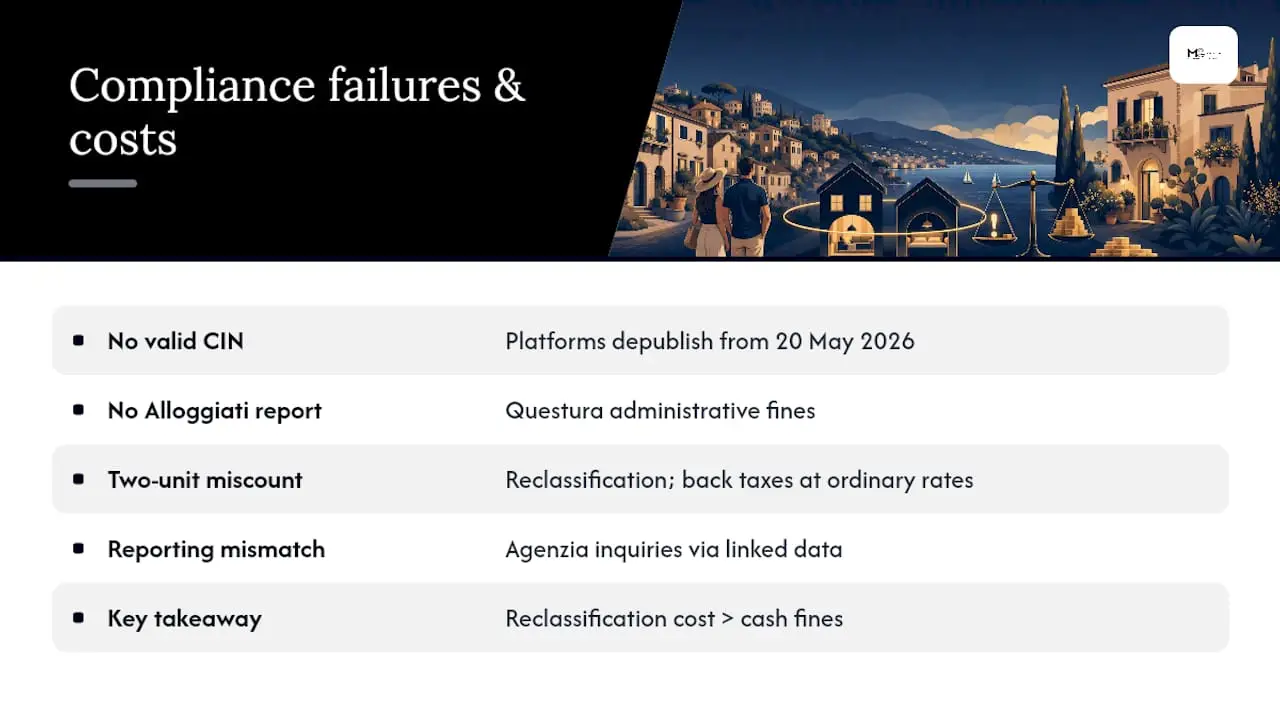
The penalties tied to short term rentals Italy noncompliance range from administrative fines to listing suspension, and platforms are becoming an active enforcement layer rather than a passive one.
Operating without a valid CIN is now the most consequential failure, because Regulation (EU) 2024/1028 requires platforms to verify registration numbers before publishing listings, with automatic checks and depublication authority taking full effect from May 20, 2026. A listing without a valid CIN simply will not stay visible.
Failing to report guests through Alloggiati Web within the required window carries administrative sanctions from the Questura, separate from any tax issue. Missing the two-unit threshold calculation, whether through an honest miscount or deliberate underreporting, exposes you to reclassification as an enterprise retroactively, along with back taxes calculated at ordinary rates rather than the cedolare secca rate you assumed applied.
Mismatches between platform-reported gross corrispettivi and your own tax filing are increasingly easy for the Agenzia delle Entrate to catch, given the automated data flows now linking BDSR records, platform reports, and withholding certificates. An owner who pockets a cleaning fee separately from the reported booking total, thinking it falls outside gross corrispettivi, is creating exactly the kind of discrepancy that triggers an inquiry.
The practical lesson: the fines matter less than the reclassification risk. A cash penalty is recoverable. Losing your cedolare secca eligibility for an entire tax year, with the tax recalculated at higher rates retroactively, is a far more expensive outcome and one that a short conversation with a tax advisor before you list a third unit would have prevented.
Guidance on Contracts and Terms of Stay for Guests
Even a 30-day locazione breve needs a written agreement, and skipping one is a common but avoidable gap. Italian law does not require a notarized contract for short stays, but a clear written agreement protects you in a dispute and gives you the documentation an auditor or a Questura inspection will expect to see.
Your terms of stay should cover, at minimum: the exact check-in and check-out dates and times, the total price and what it includes (cleaning, utilities, tourist tax), cancellation and refund conditions, house rules including any noise or guest-limit restrictions, and a clear statement of the CIN under which the property is registered.
Include the municipal tourist tax explicitly as a line item, even if you collect it separately from the platform booking price, so your records match what you report to the comune. If your property sits in a comune with a per-night tourist tax, guests should see that charge itemized before they arrive, not discover it as a surprise at check-in.
A written contract also matters for the tax side of your business. If a dispute arises over a no-show or a shortened stay, having dated, signed terms makes it far easier to justify your reported gross corrispettivo if the Agenzia delle Entrate ever asks for supporting documentation. Owners running two units under the reduced cedolare secca rate in particular should keep contract files well organized, since a due diligence-minded approach to your paperwork now saves real time if you are ever asked to reconcile a full tax year.
MG Law’s Perspective: Three Owner Scenarios in 2026
A single-unit owner has the easiest path: register for the CIN, elect the 21% rate if eligible, and reconcile ritenuta annually. Friction rarely comes from tax exposure but from paperwork gaps at filing time.
Two-unit owners face a real choice.
Owners approaching a third unit face the sharpest decision point. Converting to an enterprise structure before you are forced into it, with the partita IVA and ATECO code already sorted, causes far less disruption than a retroactive reclassification.
— Living
How MG Law Helps With CIN Registration and Tax Strategy
Navigating BDSR registration, the cedolare secca decision, and a possible transition to enterprise status is exactly the kind of layered legal and tax work that benefits from an advisor who handles all three at once, rather than a patchwork of a notary, an accountant, and a listing platform’s support desk. MG Law assists foreign investors and Italian property owners with CIN and BDSR registration, models the cedolare secca versus enterprise decision against your specific unit count and income, and handles partita IVA and SCIA setup when the two-unit threshold applies to you.
Our team also drafts and reviews the underlying property contracts and guest terms that protect you if a dispute or an audit ever surfaces. If you are unsure which side of the 2026 threshold you will land on, or you want a tax simulation before committing to a rate election, schedule a property purchase and due diligence consultation with MG Law before your next tax filing deadline.
Sources
Verify the rules directly through the Agenzia delle Entrate’s locazioni brevi guidance, the BDSR portal for CIN applications, and the text of the 2026 budget law reforms governing the two-unit threshold.
This article is general information, not a substitute for advice from a qualified lawyer. Consult a qualified legal professional about your own circumstances before acting on anything here.
- Le locazioni brevi e la cedolare secca – Agenzia delle Entrate
- Affitti brevi: nuove regole 2026 e impatti fiscali
- CIN BDSR 2026: passo dopo passo + errori da 8 000 € | HostReady
Recommended
- Property Taxes in Italy for Non Residents – A Guide for Investors
- Due Diligence in Italian Real Estate: Key Legal Verifications in 2026
- Buying Property in Italy: Legal Risks and Tax for Foreign Investors
- 10 Legal Steps Before Buying Property in Italy – Free Checklist
The information provided here is general in nature and does not replace professional assistance. Reading this content does not create a professional-client relationship.
