
If Italy treats you as a tax resident for the calendar year, it will tax your worldwide income, not just what you earn locally. That status hinges on three tests: the 183-day rule, Anagrafe registration, and domicile or “center of vital interests.” Check those first, get your codice fiscale, and gather your foreign tax documents before you touch a form.
TL;DR:
- Meeting any one of Italy’s residency tests, such as Anagrafe registration or spending over 183 days, triggers full-year global income taxation.
- Regional and municipal surtaxes can push the combined marginal income tax rate above 45 percent, especially in high-surtax regions like Lazio.
- Foreign assets and income must be reported on Quadro RW, with potential additional taxes like IVIE and IVAFE, and penalties for omission can be severe.
- Special tax regimes like the impatriati, neo-residenti, or retiree regimes offer significant relief but require careful eligibility verification and cannot usually be combined.
- Choosing the correct filing form depends on income sources; self-employed and foreign asset holders must use Redditi PF, while employees or pensioners with simple income can file Modello 730, with deadlines typically in September or November.
Table of Contents
- What Determines Expat Taxes in Italy: The Residency Rules
- IRPEF Rates, Regional Surtaxes, and What They Actually Cost You
- Special Tax Regimes That Can Cut Your Italian Bill
- Modello 730 vs Redditi PF: Forms, Deadlines, and Payments
- Quadro RW, IVIE, and IVAFE: Reporting Foreign Wealth Correctly
- Your First-Year Checklist: Documents, Timing, and Cashflow
- CAF, Commercialista, or Tax Lawyer: Who Handles What
- What MG Law Sees Go Wrong, and Why It Matters
- Get Your Residency and Regime Position Reviewed Before You File
- Sources
What Determines Expat Taxes in Italy: The Residency Rules
Residency, not citizenship or visa type, decides whether Italy taxes your entire global income or just what you earn within its borders. Get this wrong and you either overpay or, worse, underreport and face penalties years later.
Italy applies three separate tests, and meeting just one is enough to make you a tax resident for the full calendar year. The Italian Civil Code and the Testo Unico delle Imposte sui Redditi (TUIR) set out these criteria, and the Agenzia delle Entrate treats them as independent triggers, not a checklist where you need to fail all three to escape.
- Anagrafe registration: If you register your residence with the local municipal registry (Anagrafe), you are a tax resident from that date, regardless of how many days you actually spend in Italy.
- Habitual abode (183-day rule): Spending more than 183 days in Italy during a calendar year (184 in a leap year) establishes residency even without formal registration.
- Domicile or center of vital interests: If your primary personal and economic relationships, your family, your main bank accounts, your business dealings, are in Italy, tax authorities can deem you resident even with fewer days physically present.
Here is where most newcomers get tripped up: these tests do not prorate. If you move to Italy in March and meet any test that year, Italy can tax your worldwide income for the entire calendar year, including income earned before you arrived. Keep boarding passes, lease agreements, and utility bills that document exactly when your presence and ties shifted. That paper trail becomes essential if the Agenzia delle Entrate ever questions your residency start date.
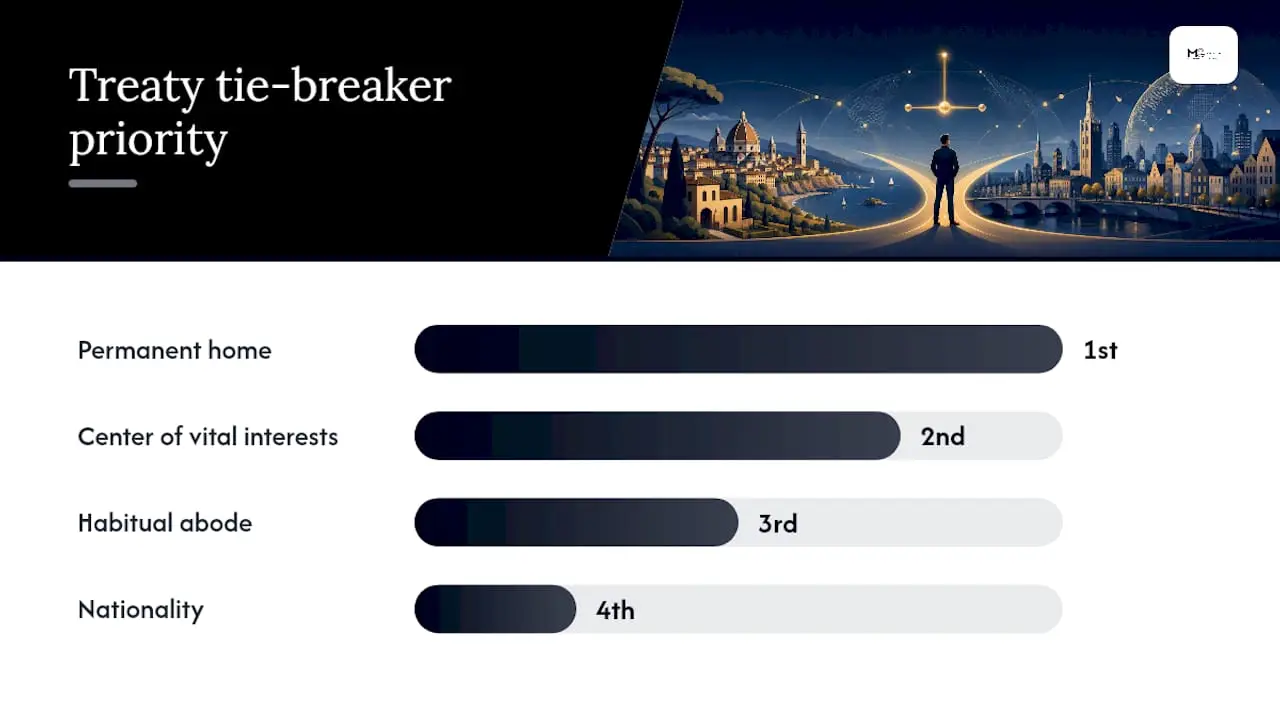
If you remain a tax resident of another country under that country’s own rules, you may fall into dual residency. Italy’s network of double taxation treaties includes tie-breaker provisions, typically prioritizing permanent home, then center of vital interests, then habitual abode, then nationality, to assign residency to a single country. When treaty tie-breakers apply, professional guidance becomes worthwhile fast, since misapplying them risks double taxation on the same income. Mglawfirm’s residency guide for foreigners walks through documentation strategies for exactly this scenario.
IRPEF Rates, Regional Surtaxes, and What They Actually Cost You
Italy’s national income tax, IRPEF (Imposta sul Reddito delle Persone Fisiche), uses progressive brackets, but your real tax bill also includes regional and municipal surtaxes layered on top. For 2026, the national brackets are:
These figures come from the Movingto, which also confirms the surtax ranges below. Regional surtaxes (addizionale regionale) run roughly 1.— to 3.33% depending on where you live, and municipal surtaxes (addizionale comunale) add up to about 0.9% more. A freelancer earning €45,000 in a high-surtax region like Lazio pays noticeably more than the same earner in a lower-surtax comune, even though the national IRPEF bracket is identical for both.
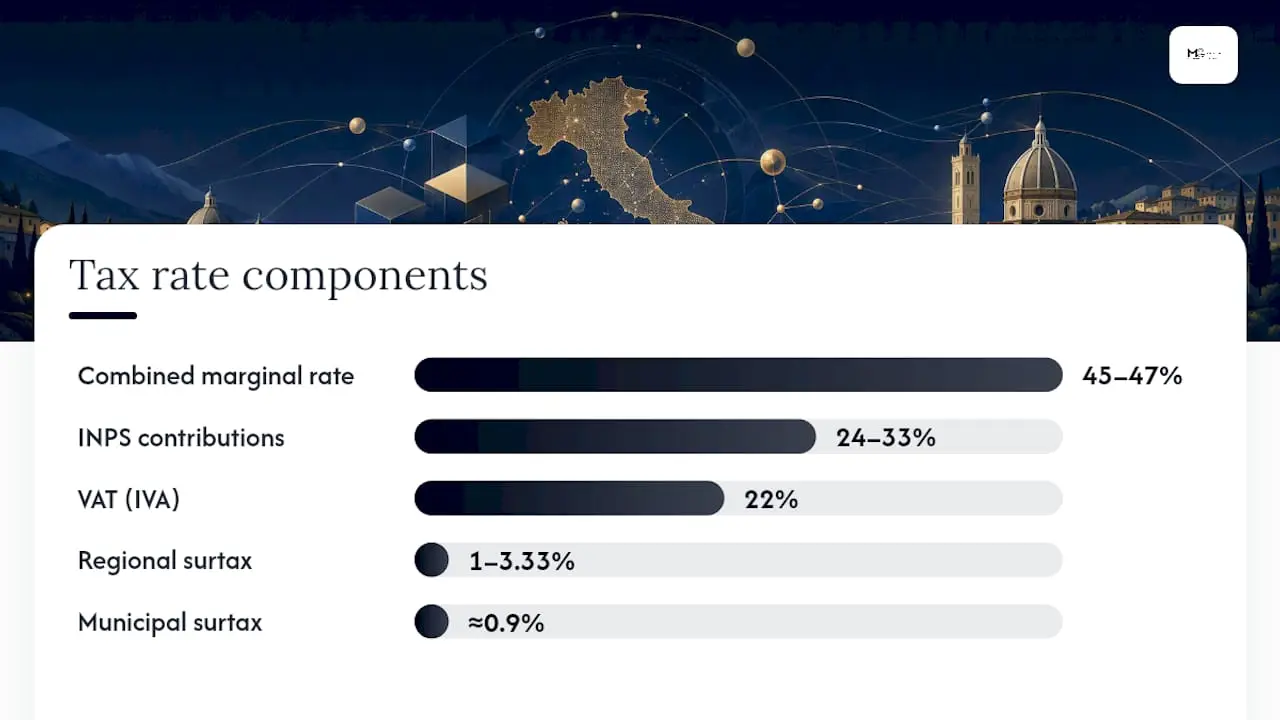
Stack the top rates and you land near a 45% to 47% combined marginal rate for higher earners, depending on your specific region and municipality. That is not a flat national number. It shifts based on your comune of residence, which is one more reason the timing of your Anagrafe registration matters beyond just triggering residency.
Beyond IRPEF, a few other line items shape your real cost of living as an expat:
- INPS social contributions: Employees typically see contributions withheld by their employer at source, while self-employed workers register with INPS and pay contributions directly, often 24% to 33% of taxable income depending on activity type and whether you have a separate pension fund.
- IMU (property tax): Owners of a second home or non-primary residence in Italy owe IMU annually, calculated on cadastral value, not market value.
- TARI (waste tax): A municipal charge tied to property size and household composition, billed separately from IMU.
- IVA (VAT): Freelancers and business owners charge and remit VAT at the standard 22% rate on most goods and services, unless they qualify for the forfettario regime discussed below.
If you are buying property as part of your relocation, Mglawfirm’s property tax guidance covers IMU calculations and exemptions specific to foreign buyers in more depth.
Special Tax Regimes That Can Cut Your Italian Bill
Italy runs several regimes designed specifically to attract foreign talent, retirees, and high-net-worth individuals, and picking the right one can mean the difference between a 43% marginal rate and a fraction of that. None of them apply automatically. You have to elect in and meet specific conditions.
The expatriate regime (regime degli impatriati) exempts a portion of employment or self-employment income earned in Italy from IRPEF for qualifying new residents. The relief generally runs five years, with a possible extension to ten years if you have a minor child or purchase Italian residential property before or shortly after moving. Income caps and specific employer conditions apply, so eligibility needs individual verification.
The new-resident flat tax (neo-residenti, art. 24-bis TUIR) targets wealthier individuals with substantial foreign income. From January 1, 2026, the headline substitute tax rises to €300,000 per year for the main taxpayer, plus €50,000 for each qualifying family member included in the election. This flat amount replaces IRPEF on foreign-source income and can run for up to 15 years, provided you were not tax resident in Italy for at least 9 of the preceding 10 years. Italian-source income still gets taxed under ordinary rules.
The 7% retiree regime applies to foreign pensioners who move to a qualifying small municipality (generally towns under 20,000 residents in southern Italy or certain earthquake-affected zones in central Italy) and were not Italian tax resident in the prior five years.
| Regime | Who It Fits | Headline Benefit | Duration |
|---|---|---|---|
| Impatriati | Employees/self-employed relocating for work | 50% income exemption | 5 years, extendable to 10 |
| Neo-residenti (art. 24-bis) | High-net-worth new residents | €300,000 flat substitute tax on foreign income | Up to 15 years |
| 7% retiree regime | Foreign pensioners in qualifying towns | 7% flat rate on foreign pension income | Up to 9 years |
| Forfettario | Small self-employed/freelancers | 5% (then 15%) substitute rate on partial revenue | While under turnover cap |
You generally cannot stack these regimes.
Pro Tip: If your situation involves an ambiguous residency start date or a borderline case for habitual abode, request an advance ruling (internally) from the Agenzia delle Entrate before filing. A 2026 cross-border tax forecast flags real interpretative uncertainty around habitual abode, and a ruling locks in your regime eligibility instead of leaving it exposed to a later audit.
Mglawfirm’s dedicated pages on the 7% flat tax for foreign retirees and the HNWI flat tax regime go deeper into qualifying conditions for each.
Modello 730 vs Redditi PF: Forms, Deadlines, and Payments
Your filing route depends on your income sources, and picking the wrong form creates real complications, since one of them cannot report everything you may owe.
Modello 730 is built for employees and pensioners with relatively simple income. It is generally due by September 30 of the year following the tax year, and it lets you settle any balance directly through payroll or pension withholding, which is convenient if it fits your situation.
Modello Redditi Persone Fisiche (Redditi PF) is the form for everyone else: the self-employed, business owners, landlords with rental income, and critically, anyone who needs to report foreign assets. If you have foreign bank accounts, overseas investments, or property abroad, you must use Redditi PF, because Quadro RW, the schedule for foreign asset reporting, does not exist on Modello 730 at all. Filing 730 when you owe an RW disclosure leaves you noncompliant even if your income tax itself is correct.
According to the Agenzia delle Entrate’s official filing guidance, Redditi PF is generally due by telematic submission around November 30, though exact dates shift slightly year to year. Non-residents without an Italian intermediary may in some cases file by registered post, with a separate deadline window.
| Task | Typical Timing |
|---|---|
| Modello 730 submission | By September 30 |
| Redditi PF telematic submission | By November 30 |
| First balance payment (saldo) | Around June 30 |
| First advance payment (primo acconto) | Around June 30 |
| Second advance payment (second acconto) | Around November 30 |
Payments run through the F24 form, Italy’s universal payment slip for taxes, contributions, and many local charges, submitted through your bank, the Agenzia delle Entrate’s own portal, or a commercialista acting on your behalf. First-year residents often get blindsided here: your June payment can include both the balance for the prior year and the first acconto for the current year, effectively asking for what feels like a year and a half of tax in one sitting.
Missing deadlines triggers late-payment penalties and interest, calculated daily, so if cash flow is tight, discuss installment options with a professional before the due date rather than after.
Quadro RW, IVIE, and IVAFE: Reporting Foreign Wealth Correctly
Quadro RW is not an optional disclosure for the wealthy. If you are an Italian tax resident holding foreign bank accounts, brokerage portfolios, life insurance wrappers, or real estate abroad, you generally must report those assets on this schedule, even in years when no additional tax is actually due on them.
The two wealth taxes tied to this reporting are:
- IVIE (Imposta sul Valore degli Immobili all’Estero): a wealth tax on foreign real estate, calculated at roughly 1.06% of the property’s value, generally the purchase cost or local cadastral-equivalent value where available.
- IVAFE (Imposta sul Valore delle Attività Finanziarie all’Estero): a wealth tax on foreign financial assets, generally 0.2% of value, with a fixed fee structure for certain foreign bank and savings accounts, often cited around €34.20 per account regardless of balance.
Valuing these assets correctly means using year-end market values converted at the official Bank of Italy exchange rate for December 31, and keeping documentation of ownership percentage if an account or property is jointly held, since only your proportional share gets taxed and reported.
Some de minimis thresholds exist for very small foreign account balances, but they are narrow, and most expats with an active foreign bank account will not qualify for an exemption. Do not assume a small balance automatically excuses you from RW reporting; check the specific threshold with a professional rather than skipping the schedule on assumption.
Penalties for omitting Quadro RW disclosures can be steep and are often applied close to automatically once discovered, frequently calculated as a percentage of the undisclosed asset value per year of omission. If you realize a past filing missed this schedule, ravvedimento operoso (voluntary correction) lets you file late and pay reduced penalties, a meaningfully better outcome than waiting for the Agenzia delle Entrate to find the gap during a routine cross-border data exchange.
Your First-Year Checklist: Documents, Timing, and Cashflow
Compliance in your first year comes down to sequencing. Do these roughly in order:
- Obtain your codice fiscale at an Italian consulate before arrival or at a local Agenzia delle Entrate office once in Italy. Nothing else, banking, contracts, tax filings, works without it.
- Register with the Anagrafe if you are establishing formal residence, understanding this immediately starts your residency clock.
- Set up SPID (the digital identity system) and an Italian bank account, both increasingly required for online filing and utility setup.
- Collect foreign income documentation: CUs or equivalent wage statements, brokerage year-end statements, foreign pension certificates, and property valuations for anything you will need to report on Quadro RW.
- Value your foreign assets as of December 31 using official exchange rates, and document ownership shares for jointly held accounts or property.
- Determine your filing form: Modello 730 if you have only employment or pension income with no foreign assets; Redditi PF if you have foreign holdings, self-employment income, or rental income.
- File and pay by the applicable deadline, budgeting for both the balance due and the first advance payment landing in the same June cycle.
The cashflow reality catches many newcomers off guard. Because Italy can tax your full calendar year once residency is triggered, your first payment cycle often bundles a full-year balance with an advance installment for the following year.
| Payment Component | When Due | What It Covers |
|---|---|---|
| Saldo (balance) | June | Prior year’s actual tax liability |
| Primo acconto | June | Advance toward current year (typically 50% of estimate) |
| Secondo acconto | November | Remaining advance toward current year |
Bring a commercialista or CAF everything listed above, plus prior-year foreign tax returns and any withholding certificates, well before the June deadline, not the week of it.
CAF, Commercialista, or Tax Lawyer: Who Handles What
Not every filing needs the same level of expertise, and picking the wrong help wastes money or, worse, leaves gaps in a filing that looked simple but wasn’t.
- CAF (Centro di Assistenza Fiscale): Best for straightforward Modello 730 filings, typically employees or pensioners with no foreign assets and no special regime elections. Fees are usually modest and often subsidized.
- Commercialista: An accountant qualified for Redditi PF, business income, rental income, and standard Quadro RW compliance. Necessary once your situation involves self-employment, property, or foreign holdings.
- Tax lawyer: Essential when a special regime election is contested, a treaty tie-breaker applies, you need an advance ruling, or you are correcting a prior-year omission through ravvedimento operoso.
Fee structures vary widely: a simple CAF-assisted 730 might run a modest flat fee, while Redditi PF with RW disclosures, regime elections, or advance ruling support runs on hourly or project-based advisory fees reflecting the added complexity.
Pro Tip: When shopping for help, ask specifically whether the professional has handled Quadro RW disclosures and impatriati or neo-residenti elections for foreign clients. A red flag is anyone who cannot explain how your specific foreign tax credits will be documented, since that documentation requirement is where most disputes with the Agenzia delle Entrate actually start.
What MG Law Sees Go Wrong, and Why It Matters
The single most expensive mistake we see is not a wrong tax rate. It is a missed Quadro RW filing from someone who genuinely did not realize a modest foreign brokerage account or an inherited overseas property needed disclosure. Penalties compound annually until caught, and by the time a client discovers the gap, several years of exposure have often accumulated.
The second recurring issue is residency timing assessed too casually. Clients sometimes assume a few months of overlap between two countries is harmless, only to discover Italy claims the full calendar year once the 183-day or Anagrafe trigger is met.
We run residency assessments before a client’s move whenever possible, check regime eligibility against actual documentation rather than assumptions, and help structure the certified proof foreign tax credits require, since a bank transfer alone rarely satisfies the Agenzia delle Entrate. Where a factual question like habitual abode is genuinely ambiguous, we pursue an advance ruling rather than let a client file blind. Mglawfirm’s offices across Rome, Milan, Palermo, Ostuni, and Noto mean this review happens with someone who understands both the statute and how local Agenzia delle Entrate offices tend to apply it in practice.
— Living
Get Your Residency and Regime Position Reviewed Before You File
Getting the special regime election right the first time is worth far more than fixing it after a missed deadline closes the door.
Before an initial consult, gather your arrival date documentation, prior-year foreign tax returns, and a summary of any foreign accounts, pensions, or property you hold. From there, Mglawfirm’s team maps out your filing form, your regime eligibility, and a realistic payment timeline so June does not arrive as a surprise. Visit Mglawfirm’s tax services page to schedule a residency and regime eligibility review, and get your first year of Italian tax compliance built on a plan instead of guesswork.
This article is general information, not a substitute for advice from a qualified financial advisor. Consult a qualified financial professional about your own circumstances before acting on anything here.
Sources
- Taxes in Italy for Expats: residency, income tax rates and special tax regimes
- First-year tax and compliance checklist for expats in Italy – The Traveler
Recommended
- Italy-US Tax Treaty: Guide for US Expats 2026
- Italy HNWI flat tax 2026
- Italy 7% Flat Tax for Foreign Retirees (2026)
The information provided here is general in nature and does not replace professional assistance. Reading this content does not create a professional-client relationship.
