
A 1948 case is a civil lawsuit filed in an Italian court to recognize citizenship when your lineage runs through an Italian woman whose child was born before January 1, 1948. The path still works, but Law 74/2025 narrowed it sharply. Unless you filed before March 27, 2025, or fit one of three narrow exceptions, start by confirming your ancestor’s naturalization date and pulling long-form vital records before you spend money on anything else.
TL;DR:
- Filing a 1948 case requires comprehensive, authenticated documents showing an unbroken genealogical chain with no proof of naturalization predating the child’s birth.
- Naturalization before the relevant child’s birth or while they were still a minor automatically disqualifies most claims regardless of supporting evidence.
- The 2025 reform restricts new applicants to cases involving only two generations born abroad, making most recent lineage claims ineligible unless falling within narrow exceptions.
- Jurisdiction now depends on the birthplace of the ancestor, and the process involves court petitions, hearings, and eventual registration by the Italian municipality.
- Costs vary based on document complexity, and hiring a lawyer is advised when evidence is incomplete, contradictory, or involves multiple jurisdictions.
Table of Contents
- What Is a 1948 Case and Who Does It Cover?
- Document Checklist for a 1948 Case Petition
- How the Court Petition Works: Filing, Hearings, and Registration
- Timelines, Risks, and What Separates a Strong Case from a Weak One
- What 1948 Cases Cost and When You Need a Lawyer
- How Law 74/2025 and the 2026 Rulings Reshape Eligibility
- MG Law’s Approach to Assessing a 1948 Case
- Get Your 1948 Case Reviewed by an Italian Citizenship Lawyer
- Where to Verify These Rules Yourself
- Sources
What Is a 1948 Case and Who Does It Cover?
A 1948 case exists because Italy’s administrative citizenship rules historically blocked maternal-line transmission for children born before January 1, 1948. Consular offices could process paternal-line claims through ordinary jure sanguinis applications, but a mother could not pass citizenship to a child born before that date under the old Civil Code. The Consolato Generale d’Italia still applies this cutoff as the dividing line between administrative and judicial eligibility.
That gap is why claimants go to court instead of a consulate. A judge, not a consular officer, decides whether the constitutional equal-treatment principle overrides the old rule for your specific ancestor.
Three things can break the chain before you ever reach a judge:
- Naturalization before the birth in question. If your Italian ancestor became a citizen of another country before the relevant child was born, Italian citizenship may have already been lost at that point.
- Naturalization while the child was still a minor. Older Italian law sometimes extended a parent’s naturalization to minor children automatically, cutting the chain a generation early.
- A missing or unverifiable vital record. A gap in birth, marriage, or death documentation anywhere in the chain can stall or sink a petition even when the underlying facts are sound.
Under Article 3-bis of Law 91/1992, new applicants after the March 27, 2025 cutoff generally qualify only under one of three narrow exceptions: you filed your case or application before that date, you have exclusively Italian parentage going back to a grandparent, or a parent held Italian residency for at least two years before your birth. Someone whose Italian great-grandmother’s case was already docketed in February 2025, for example, stays under the old rules even though the reform passed weeks later.
Document Checklist for a 1948 Case Petition
Court petitions live or die on paper. Italian judges expect a complete, authenticated, and translated record set, not summaries or photocopies pulled from a family tree app.
The core documents almost every 1948 case requires:
- Long-form birth certificates for every person in the direct line, including the Italian ancestor and each descendant down to you
- Marriage certificates for every generation, since a name change or a prior marriage can create gaps a judge will flag
- Death certificates where applicable, particularly for the Italian ancestor and any intermediate generation
- Naturalization records, or proof that none exist, for any ancestor who emigrated
- Apostilles on every foreign-issued document, plus certified Italian translations
- A comune extract (estratto per riassunto) confirming the ancestor’s registration in the Italian civil records, when available
| Document Type | Who Needs It | Common Source |
|---|---|---|
| Long-form birth certificate | Every person in the chain | Local vital records office, comune |
| Marriage certificate | Every married ancestor in the chain | County clerk, comune |
| Death certificate | Ancestor and intermediate generations | County clerk, foreign vital records office |
| Certificate of Non-Existence | Ancestors who emigrated abroad | USCIS (for U.S. cases) |
| Apostille and translation | All foreign documents | State-level apostille authority, certified translator |
For American ancestors, the most contested document is proof that naturalization never happened. That is where the Certificate of Non-Existence, filed as USCIS Form G-1566, becomes central: it confirms no naturalization record exists in federal archives and often carries more evidentiary weight with a judge than an affidavit ever could. When a record is genuinely unrecoverable, coordinated requests to national archives or foreign court registries plus a sworn affidavit can sometimes fill the gap, though judges weigh that kind of substitute evidence more cautiously than an official government negative certificate.
How the Court Petition Works: Filing, Hearings, and Registration
Jurisdiction changed with Law 206/2021, effective June 22, 2022: cases for applicants living abroad now generally fall to the court with authority over the municipality where the Italian ancestor was born, rather than defaulting to Rome. Many practitioners still route certain cases through Rome for procedural consistency, but the ancestor’s birthplace is now the formal starting point for determining venue.
- Filing. An Italian attorney assembles the authenticated document package and files a formal petition (atto di citazione) naming the Ministry of the Interior and the relevant comune as defendants.
- Judicial review. A judge examines the genealogical chain, the supporting certificates, and any non-naturalization proof, and may request supplemental evidence.
- Hearing. Most petitioners never need to travel to Italy; the attorney appears on their behalf at scheduled hearings.
- Government appeal window. After judgment, the government has 60 days to appeal before the ruling becomes final.
- Registration. Once final, the court order and new birth registration are forwarded to the relevant Italian municipality, which registers the citizenship. Municipal processing times vary, and follow-up is often needed to close the loop.
Timelines, Risks, and What Separates a Strong Case from a Weak One
Historically, 1948 cases with complete documentation generally resolved in one to two years, though court backlog in any jurisdiction can extend that timeframe. Petitions with a fully authenticated chain and clean non-naturalization proof have historically cleared at high success rates, though the 2025 and 2026 reforms have sharply reduced how many new applicants qualify to file in the first place.
The single biggest risk remains an ancestor who naturalized before the relevant child’s birth, or while that child was still a minor. That fact alone ends most cases regardless of how strong the rest of the file looks.
What actually strengthens a petition:
- A complete set of long-form records with no unexplained gaps between generations
- An authoritative non-naturalization certificate rather than a family assertion or secondhand memory
- A genealogical chain that is internally consistent, with names, dates, and places matching across every document
Pro Tip: Verify your ancestor’s naturalization date before you order a single apostille or translation. An early naturalization record can end the analysis in an afternoon and save months of document costs on a case that was never going to qualify.
What 1948 Cases Cost and When You Need a Lawyer
Legal fees for a 1948 case vary by document complexity and how many jurisdictions are involved, and firms typically quote a range rather than a flat number once they see your specific chain. On top of attorney fees, budget separately for apostilles, certified translations, court filing fees, and any archival research needed to trace missing records.
You should retain Italian counsel rather than continue on your own when:
- A key naturalization record is missing or contradictory across sources
- Your ancestor’s timeline raises a naturalization red flag you cannot resolve alone
- Your evidence spans multiple countries or generations with inconsistent record-keeping
- You want managed filing and municipal follow-through instead of chasing paperwork yourself
A lawyer who works Italian courts regularly can spot a fatal naturalization issue before you spend money on translations, and can push registration through a slow comune after judgment, which is often the step that drags longest without professional follow-up.
How Law 74/2025 and the 2026 Rulings Reshape Eligibility
Law 74/2025 converted an emergency decree into permanent law and added Article 3-bis to Law 91/1992, generally limiting ancestry-based citizenship to two generations born abroad. In March 2026, the Constitutional Court upheld the core of the reform, though several lower-court challenges, including cases pending in Mantua and Campobasso, remain unresolved and could still affect narrow edge cases.
Practically, this means:
- Applicants who filed a case or application before March 27, 2025 remain under the old, broader rules
- New applicants generally need exclusively Italian parentage through a grandparent, or a parent with two years of Italian residency before their birth, to still qualify
- Relying on a pending challenge as your eligibility strategy is risky since those cases could resolve in either direction
For most people outside the surviving exceptions, the 1948 judicial path has effectively merged with the tighter administrative framework rather than remaining a separate, wider door. If a 1948 case does not fit your situation, it is worth exploring citizenship by descent through the standard jure sanguinis process or, depending on your family’s history, residency-based routes to Italian citizenship.
MG Law’s Approach to Assessing a 1948 Case
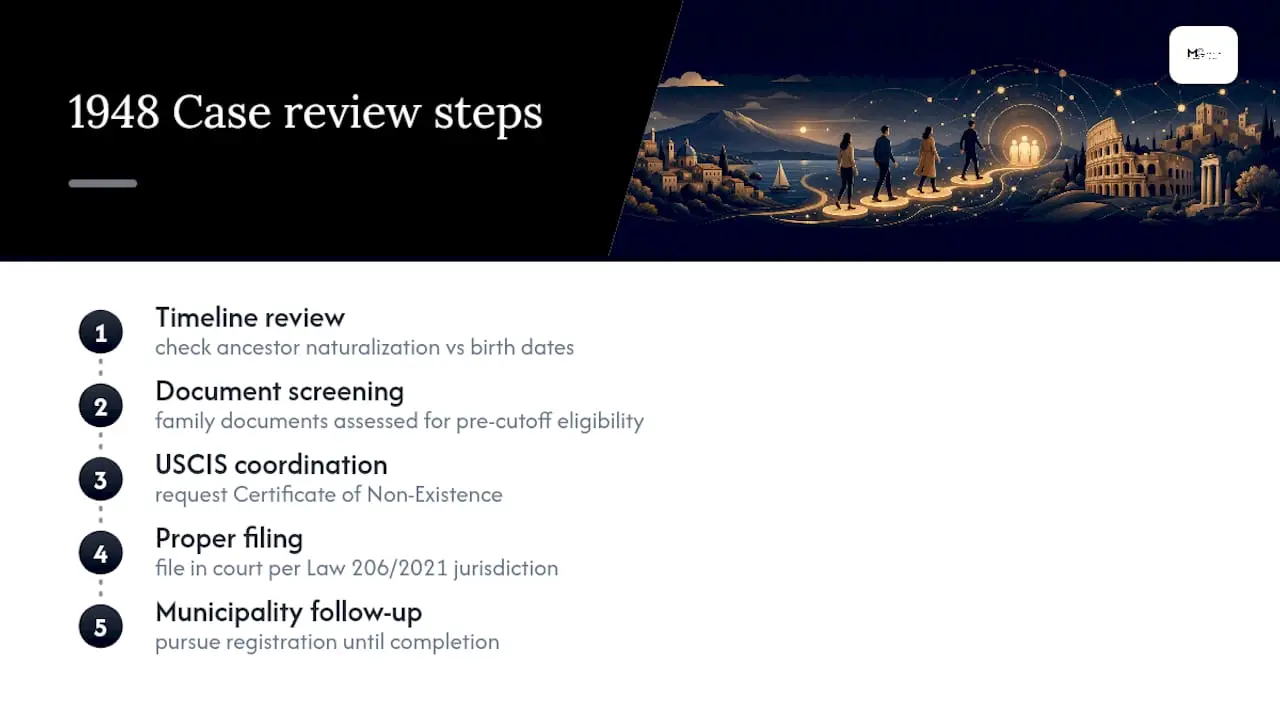
Our process for 1948 inquiries begins with a document pre-check and jurisdiction assessment before providing any filing plan, as naturalization dates often determine eligibility early in the evaluation. Our team coordinates foreign-record retrieval, including USCIS G-1566 requests for American ancestors, and follows through with the comune after judgment to make sure registration actually completes. Clients typically start by sending a family tree summary and relevant certificates already in their possession.
Get Your 1948 Case Reviewed by an Italian Citizenship Lawyer
Independent research and document collection matter, but a 1948 case rises or falls on details a genealogy website will not catch, like whether your ancestor’s naturalization record predates a birth by a few critical months. Mglawfirm reviews that timeline first, before you spend on apostilles or translations that a fatal naturalization date would make worthless.
With experienced attorneys, this firm handles the parts of a 1948 case that are hardest to manage from abroad: coordinating USCIS Certificate of Non-Existence requests, filing in the correct court under the jurisdiction rules that took effect with Law 206/2021, and following up with the municipality until registration is complete. An eligibility screening starts with a review of your family’s document set and ancestor timeline to confirm whether you fall under the pre-cutoff rules or one of the three post-2025 exceptions.
If you want that assessment, reach out through Mglawfirm’s Italian citizenship and residency services page to start the intake process and find out where your family’s case actually stands.
Where to Verify These Rules Yourself
- The Consolato Generale d’Italia publishes the baseline jure sanguinis requirements, including the January 1, 1948 maternal-line rule.
- LegalClarity’s analysis of the 2025 reforms summarizes Law 74/2025, Article 3-bis, and the March 27, 2025 cutoff in plain terms.
- USCIS explains how to request a Certificate of Non-Existence for ancestors who emigrated to the United States.
- For comparison, this British citizenship requirements guide outlines how another jurisdiction documents naturalization proof for descent-based claims.
This article is general information, not a substitute for advice from a qualified lawyer. Consult a qualified legal professional about your own circumstances before acting on anything here.
Sources
- 1948 Case Italian Citizenship: Who Still Qualifies – LegalClarity
- Citizenship iure sanguinis – Consolato Generale d’Italia Londra
- U.S. Citizenship and Immigration Services (USCIS) — G-1566 Certificate of Non-Existence reference
Recommended
- Italian citizenship new law 2025
- Italian Citizenship by Descent Lawyer Guide (2026)
- Palermo Court & Italian Citizenship After Decree 36/2025 (2026)
- Italian Citizenship Reform Referred to EU Court | 2026 Update
The information provided here is general in nature and does not replace professional assistance. Reading this content does not create a professional-client relationship.
