
The Italy family reunification visa lets non-EU spouses, minor children, dependent adult children, and qualifying parents join a family member legally residing in Italy. The process always starts the same way: the sponsor in Italy files a Nulla Osta application through the Sportello Unico per l’Immigrazione (SUI) using SPID credentials, the family member then applies for a national D visa at the competent consulate, and everyone registers for a residence permit at the Prefettura within eight days of arrival. Start the Nulla Osta online today, but check the Nulla Osta’s limited validity period, sponsor eligibility (permit type, income, housing), and the newer two-year legal stay rule before you file.
TL;DR:
- The sponsor must hold a qualifying permit, demonstrate two years of residence in Italy, and prove adequate income and housing to support eligible family members.
- Family members, including minors, adults with disabilities, and dependent parents, must submit properly legalized documents, with age cutoff maintained at the SUI submission date regardless of subsequent changes.
- Processing requires timely submission of the Nulla Osta within six months, booking consular appointments promptly, and registering residence within eight days of arrival to avoid resets and refusals.
- Common causes of visa refusal include missing apostilles, weak dependency evidence, incorrect income calculations, and missed deadlines, which can be mitigated with careful preparation.
- Engaging legal professionals helps optimize document legality, coordinate filings, and manage appeals, especially for complex cases or tight timelines.
Table of Contents
- Who Qualifies for an Italy Family Reunification Visa?
- What Must the Sponsor in Italy Prove?
- How Do You Apply for a Family Visa in Italy Step by Step?
- What Documents Does the Family Visa Application Require?
- How Long Does the Process Take and What Does It Cost?
- What Are the Most Common Reasons Family Visas Get Refused?
- How Legal Counsel Smooths the Family Reunification Process
- Get Direct Legal Support for Your Family Reunification Case
- Sources
Who Qualifies for an Italy Family Reunification Visa?
Article 29 of Legislative Decree 286/1998 defines exactly which relatives can join a sponsor in Italy. The category you fall into determines the documents you need and how strictly the Prefettura will scrutinize your dependency claim.
Eligible family members include:
- Spouse or civil partner of legal age, regardless of nationality.
- Minor children, including adopted children, provided they are under 18 at the time the Nulla Osta is submitted to SUI, not when the visa is issued.
- Dependent adult children who cannot support themselves due to a documented health condition involving total disability.
- Dependent parents who have no other children in their home country able to support them, or parents over 65 who meet a stricter set of health and dependency conditions.
Refugees and beneficiaries of subsidiary protection follow the same Article 29 framework but often qualify for relaxed documentary requirements, since proving civil status in a country of origin may be impossible. The UNHCR Italy guidance walks through those adjustments in detail. One detail applicants miss constantly: the minor cutoff is locked in at the SUI submission date. Therefore, a child who turns 18 mid-process does not lose eligibility.
What Must the Sponsor in Italy Prove?
The sponsor, not the family member abroad, carries the legal burden. Under Legislative Decree 286/1998, Articles 28 and 29 require three things: a qualifying residence permit, adequate income, and suitable housing.
- Permit type: work permits, family permits, and long-term EU residence status generally qualify, usually with a minimum one-year duration remaining.
- Income: assessed at the household level against the annual social allowance (“assegno sociale”) reference figure, which increases depending on how many family members are joining.
- Accommodation: proof of adequate housing, typically a registered rental contract or ownership deed, sometimes supported by municipal habitability certificates (referred to in some regional guidance as forms S1/S2/S3).
Two-year update: sponsors now generally need to demonstrate two years of legal residence in Italy before filing, a tightening of the older Article 28 standard. Exceptions apply, including the accompanying family member procedure for those relocating together and certain humanitarian grounds recognized by the Prefettura. If you fall short of two years, the practical move is to confirm your exact category with the local Sportello Unico before submitting, since a rejected Nulla Osta application costs months, not days.
How Do You Apply for a Family Visa in Italy Step by Step?
The Italian family reunification process runs through four distinct stages, each with its own authority and deadline.
- File the Nulla Osta on Portale ALI. Log in with SPID, attach the required revenue stamp, upload the sponsor’s income and housing documents, and submit. Original documents may need to be presented in person afterward depending on the local SUI office.
- SUI verification and transmission. The Sportello Unico coordinates police background checks on the sponsor and, once cleared, transmits the Nulla Osta electronically to the competent Italian consulate abroad. Processing normally stays within a set window unless additional checks are triggered.
- Consular visa application. The family member books an appointment and submits original civil-status documents for the national D (family reunification) visa. This must happen within the Nulla Osta’s limited validity period, or the authorization expires and the sponsor restarts from step one.
- Arrival and residence permit registration. Within eight days of entering Italy, the family member must begin the residence permit process at the Prefettura or local Sportello Unico.
Practical checklist before you start:
- Confirm SPID access works before the SUI deadline approaches.
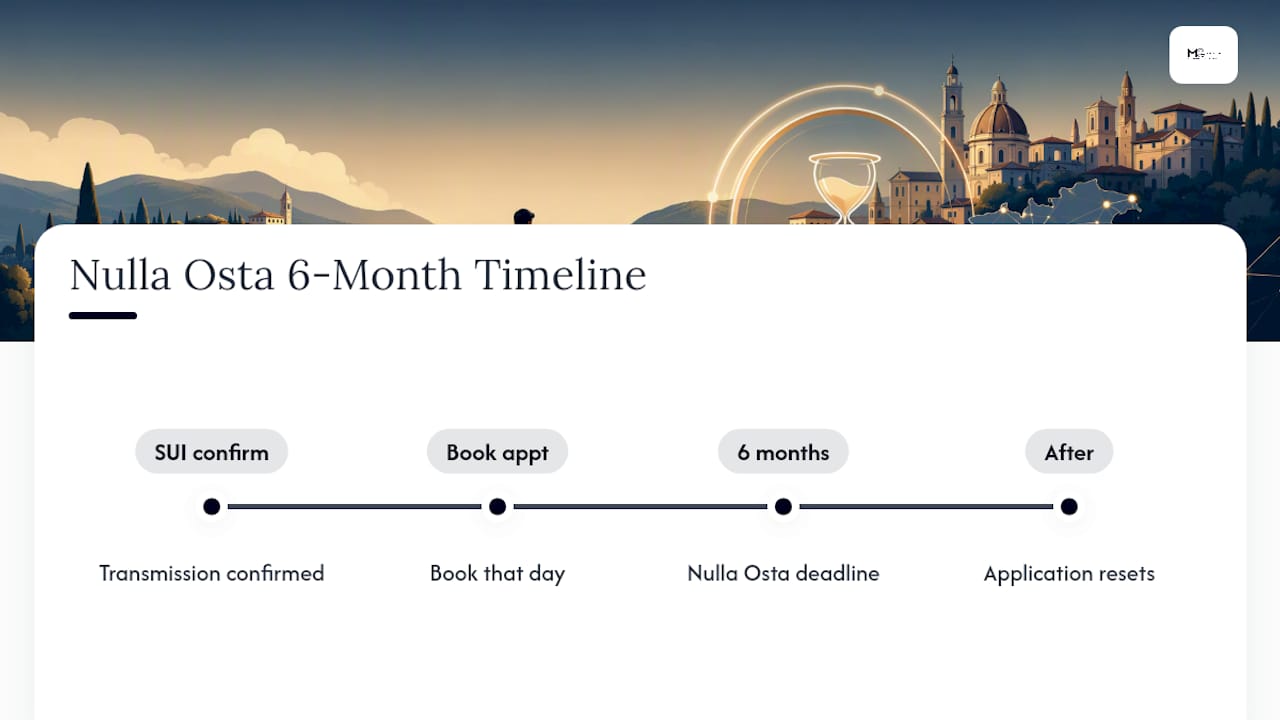
- Book the consular appointment the moment SUI confirms transmission, since waiting risks the Nulla Osta expiring.
- Keep copies of every uploaded document; SUI offices occasionally request originals later.
What Documents Does the Family Visa Application Require?
Document requirements shift by family category, but legalization mistakes sink more applications than eligibility problems ever do.
- Spouses: marriage certificate, sometimes with a “no-impediment” declaration depending on the country of origin.
- Minor children: birth certificate plus notarized consent from any parent who is not relocating.
- Dependent parents or adult children: proof of dependency (bank transfers, affidavits) and evidence that no other relatives can provide support.
Every foreign civil-status document generally needs either an apostille (Hague Convention countries) or full consular legalization (non-Hague countries), plus a certified Italian translation. Embassy guidance consistently flags outdated certificates, missing apostilles, and untranslated medical reports as leading causes of refusal.
Pro Tip: Order fresh civil-status certificates no more than three to six months before filing. Italian consulates and Prefettura offices routinely reject documents they consider stale, even when the underlying facts have not changed.
How Long Does the Process Take and What Does It Cost?
Budgeting time correctly matters as much as budgeting money. Miss the Nulla Osta’s validity window and the entire application resets.
The six-month Nulla Osta window is the single hardest deadline in the whole process. Book the consular appointment the day SUI confirms transmission rather than waiting for a convenient slot to appear.
What Are the Most Common Reasons Family Visas Get Refused?
Refusals cluster around a small number of recurring mistakes, and nearly all of them are preventable.
- Legalization errors: missing apostilles or expired civil-status certificates.
- Weak dependency evidence for adult children or parents, especially thin financial documentation.
- Income calculations that don’t meet the household threshold once all reunifying family members are counted.
- Missed deadlines, particularly Nulla Osta expiry or the eight-day Prefettura registration window.
If a Nulla Osta or residence permit application is refused, act immediately. An administrative review or appeal before the Civil Tribunal is available, but strict filing deadlines apply, and the appeal typically needs the original refusal notice, updated documentary evidence, and a clear timeline of events. This is the point where most applicants bring in a lawyer, since judicial appeals require procedural precision that a first-time filer rarely has.
How Legal Counsel Smooths the Family Reunification Process
Legal professionals handle the parts of this process where small errors cause the biggest delays: auditing documents before submission, coordinating apostille and translation work across jurisdictions, managing the SPID and SUI filing itself, liaising with consulates on appointment timing, and building appeals when a Nulla Osta or residence permit is refused. Engagement tends to matter most under tight deadlines, complex dependency claims, or when foreign documents don’t match Italian formatting expectations.
— Legal marketing team
Get Direct Legal Support for Your Family Reunification Case
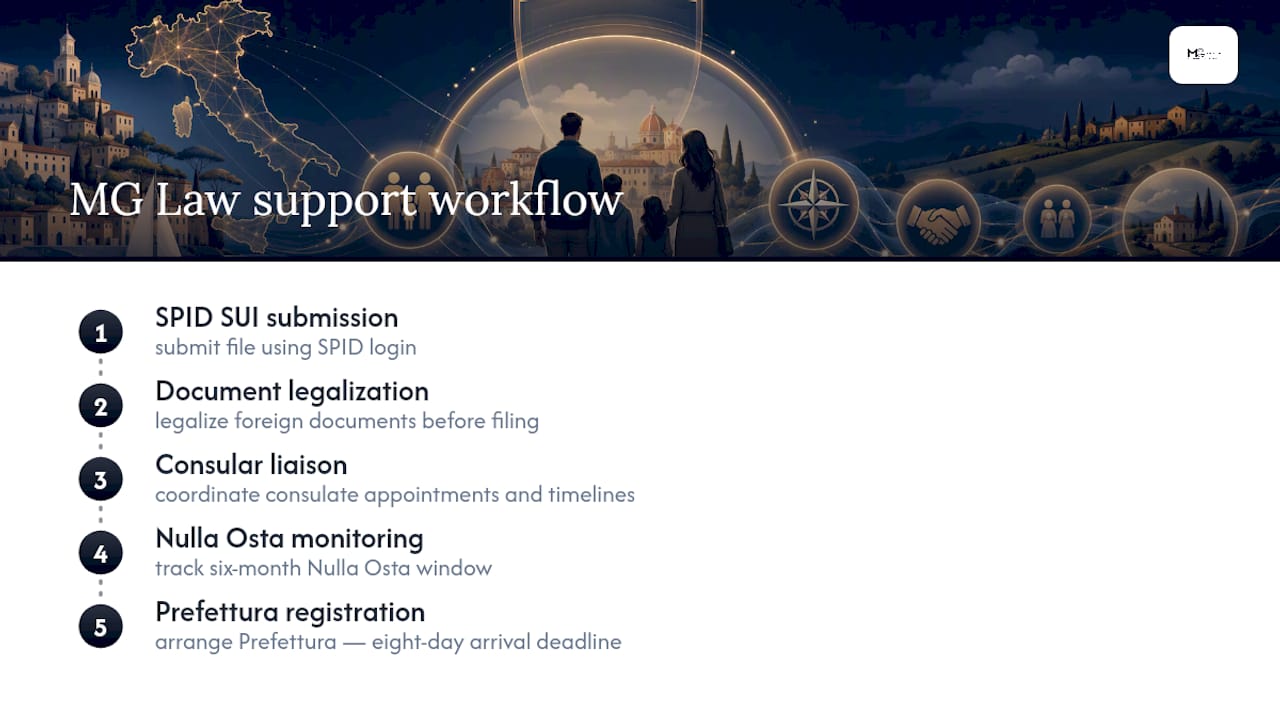
Coordinating Nulla Osta filings, consular timelines, and Prefettura registration across two countries is not a process most families want to manage alone, especially with the two-year stay rule now in play. Mglawfirm handles the full family reunification file directly, from SPID-based SUI submission and document legalization through consular liaison and Prefettura appointments, so nothing slips past the six-month Nulla Osta window or the eight-day arrival deadline. If your sponsor status, income calculation, or a foreign document’s legalization looks uncertain, reach out to MG Law’s immigration and residency team for a case review before you file.
This article is general information, not a substitute for advice from a qualified lawyer. Consult a qualified legal professional about your own circumstances before acting on anything here.
Sources
- FAMILY REUNIFICATION VISA – Family members of non-EU nationals (embassy guidance PDF)
- Prefettura guidance on family reunification (detailed procedural PDF)
- Embassy guidance: documentation and legalisation notes for family reunification
Recommended
- Elective Residency Visa Italy 2026: Requirements & How to Apply
- Italian Citizenship Lawyer for Foreigners
- EU Blue Card Italy 2026: Requirements,Salary, Process & FAQ
- Italian Tax Residency for Foreigners: Complete Guide 2026
The information provided here is general in nature and does not replace professional assistance. Reading this content does not create a professional-client relationship.
