
Yes, expats can open a personal bank account in Italy, and both EU and non-EU citizens have a clear path to do it, through either a resident account or a non-resident option. The baseline requirement is a codice fiscale plus valid photo ID, though some digital banks will onboard you with less. Your first move, before anything else, is securing that codice fiscale from the Agenzia delle Entrate or an Italian consulate.
TL;DR:
- Non-residents can open Italian bank accounts by providing a codice fiscale, valid ID, and proof of address, with non-EU citizens also needing a residency permit or visa.
- Digital banks like N26, Revolut, and Wise offer faster, app-based onboarding, often without initial proof of residence, but their IBANs may face acceptance issues with some landlords and employers.
- Traditional banks require scheduled appointments, bringing original and copies of all documents, and typically issue IBANs immediately, but account activation and card delivery take additional days.
- Basic accounts under Italian law are available for low-income residents, typically with minimal fees, while full service accounts need proof of residency and offer more banking options.
- Legal support can help resolve documentation or residency issues that cause application rejections, especially in complex cases involving property purchases or long-term stay plans.
Table of Contents
- Quick Checklist: Documents to Bring or Secure Before You Apply
- Which Account Type Fits Your Situation?
- How Do You Open an Account in Person at an Italian Bank?
- Can You Open an Account Online or With a Neobank?
- What Does It Cost to Maintain a Bank Account in Italy?
- Why Applications Get Rejected, and How to Fix It
- When Does Legal Support Make Sense for Banking Hurdles?
- Your First 30 Days: A Practical Sprint
- MG Law: Legal Support for the Bottlenecks Banks Can’t Solve
- Sources
- FAQ
Quick Checklist: Documents to Bring or Secure Before You Apply
Banks in Italy don’t improvise on paperwork. Most institutions require a codice fiscale, valid ID, and proof of address before they’ll open a resident account, and non-EU nationals typically need to show a permesso di soggiorno or at least the official receipt confirming an application is in progress. Gather everything below before you book an appointment or start an app registration.
- Passport or EU national ID card: bring the original plus one photocopy. Make sure the name spelling matches exactly across every other document.
- Codice fiscale: Italy’s tax identification number, requested through the Agenzia delle Entrate if you’re already in the country, or through an Italian consulate before you arrive.
- Proof of address: a signed rental contract, a recent utility bill, or a hosting declaration (dichiarazione di ospitalità) if you’re staying with someone. If you don’t have permanent housing yet, some banks accept a temporary address or the address of a legal representative.
- Permesso di soggiorno or entry visa: required for non-EU nationals; the application receipt (cedolino) sometimes suffices at more flexible branches.
- Extras that speed things up: an employment contract, a university enrollment letter for students, or an Italian mobile number for SMS verification codes.
| Document | Who needs it | Where to get it |
|---|---|---|
| Passport or EU ID | All applicants | Home country issuing authority |
| Codice fiscale | All applicants | Agenzia delle Entrate or Italian consulate |
| Proof of address | Resident account applicants | Landlord, utility provider, or host |
| Permesso di soggiorno | Non-EU nationals | Questura (police headquarters) |
| Italian phone number | Recommended for all | Local mobile carrier |
Pro Tip: Request your codice fiscale from the consulate before you leave your home country whenever possible. Arriving in Italy with it already in hand cuts your first branch visit down to a single appointment instead of two.
Which Account Type Fits Your Situation?
The account you choose depends heavily on your residency status and how long you plan to stay. A conto corrente, the standard current account, generally requires proof of Italian residency and gives full access to salary deposits, direct debits, and mortgage applications. Most traditional banks, including Intesa Sanpaolo and UniCredit, reserve their full-service accounts for residents.
Non-resident accounts exist for people who own property, receive rental income, or need banking access without living in Italy full time. They come with more restrictions, often higher fees, and less flexibility for services like mortgages.
- Conto di base (basic account): a legally mandated low-cost option under Bank of Italy consumer protection rules, available to low-income residents and designed to guarantee everyone access to basic banking.
- Neobank accounts: N26, Revolut, and Wise let you open an account remotely through an app, often without requiring a codice fiscale at the outset. They’re fast, but the IBANs they issue may not be fully accepted by every Italian employer, landlord, or utility company.
- Postal accounts through Poste Italiane: a widely used, accessible option with branches in nearly every town, popular with retirees and long-term residents alike.
- Fineco: an Italian digital-first bank that combines online convenience with full Italian banking credentials, useful if you want speed without sacrificing local acceptance.
If your plans include buying property, understanding how Italian tax residency affects your account choice matters just as much as the account features themselves.
How Do You Open an Account in Person at an Italian Bank?
Walking into a branch and expecting immediate service is a common mistake. Banks increasingly require booked appointments, and walk-ins are often turned away outright in busy cities like Rome or Milan. Here’s the realistic sequence.
- Book your appointment online or by phone. Major banks like Intesa Sanpaolo and UniCredit both offer online booking systems; smaller local banks may still want a phone call.
- Bring originals and copies of every document. The clerk will scan your passport, codice fiscale, and proof of address, and may ask about your income source or employment status.
- Sign the account agreement. Ask for the foglio informativo, the informational sheet that discloses fees, in English if the branch offers it. Most larger banks can provide one.
- Receive your IBAN the same day. Most Italian banks issue your account number and IBAN immediately after signing.
- Wait for your debit card and PIN by post. This typically takes five to ten business days, and you’ll need to activate the card, often via ATM or phone, before first use.
Keep your name formatting identical across every document you present. A middle name that appears on your passport but not your rental contract is one of the most common, and easily avoidable, causes of delay.
Pro Tip: Request the foglio informativo before signing anything. It spells out every fee in plain language, and reading it in advance saves you an awkward conversation later about a charge you didn’t expect.
Can You Open an Account Online or With a Neobank?
Digital onboarding skips the appointment entirely. You download an app, photograph your ID, and complete either a live video call or SPID verification, Italy’s national digital identity system, then wait for approval.
- N26 and Revolut allow account opening without a codice fiscale in many cases, making them useful as a bridge account while your resident paperwork is still in progress.
- Wise functions similarly, offering multi-currency accounts that work well for freelancers or remote workers billing clients abroad.
- SPID integration speeds up later steps considerably. Once you link SPID to your new IBAN, you unlock access to Italy’s public administration portals, tax filing systems, and healthcare registration.
- Limitations to expect: a non-Italian IBAN from a neobank may not satisfy every employer’s payroll system, and some utility companies and mortgage lenders still insist on a domestic IBAN starting with IT.
Approval on these apps usually takes anywhere from a few minutes to a couple of days, far faster than the branch route, but the tradeoff is reduced access to full Italian banking services like mortgages or business loans.
Pro Tip: Use a neobank as a temporary landing pad for your first paycheck or rent payment, then transition to a full Italian resident account once your permesso di soggiorno and proof of address come through; for helpful comparative insights, see the guide on opening an Irish bank account while renting.
What Does It Cost to Maintain a Bank Account in Italy?
Budgeting for an Italian account means understanding two separate cost categories: ongoing bank fees and a specific government tax.
- Monthly maintenance fees on traditional accounts typically range from 0 to 12 EUR, with many banks waiving the fee if you deposit a regular salary or fall under a certain age threshold.
- Imposta di bollo, Italy’s stamp duty, runs around €34.20 annually on accounts that hold an average balance above a set threshold; digital banks with 0 EUR plans sometimes structure accounts to fall below it.
- ATM withdrawals outside your bank’s network and international transfers usually carry a per-transaction fee, while transfers within the SEPA zone through online banking are often free or minimal.
- IVAFE, a tax on foreign financial assets, applies mainly to Italian tax residents holding accounts abroad, not the reverse, so non-residents opening an Italian account generally don’t trigger it themselves.
The imposta di bollo and IVAFE are the two tax details expats consistently overlook. Keeping your average balance under the stamp duty threshold, or choosing a basic account, is a legitimate way to sidestep it.
Why Applications Get Rejected, and How to Fix It
Most rejections trace back to two causes: KYC and anti-money-laundering concerns, or documents that simply don’t match each other. A rental contract with a different address than your permesso di soggiorno is a classic trigger.
- Request written reasons for the rejection. Under Bank of Italy consumer protection rules, the institution must notify you formally, and that notice tells you exactly what to correct.
- Provide certified or updated documents. A notarized translation or a fresh utility bill often resolves the issue on a second attempt.
- Use a temporary alternative while you fix it. Postepay Evolution or a fintech account like N26 keeps you financially operational without waiting weeks for a resolution.
- Escalate if needed. If the rejection seems unjustified, you can file a formal complaint with the Bank of Italy, or consult a legal advisor if the issue involves residency or contested documentation.
When Does Legal Support Make Sense for Banking Hurdles?
Some banking obstacles aren’t banking problems at all, they’re legal and administrative ones. A multilingual legal team, with offices in several major Italian cities, regularly assists clients who hit exactly this kind of wall.
Typical situations where legal support saves time include obtaining a codice fiscale through a consulate when the process stalls, legalizing foreign documents for Italian bank acceptance, drafting a power of attorney so someone can manage your account while you’re still abroad, and formally contesting a rejected application. Before a consultation, gather your existing documents, any written rejection notice, and a clear timeline of what you’ve already tried. In cases involving residency or property purchases, legal assistance often compresses timelines that would otherwise stretch across months of back-and-forth with consulates or branch staff.
Your First 30 Days: A Practical Sprint
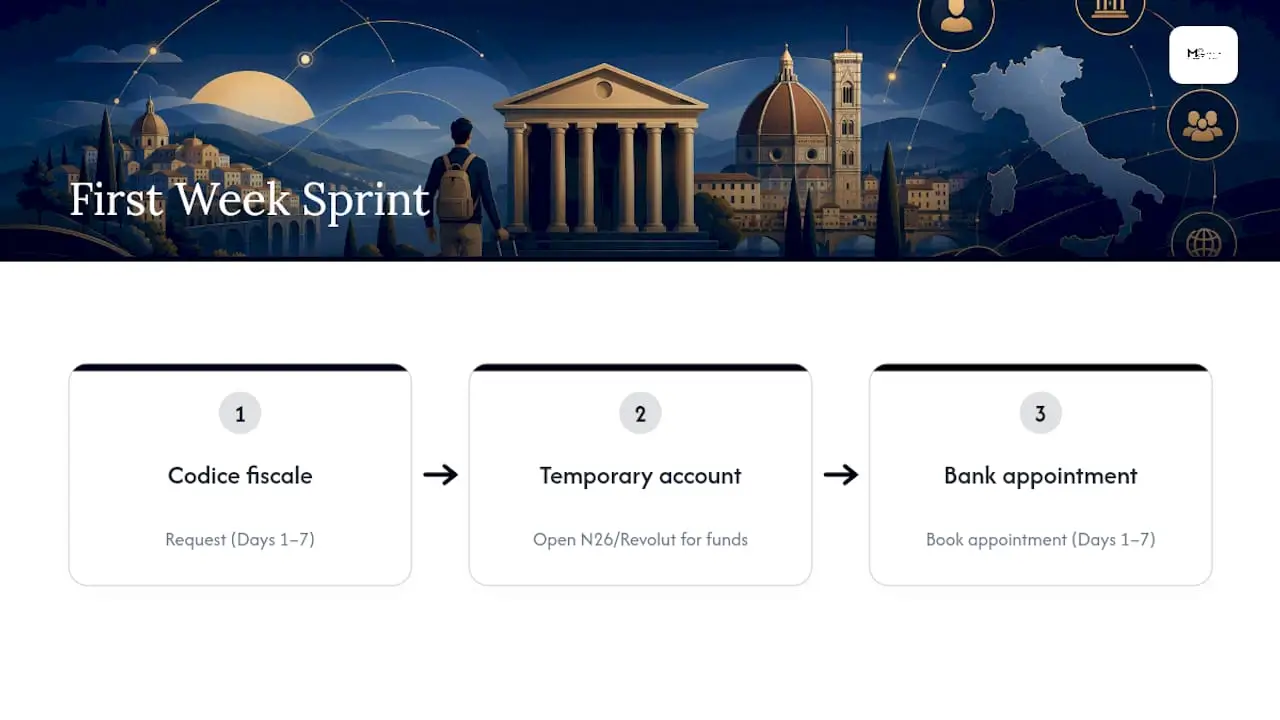
Days 1 through 7: request your codice fiscale, open a temporary N26 or Revolut account if you need to receive funds immediately, and book your bank appointment now rather than later.
Weeks 2 and 3: attend the branch appointment, submit your documents, and collect your IBAN. Register for SPID if your bank supports linking it.
Week 4: finalize your permanent account, redirect your salary and direct debits, and confirm your tax reporting obligations are in order.
— Legal marketing team
MG Law: Legal Support for the Bottlenecks Banks Can’t Solve
A bank teller can process your paperwork, but they can’t legalize a foreign document, draft a power of attorney, or argue your case if an application gets wrongly refused. That’s where Mglawfirm fits in, not as a bank replacement, but as the legal backup for the administrative snags that stall so many expats mid-process. Multilingual attorneys regularly help foreign clients secure a codice fiscale through consular channels, prepare powers of attorney for remote banking needs, and resolve residency documentation that a bank has flagged as inconsistent.
If your banking issue is really a tax residency question, or if you’re opening an account specifically to manage an Italian property purchase, it’s worth reviewing your tax residency status before you go further. For anyone whose banking needs are tied to buying property in Italy, MG Law’s property purchase legal support covers the due diligence steps a bank account alone won’t touch. Reach out for an initial consultation and bring your existing documents, including any written rejection notice from a bank, so the team can assess your situation from day one.
Sources
- How to open a bank account in Italy
- Bank of Italy — Current accounts made easy (consumer guide)
- Agenzia delle Entrate
- How to open a bank account in Italy as an expat – MondoExpat
- Best bank in Italy for expats 2026 — Freenance
This article is general information, not a substitute for advice from a qualified financial advisor. Consult a qualified financial professional about your own circumstances before acting on anything here.
FAQ
Can Foreigners Open a Bank Account in Italy?
Yes. Both EU and non-EU citizens can open a personal bank account in Italy, provided they have a codice fiscale and valid identification, with non-EU nationals typically also needing proof of legal residency status.
Which Italian Bank Is Best for Foreigners?
It depends on your needs: traditional banks like Intesa Sanpaolo, UniCredit, and Fineco offer full Italian banking services including mortgages, while Poste Italiane provides wide accessibility, and digital banks like N26 and Revolut offer the fastest remote onboarding for temporary needs.
Can I Just Walk Into a Bank and Open an Account?
Not reliably. Many Italian banks now require a booked appointment, and walk-ins are frequently turned away in busy branches, so scheduling ahead is strongly recommended.
Can I Open a Bank Account in Italy Without Residency?
Yes, non-resident accounts exist specifically for this purpose, though they typically come with more restrictions and higher fees than a standard resident current account, and neobanks offer an even faster non-resident alternative.
Recommended
- Moving to Italy from the USA: Requirements 2026
- Italian Citizenship Lawyer for Foreigners
- EU Blue Card Italy 2026: Requirements,Salary, Process & FAQ
- Elective Residency Visa Italy 2026: Requirements & How to Apply
The information provided here is general in nature and does not replace professional assistance. Reading this content does not create a professional-client relationship.
