
Yes, crypto gains are taxable in Italy in 2026, and the headline substitute tax rate on most disposals rises to 33% starting January 1, effective for gains realized this year and declared in 2027. The annual allowance that once shielded small gains disappeared starting with the 2025 tax year. Alongside the capital gains tax, resident taxpayers holding crypto abroad must also report those assets on Quadro RW and may owe IVAFE. Start by pulling your full transaction history now, and if you hold assets across multiple exchanges or wallets, get a professional read on your Quadro RW exposure before filing season arrives.
TL;DR:
- The crypto gain tax rate in Italy increases from 26% to 33% starting in 2026, with no exemptions for small gains beyond 2024.
- Gains from crypto disposals include sales, swaps, and payments, with blockchain transfers between wallets generally not taxable if ownership remains unchanged.
- Active trading, DeFi activities, or running a crypto business may trigger higher progressive income taxes or corporate rates instead of the flat substitute tax.
- Proper classification of transactions and accurate record-keeping before filing are essential to avoid penalties, especially with new transparency regulations like DAC8 and MiCA oversight.
- Using the correct tax form—Modello 730 or Modello Redditi PF—and submitting detailed foreign asset reports in Quadro RW are critical for compliance and avoiding fines.
Table of Contents
- Crypto Tax Rates in Italy: 2024 Through 2026
- What Transactions Actually Trigger Italian Crypto Tax
- Which Tax Forms and Deadlines Apply to You
- How to Calculate Your Crypto Gains and Losses
- IVAFE, Stamp Duty, and Elective Reporting Options
- DAC8, MiCA Oversight, and What Happens if You Get It Wrong
- Your Step-by-Step Filing Checklist for 2026
- When to Bring in Legal Counsel for Crypto Tax Matters
- What the 2026 Rules Actually Change for You
- How Mglawfirm Supports Your Crypto Tax Compliance
- Sources
- FAQ
Crypto Tax Rates in Italy: 2024 Through 2026
The rate you owe depends entirely on which tax year the gain falls into, and the trend has moved in one direction only: up. Understanding italian tax law for crypto starts with this timeline, because the 2025 Budget Law reshaped the substitute tax structure in ways that catch a lot of long-term holders off guard.
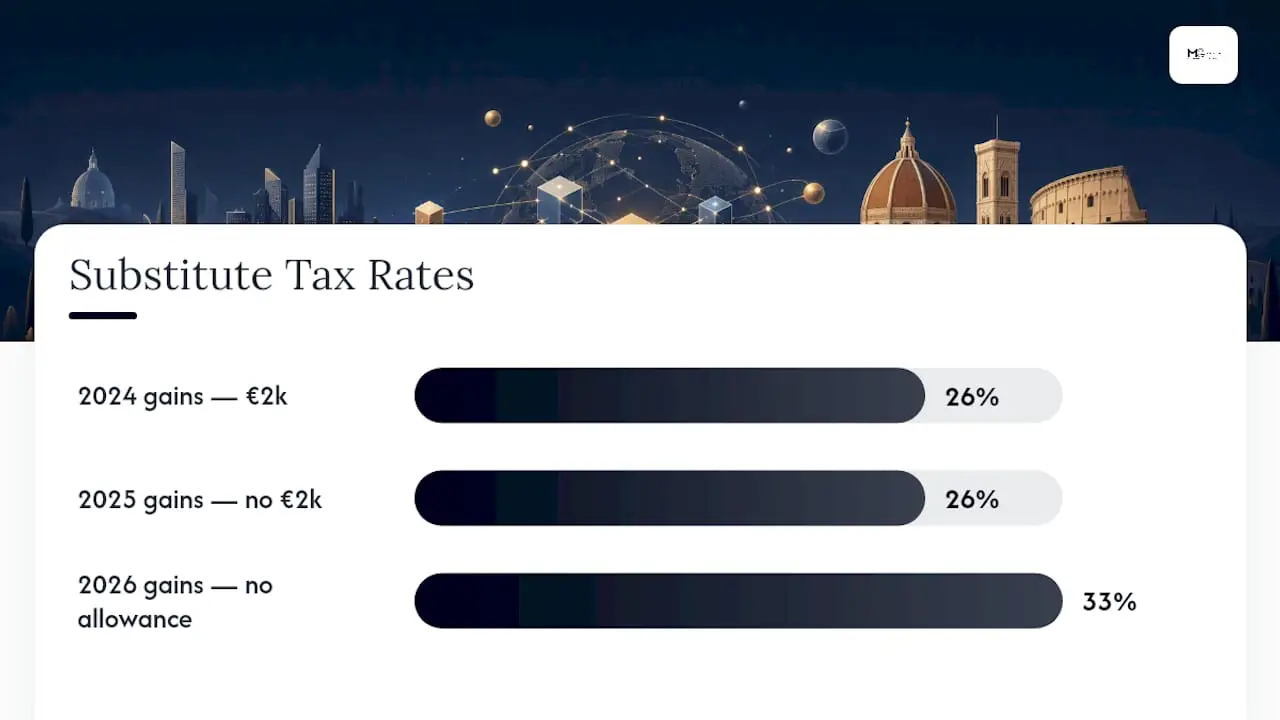
For gains realized through the end of 2024, the imposta sostitutiva (substitute tax) sat at 26%, with the first €2,000 in annual gains exempt. That exemption vanished for gains realized in 2025, still taxed at 26% but with no floor protecting small investors. Then the 2025 Budget Law pushed the rate to 33% for gains realized from January 1, 2026 onward, a jump of seven percentage points that meaningfully changes the math on any disposal you’re planning this year.
Rate timeline at a glance:
- 2024 gains (declared 2025): 26% substitute tax, annual allowance applied
- 2025 gains (declared 2026): 26% substitute tax, no allowance
- 2026 gains (declared 2027): 33% substitute tax, no allowance
There’s one notable carve-out. Euro-denominated e-money tokens (EMTs) that qualify as MiCA-compliant stablecoins may retain more favorable treatment under certain conditions, since Regulation (EU) 2023/1114 (MiCA) treats euro-pegged tokens differently from other crypto-assets for regulatory purposes. Verify with a tax advisor before assuming a stablecoin swap qualifies, because the classification hinges on issuer compliance status, not just the token’s peg.
Quick fact: Italy’s substitute tax on most crypto capital gains jumped from 26% to 33% between the 2025 and 2026 tax years, a 27% relative increase in the effective rate.
Not everyone falls under the substitute tax regime, either. If Agenzia Entrate determines your trading activity is habitual, organized, and profit-driven enough to constitute a business, your gains get taxed under progressive IRPEF rates (up to 43%) or corporate IRES rates instead of the flat substitute tax. Frequency of trades, use of leverage, and whether you run the activity through a company structure all factor into that determination. Occasional buy-and-hold investors rarely trigger this reclassification, but active day traders and anyone running a crypto-related business should assume scrutiny.
What Transactions Actually Trigger Italian Crypto Tax
A taxable event in Italy isn’t limited to cashing out to euros. The Agenzia Entrate circular of October 27, 2023 classifies crypto-asset gains as “redditi diversi” (miscellaneous income) under Article 67 of the TUIR (Italy’s consolidated income tax code), and it draws the taxable-event line broadly.
Transactions that trigger tax:
- Selling crypto for euros or another fiat currency
- Swapping one cryptocurrency for another (crypto-to-crypto trades count as disposals)
- Paying for goods or services with crypto
- Any deemed disposal where the token’s function or classification changes materially
Staking rewards, mining proceeds, and airdrops occupy trickier ground. Depending on the facts, Agenzia Entrate can classify these as miscellaneous income at the moment of receipt, taxed on the euro value when you gain control of the tokens, or in some cases as employment income if received through a work relationship. The distinction matters because it changes both the tax rate and the reporting form, so don’t assume every airdrop gets the same treatment as every mining reward.
Wallet-to-wallet transfers where you retain beneficial ownership, moving coins from an exchange to your own hardware wallet, for instance, are not disposals and don’t trigger tax. But you still need to document the transfer, because an unexplained balance change across wallets is exactly the kind of thing that raises questions during a review.
Pro Tip: Keep a running spreadsheet or use crypto tax software that timestamps every wallet-to-wallet transfer alongside your trades. When Agenzia Entrate cross-references exchange data against your declared history, gaps look like unreported disposals even when they’re just internal moves.
Complex DeFi activity, liquidity mining, yield farming, wrapped-token conversions, and staking derivatives sits in genuinely unclear territory. Italy’s functional approach to classifying crypto-assets tends to lump diverse activities into the same broad category, which means novel DeFi mechanics don’t always map cleanly onto existing guidance. If you’re running anything beyond simple buy, hold, and sell, professional review isn’t optional caution, it’s the only way to avoid guessing wrong on a form that carries penalty exposure.
Which Tax Forms and Deadlines Apply to You
Reporting crypto earnings in Italy runs through two possible main forms, and picking the wrong one is a common, avoidable mistake.
Modello 730 works for employees and pensioners who otherwise qualify for simplified filing, but it has limits: it can handle basic capital gains reporting through a simplified annex, yet it’s not built for complex investment portfolios. Modello Redditi PF is the standard form for investors, the self-employed, and anyone with income streams a 730 can’t accommodate, including most active crypto traders.
Within Modello Redditi PF, capital gains from crypto disposals go on Quadro RT (or the equivalent capital-gains section referred to as Quadro T in some filing contexts), where you calculate the taxable gain and apply the substitute tax rate. Separately, Quadro RW covers foreign asset monitoring, and this is where crypto held on non-Italian exchanges or in self-custodied wallets gets declared for IVAFE purposes, regardless of whether you sold anything that year. Simplified 730 filers use an equivalent Quadro W where their filing route allows it.
| Filing element | Modello 730 | Modello Redditi PF |
|---|---|---|
| Best for | Employees, pensioners with simple positions | Investors, self-employed, active traders |
| Capital gains section | Simplified annex (limited) | Quadro RT |
| Foreign asset monitoring | Quadro W (where applicable) | Quadro RW |
| Filing deadline | September 30 | November 30 |
| Payment vehicle | F24 (via withholding or direct payment) | F24 |
Deadlines matter as much as the forms themselves. Modello 730 is due by September 30 of the year following the tax year. Modello Redditi PF runs later, with a November 30 deadline in most recent cycles, though the balance payment via F24 typically falls earlier in the summer, with a surcharge option available if you pay later within a grace window. Confirm exact dates each year, since Agenzia Entrate occasionally shifts them by a few days.
You can submit directly through the Agenzia Entrate online portal, through a CAF (tax assistance center) if your situation is straightforward, or through a professional tax representative if you’re dealing with cross-border holdings, business classification questions, or multiple years of unreported activity.
How to Calculate Your Crypto Gains and Losses
Every transaction needs a euro value at the time it occurred, whether you’re converting a sale, a swap, or a payment. Use the exchange rate published by Banca d’Italia or another accepted reference rate for that specific date. Don’t average rates across a month or use a single year-end rate for transactions spread across twelve months. That’s a shortcut that produces the wrong number and invites correction later.
Steps to calculate your taxable gain:
- Establish your cost basis for each unit of crypto acquired, in euros, at the time of acquisition
- Choose an accounting method (FIFO is the generally accepted default under current Agenzia Entrate practice, though consistency matters more than which method you pick)
- Apply that method consistently across all disposals in the tax year, and across future years unless you have a documented reason to change
- For swaps and crypto payments, treat the euro value at the moment of the transaction as your disposal proceeds, and the value of what you received as the new cost basis going forward
- Sum gains and losses across all disposals to reach your net taxable gain for the year
Here’s a worked example. Suppose you bought 1 Bitcoin for €30,000 in 2023 and sold it in 2026 for €55,000. Your gain is €25,000.
IVAFE, Stamp Duty, and Elective Reporting Options
This runs independently of whether you sold anything, it’s a wealth monitoring tax, not a transaction tax, and it applies even in years with zero disposals.
- IVAFE applies to holdings on non-Italian exchanges and to self-custody wallets under current interpretation
- The rate is 0.2% of year-end value, declared through Quadro RW
- Stamp duty (imposta di bollo) can apply in specific custody arrangements, particularly where an Italian intermediary holds assets on your behalf
- Elective substitute regimes based on declared value rather than realized gains remain available in limited circumstances, with defined election windows each tax year
Choosing an elective value-based regime can simplify compliance if you’re a passive, long-term holder who doesn’t want to track every disposal. But locking in a valuation under an elective regime carries tradeoffs for how future gains get calculated once you eventually sell, so weigh that choice against your actual disposal plans, not just this year’s convenience. Whichever route you pick, keep every valuation document and election notice, because reconstructing your basis years later without records is far harder than filing correctly the first time.
DAC8, MiCA Oversight, and What Happens if You Get It Wrong
Two regulatory shifts change the compliance calculus for 2026 in ways that didn’t exist a few years ago. DAC8 extends the EU’s automatic exchange of information framework to crypto-asset service providers, meaning exchanges and custodians increasingly report transaction and identity data directly to tax authorities. Any mismatch between what you declare and what your exchange reports is exactly the kind of discrepancy that triggers an automated flag.
Separately, MiCA supervision through Bank of Italy and CONSOB means using an authorized, registered platform isn’t just a safety preference, it affects how cleanly your transaction data flows into the reporting chain authorities rely on.
- Penalties for undeclared foreign assets on Quadro RW typically scale with the value and duration of non-disclosure, and can run into meaningful percentages of unreported value plus interest
- Unpaid substitute tax carries its own penalty structure separate from the RW monitoring penalty
- Ravvedimento operoso (voluntary disclosure) substantially reduces penalties if you come forward before Agenzia Entrate opens a formal review
- Reconciling your exchange-reported data against your own records early in the year gives you time to fix errors before filing, not after
Pro Tip: If you’ve missed a filing year or underreported past gains, ravvedimento operoso is almost always cheaper than waiting to get caught. The reduction in penalties scales with how quickly you self-correct, so don’t sit on a known gap hoping it goes unnoticed.
Your Step-by-Step Filing Checklist for 2026
- Export your complete transaction history from every exchange and wallet you’ve used, including ones you no longer actively trade on
- Convert every transaction to euros using the date-specific rate, and separate disposals (taxable) from wallet transfers (not taxable, but documented)
- Classify each disposal type, sale, swap, payment, and each income receipt, staking, mining, airdrop, separately
- Calculate your net gain using a consistent accounting method, and compute IVAFE on your year-end foreign or self-custodied holdings
- Determine whether Modello 730 or Modello Redditi PF fits your situation, and complete Quadro RT and Quadro RW accordingly
- Prepare your F24 payment ahead of the deadline, factoring in the surcharge option if you need extra time
- If you find a past-year gap, consider ravvedimento operoso before filing this year’s return
- Retain all records, exchange statements, wallet exports, valuation documents, for at least the standard statute-of-limitations period, generally several years beyond the filing date
When to Bring in Legal Counsel for Crypto Tax Matters
Some situations outgrow a DIY spreadsheet approach fast, especially when navigating complex cross-border reporting and filing requirements described in What is ECI tax filing: a guide for foreign persons. A multilingual legal team regularly works with foreign investors and Italian residents navigating exactly the intersection this article covers: crypto gains, cross-border tax exposure, and Quadro RW compliance.
Typical cases the firm supports include voluntary disclosure filings for unreported prior-year holdings, cross-border tax treaty questions for dual residents or recent movers to Italy, and representation during Agenzia Entrate audits involving crypto-asset positions. Each of these carries real financial stakes, and getting professional eyes on the filing before it’s submitted is far cheaper than correcting it after.
To assess your case, Mglawfirm will typically request your full transaction history, residency status and dates, and details on where and how your assets are custodied. From there, you get a clear picture of your actual exposure and a defined plan for filing or disclosure. If your situation involves multiple jurisdictions or a complex DeFi portfolio, that initial review is where the real value shows up.
What the 2026 Rules Actually Change for You
Losing the allowance while facing automated cross-checks against exchange data is the part that actually changes behavior, because it means small, casual gains that used to fly under the radar now carry both a tax liability and a documentation burden.
The conventional advice, “just track your trades and file honestly”, undersells how much the classification questions matter. Whether a staking reward counts as miscellaneous income versus employment income, whether your trading pattern tips you into business taxation, whether a DeFi position counts as a disposal, these judgment calls are where real liability hides, not in the arithmetic of gain times rate.
If you take one thing from this: prioritize getting your classification right before you optimize your accounting method. A perfectly calculated FIFO gain on a mis-classified transaction is still a wrong filing.
— Legal marketing team
How Mglawfirm Supports Your Crypto Tax Compliance
There are legal service providers that review your actual transaction history, residency status, and cross-border exposure before you file, not after Agenzia Entrate flags a mismatch. Services may cover tax compliance for individual filers, ravvedimento operoso disclosure for unreported prior years, and residency or cross-border planning for those splitting time between Italy and another country.
Getting started is simple: a discovery call to outline your situation, a document review of your exchange history and wallet records, and, where needed, direct representation if Agenzia Entrate opens an inquiry. If you’re a US citizen with crypto holdings, our Italy-US tax treaty guide covers the added layer of dual-reporting obligations you’ll want addressed alongside your Italian filing. Visit our tax advisory services page to schedule an initial consultation and get a clear read on your 2026 filing exposure before deadlines close in.
Sources
For verification and deeper study beyond this guide, consult these primary sources directly:
- Agenzia Entrate circular: Trattamento fiscale delle cripto-attività (27 Oct 2023)
- European Commission — DAC8 overview
This article is general information, not a substitute for advice from a qualified financial advisor. Consult a qualified financial professional about your own circumstances before acting on anything here.
FAQ
How Can I Reduce My Crypto Capital Gains Tax in Italy?
There’s no legal way to avoid tax on genuine disposals, but consistent cost-basis tracking, correct classification of income versus capital gains, and timing disposals with full awareness of your annual position can prevent overpaying or misreporting; elective value-based regimes may also suit passive long-term holders.
How Much Tax Will I Pay on Crypto Income Like Staking or Mining?
Staking rewards, mining proceeds, and airdrops are generally taxed as miscellaneous income at their euro value when received, though the exact treatment depends on the facts of how and why you received them, and professional review is worthwhile for anything beyond simple staking.
Recommended
- Italy 7% Flat Tax for Foreign Retirees (2026)
- Property Taxes in Italy for Non Residents – A Guide for Investors
- Can Foreigners Avoid IMU Tax in Italy?
- Italian Inheritance Tax for Non-Residents
The information provided here is general in nature and does not replace professional assistance. Reading this content does not create a professional-client relationship.
