
Yes, non-EU nationals typically obtain an Italy work visa through an employer-sponsored nulla osta. The employer files the request at the Sportello Unico per l’Immigrazione, the consulate in your home country issues the entry visa once the nulla osta clears, and you finalize your status with a permesso di soggiorno application within eight days of arrival. Whether you move fast or wait months often depends on which route you qualify for.
TL;DR:
- The employer must submit a complete application at the Sportello Unico, with supporting documents, to secure a nulla osta, which is needed for the visa process.
- Outside-quota routes like the EU Blue Card and intra-company transfers allow year-round applications and typically offer faster, more predictable processing than the limited click-day quotas.
- Missing or uncertified translation, inconsistent job details, or employer compliance issues are common causes of delays or refusals in both the nulla osta and visa stages.
- Consular appointments vary by country, often taking two to six weeks, and require careful preparation of documents such as proof of accommodation, travel plans, and background checks.
- Legal support can help prevent costly errors, especially in complex cases involving Blue Cards, prior compliance flags, or contested decisions, by reviewing documents and guiding the process.
Table of Contents
- How Does Employer Sponsorship Work in Italy?
- Which Sponsorship Route Fits Your Situation?
- What Documents Does the Employer Need for the Nulla Osta?
- What Do You Need for the Consular Visa Appointment?
- What Happens After You Arrive in Italy?
- How Long Does the Process Take and What Does It Cost?
- What Are the Most Common Reasons Applications Get Delayed or Refused?
- When Legal Support Actually Changes the Outcome
- How Mglawfirm Supports Your Sponsorship Case
- Sources
- FAQ
How Does Employer Sponsorship Work in Italy?
The Italian system puts the employer in the driver’s seat. You cannot apply for sponsorship on your own behalf. Your future employer initiates the process, and the request lives or dies on the completeness of their filing at the Sportello Unico.
For jobs covered by Decreto Flussi quotas, the workflow runs in three phases:
- Pre-compilation. The employer prepares the application, gathers supporting documents, and drafts the employment contract proposal before the official filing window opens. Employers who treat this stage as a real project, with verified documents and translations ready in advance, dramatically improve their odds of securing a quota place on click day.
- Click day submission. On the date set by the Ministry, employers transmit the pre-compiled file through the Ministry’s immigration portal. Quotas fill within minutes for popular categories, so a half-finished application is a wasted application.
- Nulla osta issuance and transmission. Once approved, the Sportello Unico issues the nulla osta and transmits it electronically to the relevant Italian consulate abroad, which then contacts you to schedule the visa appointment.
Your role during this phase is largely passive but critical: supplying accurate personal documents, signing the contract proposal, and staying reachable while your employer manages the filing. Outside-quota categories skip the click-day scramble entirely, which changes the calculus for many applicants.
Which Sponsorship Route Fits Your Situation?
Not every job sponsorship runs through the Decreto Flussi quota calendar. Italy separates work authorizations into quota-bound and quota-exempt categories, and knowing which one applies to you changes your entire timeline.
The Decreto Flussi sets annual numerical caps on subordinate work entries, with the 2026 to 2028 programming cycle shaping how many slots exist for specific sectors like agriculture, tourism, and domestic care. If your job falls under a capped category, you are competing for a fixed number of spots on a specific date.
Several routes bypass the quota system entirely:
- EU Blue Card: for highly qualified roles, generally requiring a university degree or equivalent professional experience and a salary above a set threshold. Applications can be filed year-round rather than during a click day. Our EU Blue Card guide for 2026 breaks down the current salary and qualification benchmarks.
- Intra-company transfers (ICT): for employees moving within the same multinational group, subject to minimum prior employment periods with the sending entity.
- Highly skilled professionals: certain specialized roles designated by the Ministry as falling outside standard quota limits.
- Seasonal work: a separate quota track with shorter validity, aimed at agriculture and tourism.
Quick fact: the outside-quota routes exist precisely because Italy’s labor ministry recognizes that highly skilled hiring cannot wait for an annual decree calendar. If your role and salary meet Blue Card thresholds, that path usually offers more predictable timing than a quota-dependent filing. Review the Blue Card timeline breakdown before deciding which route to pursue.
What Documents Does the Employer Need for the Nulla Osta?
The employer’s submission package needs to satisfy both bureaucratic completeness and a substantive labor market check. Before requesting a nulla osta, the employer must confirm with the local Employment Center, or Centro per l’Impiego, that no suitable Italian or EU candidate is available for the role. Skipping or mishandling this step is one of the most common reasons files stall.
| Document category | What it covers |
|---|---|
| Company registration | Certificate of incorporation, VAT number, Chamber of Commerce registration |
| Financial capacity | Proof the company can pay the offered salary, often recent tax filings or bank statements |
| Employment contract proposal | Job title, salary, contract type, and reference to the applicable CCNL (national collective bargaining agreement) |
| Accommodation evidence | Lease, deed, or declaration confirming suitable housing for the worker |
| Labor market test result | Confirmation from Centro per l’Impiego that the position could not be filled locally |
Every foreign-language document destined for an Italian office needs a certified translation, and some require legalization or an apostille depending on the issuing country. Employers who submit uncertified translations or omit the CCNL reference routinely see their filings bounced back for correction, costing weeks they rarely have during a tight quota window.
What Do You Need for the Consular Visa Appointment?
Once your employer secures the nulla osta, the ball moves to you and the Italian consulate covering your place of residence. Consulates generally ask for a consistent set of materials, though exact requirements vary slightly by post, so confirming with your specific consulate before the appointment saves a wasted trip.
- Original nulla osta or confirmation of its issuance.
- Valid passport with at least three months’ validity beyond the visa period.
- Completed visa application form and passport-style photos.
- Proof of accommodation in Italy.
- Flight reservation or travel itinerary.
- Police clearance certificate, where requested, and academic diplomas.
- Declaration of Value for foreign degrees, particularly relevant for EU Blue Card applicants whose qualification underpins the salary threshold.
The entry visa carries a limited validity window, so plan your travel dates around it rather than booking flights before the visa is actually issued. Appointment availability differs enormously between consular posts. Some capitals process visa interviews within two weeks; others carry backlogs stretching past a month. Certified copies and translations prepared in advance shave real time off the appointment itself.
What Happens After You Arrive in Italy?
Landing in Italy is the beginning of a second administrative sprint, not the finish line. Once the entry visa is used, you have eight days to submit your permesso di soggiorno application at the designated post office using the kit provided by the Questura, and to sign the contratto di soggiorno at the Sportello Unico that formalizes your employment terms under Italian law.
Your employer carries parallel obligations that begin the moment you start work:
- Register your hiring with INPS (social security) and INAIL (workplace injury insurance).
- File the UNILAV notification confirming the employment relationship, a step required under Italian labor compliance rules.
- Run your first payroll cycle in line with the CCNL terms specified in the nulla osta file.
For your own first-month checklist, get your codice fiscale (tax code) if you don’t already have one, register with the national health service or arrange private coverage, and keep your housing documentation accessible since the Questura may request it again during the permesso interview.
Pro Tip: Photocopy every document you submitted for the visa, in triplicate, before you leave for Italy. The Questura and the post office rarely accept the same paperwork format twice, and having originals plus copies on hand avoids a second trip across town.

How Long Does the Process Take and What Does It Cost?
The nulla osta has a default processing window of 60 days if the Sportello Unico raises no objections, though quota-bound applications during heavy click-day periods can run longer simply due to volume. Consular visa appointments add anywhere from two to six weeks depending on the post.
Typical costs to budget for include:
- Consular visa issuance fee, generally a fixed amount set by the consulate.
- Permesso di soggiorno postal kit and stamp duty, paid at the post office.
- Certified translation and legalization costs for contracts, diplomas, and civil documents.
What lengthens the timeline? Incomplete pre-compilation before click day, consulate backlogs at high-demand posts, and missing documents in the nulla osta file are the three most common delays employers and applicants report.
What Are the Most Common Reasons Applications Get Delayed or Refused?
Most refusals trace back to inconsistency, not ineligibility. A mismatch between the salary or job title listed in the nulla osta and the consular visa file is a frequent red flag. Missing CCNL references, weak accommodation proof, or an employer with a spotty compliance history on prior hires all raise scrutiny.
- Cross-check every figure and title across the nulla osta, the contract, and the visa application before submission.
- Keep a documented record of the Centro per l’Impiego labor market check in case it’s challenged later.
- Verify the employer’s tax and social security standing before filing, since past violations can jeopardize new requests.
Pro Tip: Run a document reconciliation pass the week before filing, line by line, comparing every name spelling, date, and job title across all forms. Small typos cause disproportionate delays at both the Sportello Unico and the consulate.
When Legal Support Actually Changes the Outcome
Straightforward sponsorships often move smoothly without legal counsel. Where things get complicated, EU Blue Card evidence packages, intra-company transfer conditions, an employer with a prior compliance flag, or a contested Questura decision, having an immigration lawyer review the file before submission tends to prevent costly resubmissions.
A legal team with multilingual capabilities provides support to foreign professionals and their employers sponsoring them in Italy across these scenarios. Before reaching out to counsel, gather your contract offer, CCNL reference, and any prior visa history. Preparation shortens every conversation that follows.
— Legal marketing team
How Mglawfirm Supports Your Sponsorship Case
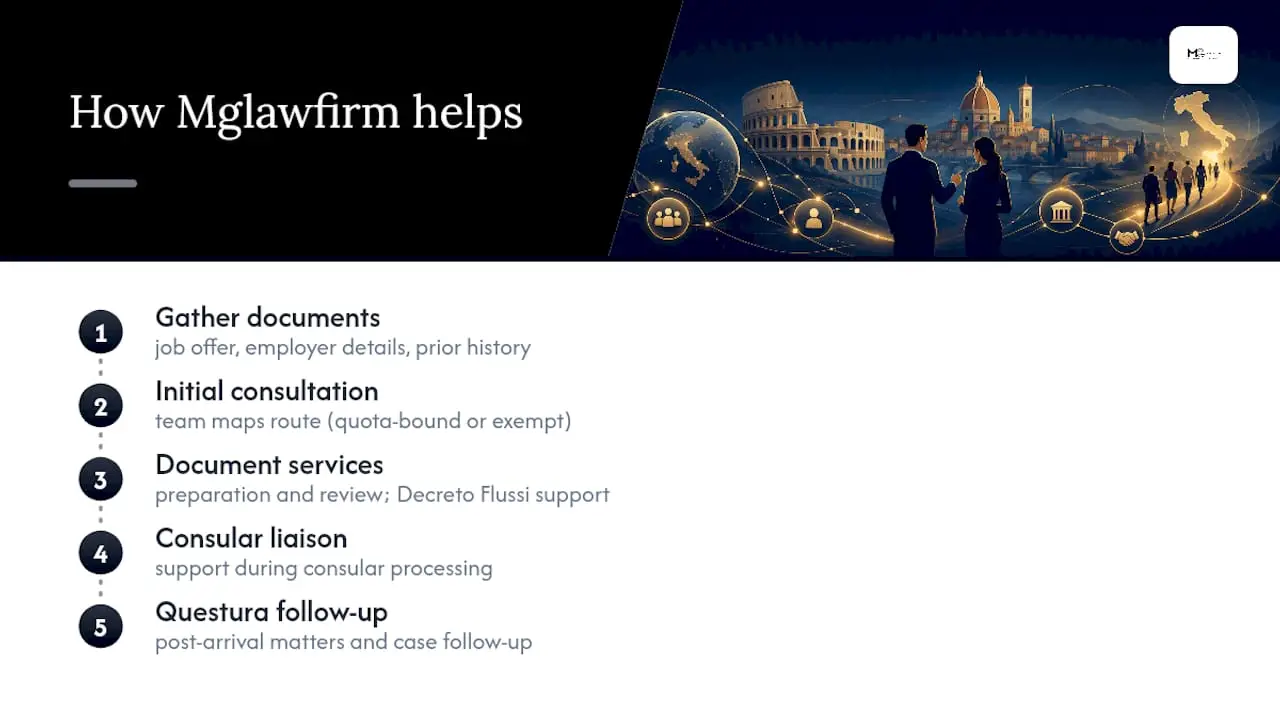
Legal support services can help coordinate sponsorship guidance beyond scattered consulate FAQs and forums, providing expertise on document requirements, employer filings, and handling cases across Italy’s immigration offices. Relevant services include document preparation and review, pre-compilation support for Decreto Flussi click days, liaison during consular processing, and follow-up on Questura matters after arrival.
Starting is simple: bring your job offer, employer details, and any prior immigration history to an initial consultation, and the team maps out exactly what your specific route, quota-bound or exempt, requires. Mglawfirm makes no guarantees about outcomes, since immigration decisions rest with Italian authorities, but it does offer a clear scope of legal support at every stage. Visit the immigration and residency services page to schedule a consultation and get your document checklist started.
This article is general information, not a substitute for advice from a qualified lawyer. Consult a qualified legal professional about your own circumstances before acting on anything here.
Sources
- Cliclavoro
- Ingress and stay for work in Italy (Ministero del Lavoro e delle Politiche Sociali)
- Dettaglio norma — Legislative Decree no. 286/1998 (IntegrazioneMigranti)
- Employed worker — Italy (EU Immigration Portal)
- Hiring Non-eu Workers Under Italy’s Decreto Flussi 2026–2028: the Employer’s Playbook
FAQ
How Do You Get Visa Sponsorship in Italy?
Your prospective employer files a nulla osta request at the Sportello Unico per l’Immigrazione, either during a Decreto Flussi click day for quota-bound roles or year-round for outside-quota categories like the EU Blue Card. Once approved, you apply for the entry visa at the Italian consulate covering your residence.
Are There Sponsorship Jobs Available in Italy in 2026?
Yes, sponsorship opportunities exist across quota-bound sectors covered by the 2026 to 2028 Decreto Flussi programming and outside-quota categories such as EU Blue Card roles, intra-company transfers, and highly skilled positions that can be filed at any time of year.
Can You Apply for an Italy Work Visa Online in 2026?
The employer’s nulla osta request is filed electronically through the Ministry’s immigration portal, but you personally must attend an in-person appointment at the Italian consulate for the visa interview and later at the Questura for your permesso di soggiorno.
Is Italy Currently Issuing Work Visas?
Yes. Italy continues to issue work visas through both the quota-based Decreto Flussi system and outside-quota routes like the EU Blue Card, though quota-bound categories remain limited to specific click-day windows set by the Ministry of Labor.
What Happens if the Nulla Osta or Visa Application Gets Denied?
You and your employer can generally appeal a denial through administrative or judicial channels within Italy’s immigration framework under Legislative Decree no. 286/1998, though the specific remedy depends on the grounds for refusal stated in the denial notice.
Recommended
The information provided here is general in nature and does not replace professional assistance. Reading this content does not create a professional-client relationship.
