
Yes, family reunification in Italy is available to qualifying sponsors, and the process starts online. If you hold an eligible residence permit and meet the income and housing thresholds, your first move is filing the nulla osta application through the Sportello Unico per l’Immigrazione (SUI) at your local Prefettura, or through an authorized Patronato. This authorization rests on Legislative Decree 286/1998, Articles 28 and 29, and every supporting document must be legalized and translated before submission.
TL;DR:
- Only sponsors with eligible residence permits held for the required minimum duration can initiate family reunification, and income plus housing thresholds are strictly assessed.
- Civil documents must be legalized or apostilled and translated before submission, often causing delays if not prepared early.
- The process involves three steps: filing the nulla osta online, scheduling the visa appointment, and registering after entry within eight days, all of which require timely action.
- Consulates take up to 30 days to process visas, but delays in document verification can extend this period significantly.
- Common pitfalls include expired nulla osta and incomplete documentation, which can be remedied with professional legal support to restart or streamline the process.
Table of Contents
- Who Qualifies for Family Reunification in Italy?
- How Do You Apply for Family Reunification in Italy?
- What Income and Housing Do Sponsors Need to Show?
- What Documents Do You Need and How Do You Legalize Them?
- How Long Does Family Reunification Take and What Does It Cost?
- What Happens After Your Family Member Arrives?
- What Goes Wrong and How Do You Appeal a Denial?
- How MG Law Supports Family Reunification Applications
- The Mistake We See Most Often
- Get Full-Service Support for Your Reunification Case
- Sources
- FAQ
Who Qualifies for Family Reunification in Italy?
Not every residence permit lets you sponsor relatives, and not every relative qualifies. The Italian Civil Code and Legislative Decree 286/1998 set both boundaries clearly.
Sponsors generally need a residence permit tied to work, study, research, subsidiary protection, asylum, or long-term EU residence, held for a minimum duration that varies by category. A reported update tightening the required length of legal stay for certain permit types has circulated widely; check current thresholds directly with your Prefettura before filing, since exceptions apply to protection holders and some research-permit categories.
Family members covered under Italian immigration law include:
- Your spouse or registered partner, provided the marriage or union is legally recognized in Italy.
- Minor children, including adopted children and those born outside the marriage, subject to the other parent’s consent where applicable.
- Adult children only if they are unable to support themselves due to a documented disability.
- Dependent parents, when no other adult children in their country of origin can support them or, in some cases, when they are over 65 and no equivalent support exists.
Refugees and holders of subsidiary protection status are often exempt from the standard income and housing tests, following UNHCR guidance on family reunification routes for protected individuals.
How Do You Apply for Family Reunification in Italy?
The procedure moves through three distinct phases, each with its own actor and its own clock. Missing a window at any stage forces you to restart.
- File the nulla osta online. The sponsor submits the application through the SUI portal at the Prefettura, often with help from an authorized Patronato. The Sportello Unico per l’Immigrazione verifies the sponsor’s criminal record, income, and housing suitability before issuing authorization.
- Book the consulate visa appointment. Once the nulla osta is issued, it is transmitted electronically to the competent consulate in the family member’s home country. The consulate has up to 30 days to process the visa and typically requires an in-person interview plus legalized civil documents.
- Register within eight days of entry. After the family member arrives in Italy, they must report to the Sportello Unico or Prefettura to collect the permesso di soggiorno application kit, mail it through the designated postal service, then attend a Questura appointment for fingerprinting and permit issuance.
Pro Tip: Book your consulate appointment the same week your nulla osta is issued. The period sounds generous, but consular calendars in busy jurisdictions fill up fast, and a missed window means reapplying from scratch.
What Income and Housing Do Sponsors Need to Show?
Two tests decide whether your application clears the Prefettura desk: income adequacy and housing suitability. Both get scrutinized closely, and both trip up more applicants than any other part of the process.
- Income threshold. The benchmark is the annual assegno sociale (social allowance). Sponsoring one family member typically requires income equal to the assegno sociale; each additional adult relative raises the bar by half that amount. Sponsoring a minor child under 14 triggers a higher combined threshold rather than the standard incremental increase.
- Accommodation suitability (idoneità abitativa). You need proof the property meets local size and habitability standards, typically a rental contract, property title deed, or a certification issued by the municipality confirming the dwelling qualifies.
- Permit duration rules. Standard sponsor permits must run for a set minimum period, and a reported two-year legal-stay requirement now applies to some categories. Exceptions exist for accompanying family members already in Italy, holders of research permits, and individuals with protection statuses.
What Documents Do You Need and How Do You Legalize Them?
Document preparation is where most delays originate, not the online filing itself. Build your file early.
- Valid passports for every applicant, plus a copy of the sponsor’s current residence permit.
- Legalized marriage and birth certificates establishing the family relationship.
- Proof of income: payslips, tax returns, or employment contracts covering the required period.
- Proof of accommodation and, where the consulate requires it, health insurance coverage.
Foreign civil documents need either an Apostille (for Hague Convention countries) or full consular legalization, plus a certified Italian translation. Bring both originals and copies to your consular appointment, since embassy procedural guidance frequently lists extra documentary requests that vary by post.
How Long Does Family Reunification Take and What Does It Cost?
The nulla osta stays valid for six months, giving you a fixed window to complete the consulate visa step before it expires with no automatic extension. Once the family member enters Italy, the permesso di soggiorno application must be filed within eight days, a deadline the Questura enforces strictly.
Consulates get 30 days to process a visa application, but that clock pauses whenever the post needs to verify records with a foreign registry office. Consular guidance confirms this discretion routinely extends real-world timelines well past a month, particularly for civil documents issued outside the EU.
| Cost Item | Typical Range |
|---|---|
| Entry visa fee | Set by consulate, varies by nationality |
| Permesso di soggiorno kit (postal) | Fixed postal service charge |
| Revenue stamp (marca da bollo) | Standard flat fee |
| Permesso issuance and renewal fees | Set by Questura schedule |
Exact amounts shift by consulate and prefettura, so confirm current figures with your specific consular office before budgeting.
What Happens After Your Family Member Arrives?
Arrival triggers a short but strict sequence. Collect the permesso kit at the Sportello Unico, complete it, and mail it through the designated post office within the eight-day window. The Questura appointment that follows includes fingerprinting and final permit issuance.
- The residence permit for family reasons grants access to employment and public education immediately, per Polizia di Stato guidance.
- If the sponsor dies or the couple separates, conversion to an independent permit type is possible under defined conditions.
- After five years of continuous legal residence, the family member can apply for long-term EU residence, subject to renewed income and integration checks.
What Goes Wrong and How Do You Appeal a Denial?
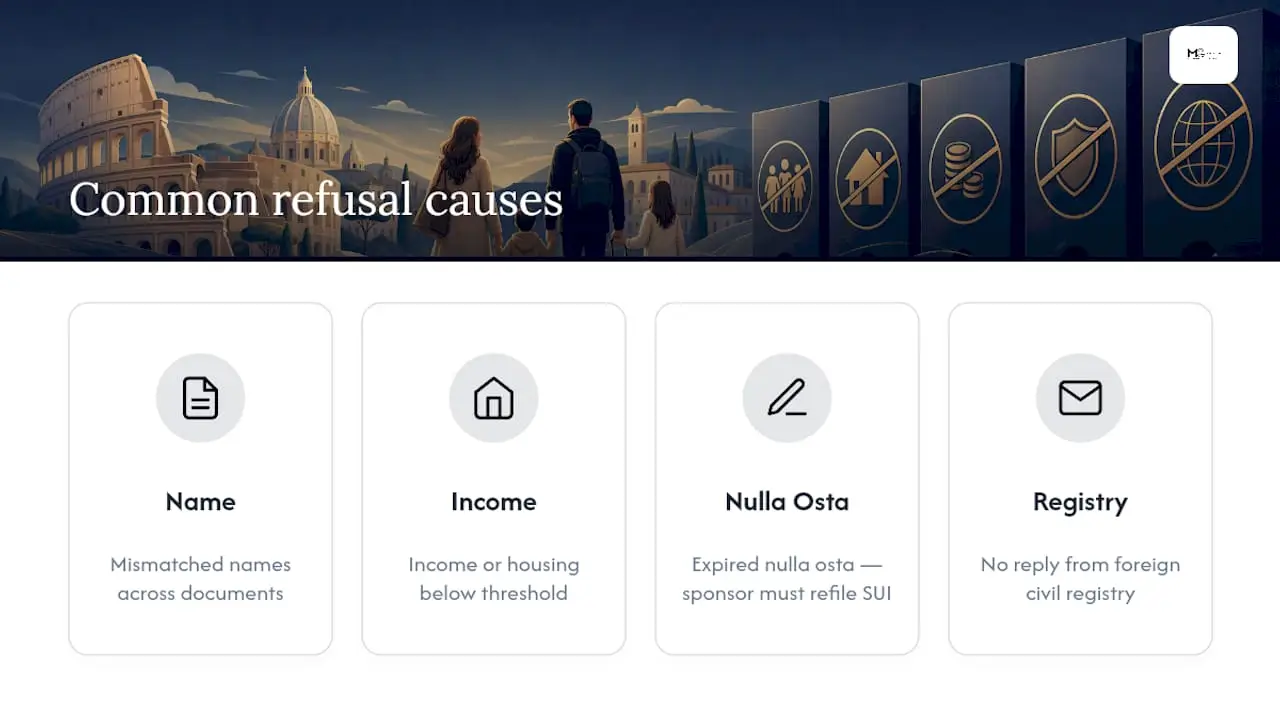
Most refusals trace back to the same handful of causes: mismatched names across documents, income or housing evidence that falls short of the threshold, an expired nulla osta, or a foreign civil registry that never responded to a consular verification request.
If your nulla osta lapses before the consulate appointment, the sponsor must file a new SUI application; there’s no automatic renewal. Negative decisions can be challenged through administrative remedies first, and unresolved cases proceed to civil tribunal review for residence permit refusals.
How MG Law Supports Family Reunification Applications
Legal firms prepare nulla osta packages, coordinate document legalization and certified translation, and liaise with the Prefettura, consulate, and Questura on clients’ behalf. Complex cases, civil-status recognition disputes, protection-based reunifications, and authorizations nearing expiration often benefit from experienced counsel guiding the file.
The Mistake We See Most Often
The most common error we see: applicants wait until after SUI clearance to start legalizing and translating documents, then lose weeks to consular delays. Start legalization immediately, and confirm your specific consulate’s requirements before booking anything.
— Legal marketing team
Get Full-Service Support for Your Reunification Case
Mglawfirm is the alternative to piecing together your application through generic online guides. Every case runs through a multilingual team that manages nulla osta preparation, document legalization and translation, and follow-up with the Prefettura and consulate in one coordinated file, so nothing falls through a jurisdictional gap. Our family reunification and residence permit services cover the full arc from initial SUI filing through long-term residence planning, and our broader legal services for foreign nationals in Italy extend into related matters like property purchase and tax residency once your family is settled. If your case involves protection status, a near-expired nulla osta, or a contested civil-status document, book an initial consultation now and we will map out your exact filing sequence before deadlines start working against you.
Sources
- Family reunification – Italy | EU Immigration Portal
- Family reunification procedural guidance (Prefettura PDF)
- Family reunification – UNHCR Italy
For readers comparing income thresholds across jurisdictions, some partner resources cover comparable sponsorship rules abroad, such as salary requirements for sponsoring parents in the UAE.
This article is general information, not a substitute for advice from a qualified lawyer. Consult a qualified legal professional about your own circumstances before acting on anything here.
FAQ
How Long Does It Take to Get a Family Reunion Visa in Italy?
Consulates have up to 30 days to process the visa once the nulla osta arrives, but that clock pauses whenever verification with a foreign civil registry is needed, often extending total processing well beyond a month.
What Are the Rules for Family Reunification in Italy?
Sponsors need an eligible residence permit, income at or above the assegno sociale benchmark, and adequate housing, while covered family members include spouses, minor children, dependent adult children with disabilities, and dependent parents under Legislative Decree 286/1998. Refugees and subsidiary protection holders may be exempt from the standard income and housing tests.
What Are the Requirements for Family Reunification?
You need a valid nulla osta, legalized and translated civil documents proving the relationship, proof of income and housing, and a visa application filed at the competent consulate within the nulla osta’s six-month validity window.
How Does the Two-Year Stay Rule Affect Eligibility?
Some sponsor categories now face a reported minimum two-year legal-stay requirement before filing, though exceptions apply to research permit holders, protection statuses, and family members already accompanying the sponsor in Italy. Confirm your specific category with the Prefettura before applying, since exceptions vary by permit type.
Can MG Law Help if My Nulla Osta Has Expired?
Yes, Mglawfirm regularly handles restart filings when a nulla osta lapses before the consular appointment, preparing the new SUI application and coordinating legalization so the second attempt moves faster than the first.
Recommended
- EU Blue Card Italy 2026: Requirements,Salary, Process & FAQ
- Elective Residency Visa Italy 2026: Requirements & How to Apply
- Italian Citizenship by Descent Lawyer Guide (2026)
- Italian Citizenship by Descent: Best Rated Law Firms (2026 Guide)
The information provided here is general in nature and does not replace professional assistance. Reading this content does not create a professional-client relationship.
