
If you transfer tax residence to Italy and meet the professional qualification tests, qualifying Italian employment or self-employment income is generally taxed on only 50% of its amount, and 40% in specific cases like relocating with a minor child. The benefit runs for a base period of several tax years and can be extended if a qualifying home is purchased under the specified conditions. The legal anchor is Article 5 of Legislative Decree 209/2023, and the details below determine whether you actually clear the bar.
TL;DR:
- The income exclusion under the impatriate regime applies only if you have not been an Italian tax resident for two years prior to relocation, or six to seven years if returning to the same employer or group.
- To qualify, you must meet residency, prior non-residence, and professional qualification tests, with strict documentation of each step to prevent claim denial.
- The regime offers a 50% tax exemption on qualifying income for four years, extendable to seven with a property purchase, with a €600,000 annual income cap.
- Moving with a minor child or having one adopted or born during the benefit period reduces the taxable share to 40%, requiring additional proof of family residence.
- Administrative errors, especially regarding employment group history, residency registration, or incomplete qualification proof, are the main reasons claims are challenged or revoked.
Table of Contents
- What Is the Impatriate Regime in Italy?
- Do You Meet the Eligibility Tests? Residency and Prior Non-Residence Explained
- How Much Do You Actually Save? Rates, Caps, and Duration
- Claiming the Benefit: Your First-Year Action Plan
- Can You Combine It With Other Tax Incentives?
- Your Pre-Move Checklist: Documents, Timeline, and Questions
- Where Claims Go Wrong: Common Pitfalls
- How Does the Regime Treat Your Family?
- What Proof Does the Tax Authority Actually Check?
- How Does Italy’s Regime Compare to Other EU Incentives?
- When Should You Bring in a Tax Lawyer?
- How Mglawfirm Supports Your Impatriate Regime Claim
- Sources
- FAQ
What Is the Impatriate Regime in Italy?
The impatriate regime is a tax incentive built to pull skilled workers, researchers, and returning professionals back into Italy’s labor market by cutting their taxable income for several years after relocation. It works by excluding half of qualifying income from Italian personal income tax (IRPEF), rather than by lowering the tax rate itself. That distinction matters for how you calculate your actual liability, since deductions and progressive brackets still apply to the remaining 50%.
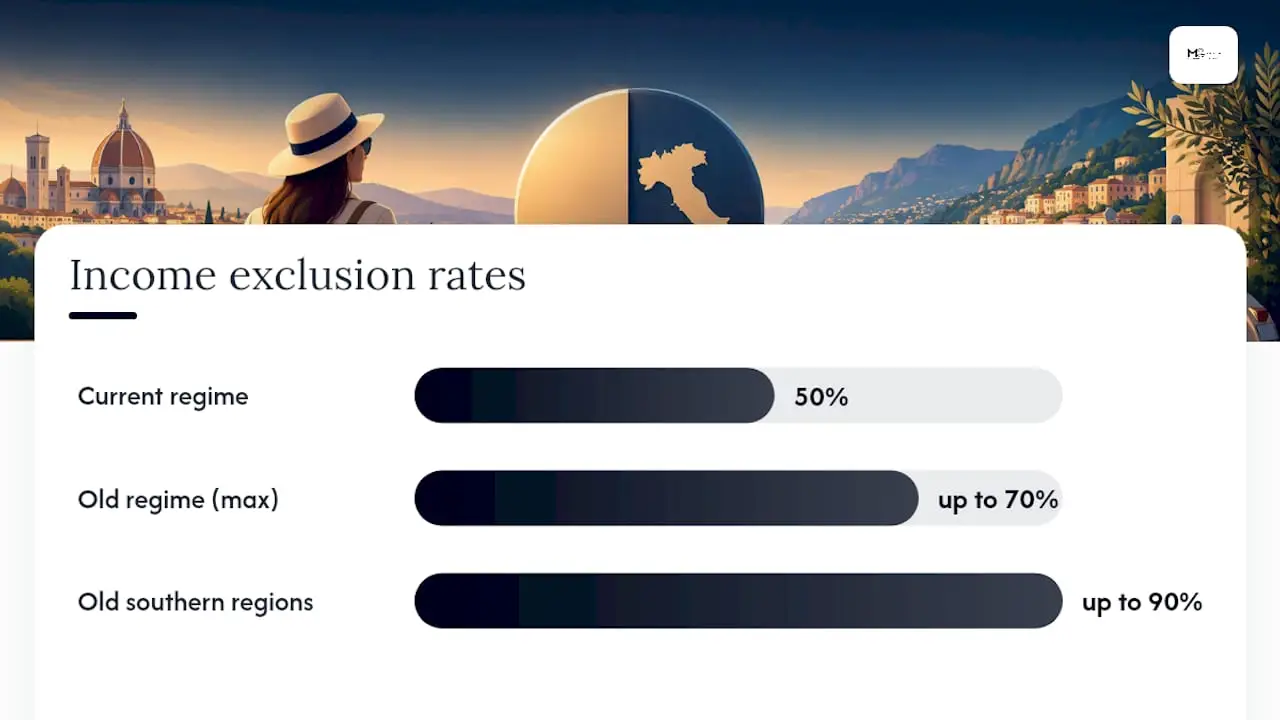
The current version applies to workers who transferred their tax residence to Italy starting from the 2024 tax period. It replaced the older, more generous “lavoratori impatriati” scheme from Legislative Decree 34/2019, which offered up to a 70% or 90% exclusion in some southern regions. If you moved before 2024, you likely remain under the old rules through their original expiration; if you’re planning a move now, Article 5 of DLgs. 209/2023 is what governs your situation.
Two legal anchors define the framework:
- Article 5, Legislative Decree 209/2023 sets the substantive conditions: residency transfer, prior non-residence, work performed mainly in Italy, and qualification requirements.
- Article 2 of the TUIR (Italy’s Consolidated Income Tax Act) supplies the test for tax residency itself, since you cannot claim the regime without first establishing Italian tax residence.
The regime targets a specific slice of the workforce, not every relocating employee. Eligible profiles generally include:
- Highly qualified or specialized professionals under the criteria in Legislative Decrees 108/2012 and 206/2007
- Researchers and university-level academics moving their base to Italy
- Graduates who studied or worked abroad for a sustained period before returning
- Managers and executives whose role satisfies the specialization threshold
If your role doesn’t fit one of those categories, the regime likely won’t apply, regardless of your salary or seniority.
Do You Meet the Eligibility Tests? Residency and Prior Non-Residence Explained
Eligibility hinges on three separate tests, and missing any one of them disqualifies the claim even if the other two are satisfied cleanly.
The tax residency test. Under Article 2 of the TUIR, you become an Italian tax resident if, for the greater part of the tax year, you meet any one of these conditions: registration in the anagrafe (the civil registry of the resident population), habitual residence in Italy, or the center of your personal and economic interests in Italy. The 183-day threshold (184 in leap years) is the most commonly cited marker, but registration alone can trigger residency even with fewer physical days present. This is not a box you check retroactively. You need to formally register with your local anagrafe office at the start of the relevant tax year for the claim to hold up under audit.
The prior non-residence test. You must not have been an Italian tax resident for a minimum period before the move. In the standard case, that period is the two tax years preceding the transfer. But the requirement extends significantly longer in specific scenarios.
The same-employer, same-group extension applies. This is where most claims run into trouble. If you return to work for the same employer you worked for before leaving Italy, or for a company belonging to the same group, the required prior non-residence period jumps to six or seven tax years. An Agenzia delle Entrate administrative ruling, Risposta n. 263_2025, confirms this extended window applies specifically when the returning worker’s activity in Italy is performed for the same employer or for an entity within the same corporate group as the one employing them abroad. The logic is straightforward: the rule exists to attract genuinely new talent and activity to Italy, not to let a multinational rotate the same employee through a foreign subsidiary for two years to unlock a tax break.
Anti-abuse checkpoint: Agenzia delle Entrate’s own guidance flags documentation of the non-residence period and “same-group” status as the most common grounds for later denial or benefit recovery, according to the Risposta n. 263_2025 clarification. If your employment history involves any group affiliation, treat this as the single highest-risk element of your claim.
Qualification requirements. You also need to demonstrate the specialized or highly qualified profile referenced in Legislative Decrees 108/2012 and 206/2007. In practice, this means keeping on file:
- University diplomas or professional qualifications recognized in the relevant field
- Employment contracts showing seniority or specialized function
- Evidence of professional registration where applicable (engineering orders, medical boards, and similar bodies)
How Much Do You Actually Save? Rates, Caps, and Duration
The core mechanic is an income exclusion, not a flat rate. Qualifying Italian employment or self-employment income is included in your taxable base at 50%, meaning the other half is exempt from IRPEF entirely. In specific circumstances, most notably when the relocating worker moves to Italy together with a minor child, or has a minor child born or adopted during the benefit period, the taxable portion drops further to 40%, according to Agenzia delle Entrate’s infogen guidance. That family-linked reduction stacks with the base regime rather than replacing it.
Agenzia delle Entrate guidance also references an annual limit of €600,000 for qualifying income counted under the benefit. Above that threshold, the practical effect is that the exclusion mechanism stops delivering additional relief on income beyond the cap, which matters for senior executives and highly paid specialists structuring compensation packages.
| Element | Standard case | Reduced-inclusion case |
|---|---|---|
| Taxable share of qualifying income | 50% | 40% |
| Trigger condition | Standard eligibility met | Relocation with a minor child, or child born/adopted during the benefit period |
| Base duration | 4 tax years | 4 tax years |
| Extension available | +3 years with qualifying property purchase | +3 years with qualifying property purchase |
| Income reference cap | €600,000 annually | €600,000 annually |
The base benefit period is four tax years, starting with the year you become an Italian tax resident. Buy a qualifying residential property in Italy by the deadline set in the implementing rules, and you extend the benefit for three additional years, for a potential total of seven. Timing that purchase against your own relocation calendar is one of the more consequential planning decisions in the entire process. Buy too early or too late relative to the transfer, and you risk missing the window that unlocks the extension.
Claiming the Benefit: Your First-Year Action Plan
You have two practical routes to activate the regime, and the right one depends on your employment structure.
If you’re an employee with an Italian withholding agent (your employer’s Italian payroll entity), you can request that the benefit be applied directly at source. Your employer’s payroll office reduces the taxable base on your paycheck from the start, so you see the savings immediately rather than waiting for a year-end refund.
If you’re self-employed, or your employer cannot apply the benefit at source for any reason, you claim it through your annual tax return (Modello Redditi), electing the regime when you file.
Step-by-step for the relocating professional:
- Confirm eligibility against the residency, prior non-residence, and qualification tests before you move.
- Register with the anagrafe of your Italian municipality of residence promptly after arrival.
- Notify your employer’s payroll department (or your own accountant, if self-employed) that you intend to claim the regime.
- Gather documentation: qualification proof, prior employment contracts, and evidence of foreign residence for the required period.
- Track days physically present in Italy across the tax year, since this supports the residency test if questioned.
- File your tax return with the election clearly indicated, or confirm your payroll department applied the reduction correctly throughout the year.
Parallel checklist for employers and payroll agents:
- Confirm the employee’s group affiliation history before applying the benefit at source.
- Retain copies of the employee’s qualification documents.
- Flag any prior employment relationship with the same company or group for extended scrutiny.
Pro Tip: Keep a dated folder, digital or physical, containing every piece of evidence of your foreign residence, from lease agreements to foreign tax filings, from the day you start planning the move. Agenzia delle Entrate can audit these claims years later, and reconstructing proof of a residence you left half a decade ago is far harder than filing it as you go.
The most common errors are administrative rather than substantive: notifying the employer late in the tax year, failing to complete anagrafe registration promptly, or submitting incomplete qualification paperwork. Any one of these can delay the benefit or trigger a request for clarification from the tax authority.
Can You Combine It With Other Tax Incentives?
Yes, in many cases, but each regime’s own conditions must be independently satisfied. The impatriate regime is not automatically exclusive of other Italian tax incentives, and Agenzia delle Entrate’s administrative notes confirm compatibility with research incentives under Article 44 of Decree Law 78/2010, provided the researcher or academic separately meets that regime’s own requirements.
A few interaction points worth flagging:
- Research income vs. employment income. If you earn both types of income, from a university research post and a separate consulting engagement, for instance, each stream can potentially be evaluated under its own applicable regime rather than forced into a single framework.
- Social security coordination. Relocating from another EU member state often requires coordinating your social security position, and recent arrivals may need an A1 certificate to confirm which country’s system covers them during the transition. This is a separate question from income tax and shouldn’t be assumed to resolve automatically alongside the impatriate benefit.
- Family-linked increases. As noted above, relocating with a minor child, or having one during the benefit window, pushes the taxable share down to 40%. This has knock-on administrative consequences: you’ll need documentation of the child’s status and residence alongside your own.
- Regional overlays. Some regions offer additional relief that can interact with the national impatriate framework, so it’s worth checking regional programs like the Sicily IRPEF refund for new residents before assuming the national rules are your only lever.
Your Pre-Move Checklist: Documents, Timeline, and Questions
Before you relocate, assemble the paperwork trail that proves both your prior non-residence and your qualification profile. Gaps here are the leading cause of denied or clawed-back claims.
Documents to gather:
- Proof of foreign tax residence for the required prior period (tax returns, residence certificates)
- Diplomas, professional qualifications, and registration certificates
- Employment contracts, both foreign and Italian, showing role and seniority
- Payroll records establishing income type and amount
- Property purchase paperwork, if pursuing the three-year extension
Rough 12-month timeline:
| Timing | Action |
|---|---|
| Before the move | Confirm eligibility, check same-group history, plan property purchase timing |
| At arrival | Register with the anagrafe, notify employer or accountant |
| Throughout the year | Track days in Italy, retain payroll and residence evidence |
| At filing | Submit the tax return with the election, or confirm payroll applied the reduction |
Before finalizing your move, ask your employer or adviser: Is my new role with the same group I worked for abroad? Where is my payroll actually processed? Has my social security registration been confirmed with the right authority? These three questions catch most of the problems that surface later.
Where Claims Go Wrong: Common Pitfalls
The single biggest risk is the same-group trap described earlier. Professionals moving within a multinational, even to a different country entity, frequently assume a straightforward two-year non-residence test applies when the actual requirement is six or seven years. Confirm your corporate structure history before you file, not after.
A second pitfall is treating tax residency as automatic once you’ve physically relocated. Registration with the anagrafe is not optional paperwork. It’s evidentiary proof that supports your entire claim, and skipping it or delaying it creates a gap the tax authority can challenge.
A third issue is losing the benefit mid-stream by failing to maintain Italian tax residence for the full statutory period. Agenzia delle Entrate guidance is explicit that leaving Italy before completing the required residency period triggers recovery of the benefit already claimed, plus interest. If your relocation is genuinely uncertain, or your employer might reassign you abroad within a few years, factor that risk into your decision before claiming the extended, property-linked benefit period.
Finally, incomplete documentation of qualification requirements, missing diplomas, unclear professional registration, or contracts that don’t clearly establish your specialized role, gives the tax authority grounds to question the claim even when your residency facts are solid.
How Does the Regime Treat Your Family?
Family composition changes your numbers directly. Relocating with a minor child, or having one born or adopted while the benefit is active, drops your taxable income share from 50% to 40%, a meaningful difference over four to seven years of qualifying income.
This family-linked benefit requires its own documentation: proof of the child’s relationship to you, evidence of the child’s residence alongside yours in Italy, and, for births or adoptions occurring after your relocation, the relevant civil registry records. If your spouse or partner also relocates and independently qualifies for the regime under their own employment or professional profile, each of you claims the benefit separately based on your individual qualifying income, not as a combined household calculation.
Families should also think through inheritance and succession exposure as part of the broader relocation, since establishing Italian tax residence has implications beyond income tax alone. If your estate planning spans multiple countries, that’s worth reviewing separately from the impatriate claim itself.
What Proof Does the Tax Authority Actually Check?
Agenzia delle Entrate verifies impatriate claims primarily through cross-referencing anagrafe registration data, employer withholding filings, and the taxpayer’s own return. If you claimed the benefit at source through payroll, your employer’s filings need to align with what you report. If you elected the benefit in your own return, the burden of producing supporting documentation on request sits with you.
Expect the tax authority to focus scrutiny on three areas: the accuracy of your prior non-residence period, any employment link to a previous Italian employer or group entity, and whether you maintained residence for the full required duration. Keep foreign tax filings, lease or property records, and employment contracts organized and accessible, since an audit can arrive years after the initial claim. Administrative responses like Risposta n. 263_2025 exist precisely because taxpayers and employers regularly ask Agenzia delle Entrate to confirm how these verification points apply to specific, sometimes complicated, work histories.
How Does Italy’s Regime Compare to Other EU Incentives?
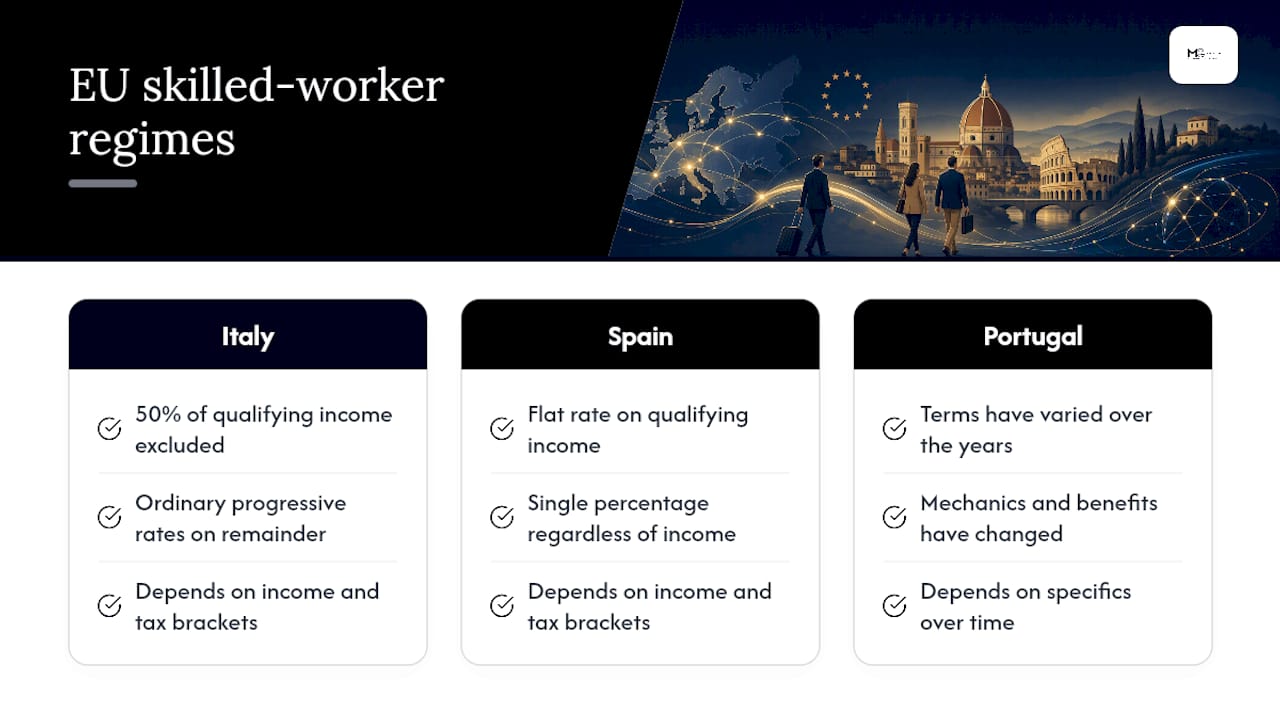
Italy is far from alone in courting skilled foreign workers through the tax code. Spain offers the Beckham Law regime, taxing qualifying new residents at a flat rate rather than through an income exclusion. Portugal has cycled through its own non-habitual resident program with varying terms over the years.
The mechanics differ meaningfully. Italy’s approach excludes half your qualifying income from the tax base and then applies ordinary progressive rates to what remains, while a flat-rate regime like Spain’s applies a single percentage regardless of income level. Which structure benefits you more depends heavily on your income level and bracket exposure.
When Should You Bring in a Tax Lawyer?
The clients who benefit most from the impatriate regime tend to share a pattern: mixed income streams, a group employment history somewhere in their background, or a property purchase they’re trying to time correctly against the relocation date. Any one of those factors adds real complexity to what looks, on paper, like a straightforward exclusion.
Legal professionals work with relocating professionals, researchers, and executives across multiple Italian cities, combining tax residency planning with immigration and property services related to moving to Italy. If your employment history involves a corporate group, if you’re combining the impatriate benefit with research incentives or a property purchase, or if social security coordination across borders is part of the picture, that’s the point to bring in a qualified tax lawyer rather than rely on a general summary.
— Legal marketing team
How Mglawfirm Supports Your Impatriate Regime Claim
Mglawfirm gives relocating professionals a single point of contact for the residency, tax, and property questions that the impatriate regime raises all at once, rather than juggling separate advisers who don’t talk to each other. Our multilingual team handles tax residency and cross-border planning, reviews same-group employment history before you file, and coordinates the timing of a qualifying property purchase against your relocation date to protect the three-year extension. We also support the broader residence and citizenship picture for clients whose move to Italy extends beyond a single tax filing. If you want a case review before you commit to a relocation date or a property purchase, reach out to Mglawfirm for a tailored assessment of your eligibility and the documentation you’ll need to defend it.
FAQ
What Is the 7% Rule in Italy?
It’s not tied to employment or professional qualification tests. Details on that scheme are covered in our guide to Italy’s 7% flat tax for foreign retirees.
Can You Live on €3,000 a Month in Italy?
Monthly living costs vary enormously by region and lifestyle, and no single figure applies nationwide.
Why Are Wealthy Individuals Moving to Italy?
Italy’s mix of tax incentives, including the impatriate regime, the flat tax for high-net-worth new residents, and regional relief programs, has made the country an increasingly attractive relocation destination for high earners and retirees alike. The impatriate regime specifically appeals to working professionals rather than pure investors, since it’s tied to employment or self-employment income rather than passive wealth.
How Are Expats Taxed in Italy?
Expats who become Italian tax residents are generally taxed on worldwide income under the ordinary progressive IRPEF brackets, unless they qualify for a special regime. Under the impatriate regime, only 50% (or 40% in qualifying family cases) of eligible Italian employment or self-employment income counts toward that taxable base, according to Agenzia delle Entrate.
How Do I Know If I Qualify for the Impatriate Regime?
You generally qualify if you transfer tax residence to Italy, were not an Italian tax resident for the required prior period, perform most of your work in Italy, and hold a qualifying professional or research credential. A same-group employment history extends the required non-residence period to six or seven years, so reviewing your employment chain with a qualified adviser before filing is worth the time.
Recommended
- Italy 7% Flat Tax for Foreign Retirees (2026)
- Italy-US Tax Treaty: Guide for US Expats 2026
- Italy 7% Flat Tax for Foreign Retirees
- Property Taxes in Italy for Non Residents – A Guide for Investors
The information provided here is general in nature and does not replace professional assistance. Reading this content does not create a professional-client relationship.
