
You must present a health policy with at least €30,000 in coverage that explicitly lists your name, the policy dates, and benefits for emergency hospitalization, medical evacuation, and repatriation. The proof has to arrive as a signed, stamped certificate of coverage, not just an insurance membership card. Some visa categories, particularly elective residence and digital nomad applications, face tighter scrutiny of that paperwork than a standard tourist visa does.
TL;DR:
- A valid health insurance policy must explicitly list your name, coverage dates, and benefits including hospitalization, emergency treatment, evacuation, and repatriation.
- The certificate of coverage must be signed, stamped, and include clear language confirming all required benefits, not just a membership card or app screenshot.
- Rejections often stem from missing signatures, incorrect dates, inadequate coverage amounts, or vague wording, which can usually be corrected before your appointment.
- Short-stay visas require a policy covering up to 90 days with Italian-specific wording, while longer stays or elective residency may need policies with higher ceilings and stricter proof.
- MG Law offers review services to ensure your insurance documentation meets consular requirements, saving time and preventing rejection delays.
Table of Contents
- What Your Health Insurance for Italy Visa Must Cover
- Do Requirements Change by Visa Type?
- The Certificate of Coverage Checklist Consulates Expect
- Why Applications Get Delayed Over Insurance Paperwork
- Choosing a Policy: Types, Fit, and Realistic Costs
- When Does Private Insurance Give Way to the SSN?
- MG Law’s Checklist for a Clean Consulate Submission
- Your Pre-Appointment Action List
- Why the Wording Matters More Than the Number
- How MG Law Helps With Visa Insurance and SSN Paperwork
- Sources
What Your Health Insurance for Italy Visa Must Cover
Consulates and the Questura check specific benefit categories, not just a dollar figure on a brochure. A policy that meets the minimum €30,000 emergency coverage threshold but excludes evacuation or repatriation will usually get flagged. The required benefit list is short but strict:
- Hospitalization for illness or injury during the stay
- Emergency medical treatment, including outpatient care
- Medical evacuation to an appropriate facility
- Repatriation of remains in case of death
Co-pays, deductibles, and waiting periods are the most common reasons an otherwise well-funded policy gets rejected. A high coverage ceiling means little to a visa officer if the fine print requires the applicant to pay significant out-of-pocket costs. Also confirm whether your policy is Schengen-area wording or Italy-only. Schengen wording covers travel across the zone during a short stay, but long-stay visas generally want validity specific to Italian territory for the requested period.
Do Requirements Change by Visa Type?
Yes. The insurance requirement for Italian visa applications shifts depending on why you are entering the country, and applicants often buy the wrong duration or the wrong kind of policy for their category.
- Short-stay (tourist, ≤90 days): Standard Schengen travel insurance with the €30,000 minimum and a certificate matching your exact travel dates.
- Student visas: A private policy covers the visa stage; after arrival, students can transition to the SSN through voluntary registration.
- Work visas and EU Blue Card: Private cover is required at entry, with employer-led SSN registration following once you start work. The EU Blue Card process outlines how that handoff typically works.
- Digital nomad and elective residence: Expect stricter review, sometimes higher coverage ceilings, and a request for proof the policy cannot be canceled mid-term.
Elective residence applicants in particular should review the elective residency visa requirements before purchasing a policy, since consular offices vary in what they consider sufficient.
The Certificate of Coverage Checklist Consulates Expect
A generic insurance card rarely survives consular review. What officers want is a document that functions like a legal attestation, not a marketing artifact. Based on consulate documentation guidance, your certificate should include:
- Full legal name and date of birth matching your passport
- Policy start and end dates covering the entire requested stay
- Stated coverage amount of at least €30,000
- Explicit language confirming hospitalization, emergency care, evacuation, and repatriation
- Insurer’s contact details, with a signature or official stamp
Screenshots of an app dashboard, unstamped PDFs, or a plain membership card typically get rejected outright. If your insurer only issues English documentation, ask whether they can also provide an Italian translation or a formal visa letter. Some Questura offices specifically request insurer statements confirming no deductible applies to emergency hospital care, a detail worth requesting before your appointment rather than after a denial.
Why Applications Get Delayed Over Insurance Paperwork
Most rejections trace back to a handful of repeat mistakes, and nearly all of them are fixable before you ever walk into the consulate.
- Missing signature or insurer stamp on the certificate
- Policy dates that don’t align with your actual travel or visa validity window
- Coverage ceiling below €30,000, or vague wording that doesn’t specify the required benefits
- Co-pay clauses buried in the policy terms
- An insurer with no way to be reached or verified from Italy
Timing causes its own set of problems. A policy that starts after your planned arrival date, or a monthly cancellable plan with no proof of payment through your full stay, raises immediate red flags. According to Italy Handbook’s comparison of visa insurance types, officers often reject policies specifically over ambiguous repatriation language.
Pro Tip: Request your certificate no more than two to three weeks before your consulate appointment, and ask the insurer directly for a non-cancellable, paid-in-full confirmation letter. A certificate issued too early can look stale, and one issued after your appointment date obviously won’t help at all.
Choosing a Policy: Types, Fit, and Realistic Costs
Four broad categories cover most applicants, and picking the wrong one wastes money or, worse, produces a certificate the consulate will not accept.
- Short-stay Schengen travel insurance fits tourists and business travelers under 90 days; it is the cheapest option and easiest to document, as described in Travel Insurance – easy-insured.ca.
- Long-stay private policies suit students, remote workers, and anyone staying beyond 90 days who isn’t yet eligible for the SSN.
- International Private Medical Insurance (IPMI) works for digital nomads and elective residence applicants who need broader geographic coverage and English-language certificates.
- Local Italian polizze can be cheaper once you’re already resident, though industry practice suggests they sometimes lack the bilingual documentation consulates abroad expect.
Cost depends heavily on age, trip length, pre-existing conditions, and how high a ceiling you carry. Tourists on short trips typically pay the least; digital nomads and elective residence applicants, who often need higher ceilings and non-cancellable terms, pay more. Before buying, confirm the insurer issues a proper certificate, offers Italian-language documentation on request, and lists a contact reachable from within Italy.
When Does Private Insurance Give Way to the SSN?
Private insurance is a bridge, not a permanent solution, for most long-stay visa holders. Employees generally get enrolled in the Servizio Sanitario Nazionale automatically through their employer. Many students and elective residence holders, by contrast, need to register voluntarily.
- Obtain your Codice Fiscale first; it’s required before any ASL appointment
- Visit the local ASL (Azienda Sanitaria Locale) office to register, whether mandatory or voluntary
- Voluntary registrants typically pay an annual lump sum through the F24 payment form
- Keep your payment receipt, since it’s often requested during permesso di soggiorno renewals
The Tessera Sanitaria (health card) is issued after the ASL processes your registration, and registration validity generally tracks your residence permit period. Expect a gap between your arrival and card issuance, during which your original private policy should still be active.
MG Law’s Checklist for a Clean Consulate Submission
Mglawfirm reviews visa insurance documentation as part of broader immigration support, and the same errors surface again and again across client files. A short operational checklist catches most of them before submission:
- Confirm the certificate lists your name, dates, and the €30,000 minimum in plain language
- Check translation needs early, since some consulates want Italian wording alongside English
- Verify apostille or legalization requirements if your certificate originates outside the EU
- Flag any co-pay or waiting-period clause for renegotiation with the insurer before applying
Legal review is worth arranging for elective residence cases, situations where consular staff have given inconsistent guidance, or any high-value visa category where a rejection means restarting a multi-month process. Applicants moving through the broader Italian residence and citizenship process often benefit from having insurance documentation checked alongside their other filings.
Your Pre-Appointment Action List
Before you book a consulate slot or head to Questura, work through this sequence in order:
- Purchase a policy dated to cover your full requested stay, starting on or before your arrival date
- Request a signed, stamped certificate of coverage naming you specifically
- Apply for your Codice Fiscale as soon as you’re eligible
- Prepare Italian translations of any English-only insurer documents
- Save every payment receipt tied to your policy and, later, your SSN enrollment
Documentation gaps remain one of the most cited reasons for visa delays according to consular guidance, which makes this checklist worth completing weeks, not days, before your appointment. Verify acceptance directly with your consulate’s contact line, ask your insurer for a written visa letter if anything seems ambiguous, and consider a quick document review with MG Law if your case involves elective residence or a history of inconsistent guidance. The pre-departure legal checklist covers the Codice Fiscale and residency steps that follow.
Why the Wording Matters More Than the Number
Applicants tend to focus on the coverage ceiling, chasing a higher number as if it guarantees approval. It doesn’t. A €50,000 policy with a hidden co-pay clause fails just as often as a bare-minimum €30,000 policy with clean language. In practice, wording is what gets scrutinized, not the size of the figure on the cover page.

The pattern we see repeatedly involves applicants who bought insurance months before applying, only to discover the certificate was formatted for a different country’s consulate or missing the exact benefit language Italian officers expect. A policy can carry a very high nominal limit and still get rejected over vague repatriation terms or an undisclosed waiting period. That’s a legal reading problem as much as an insurance one, and it’s exactly where translation and document review add value for higher-scrutiny visa categories.
Use the checklist in this guide before your appointment, not after a rejection notice. Small wording issues are cheap to fix in advance and expensive to fix once a consulate has already said no.
— Living
How MG Law Helps With Visa Insurance and SSN Paperwork
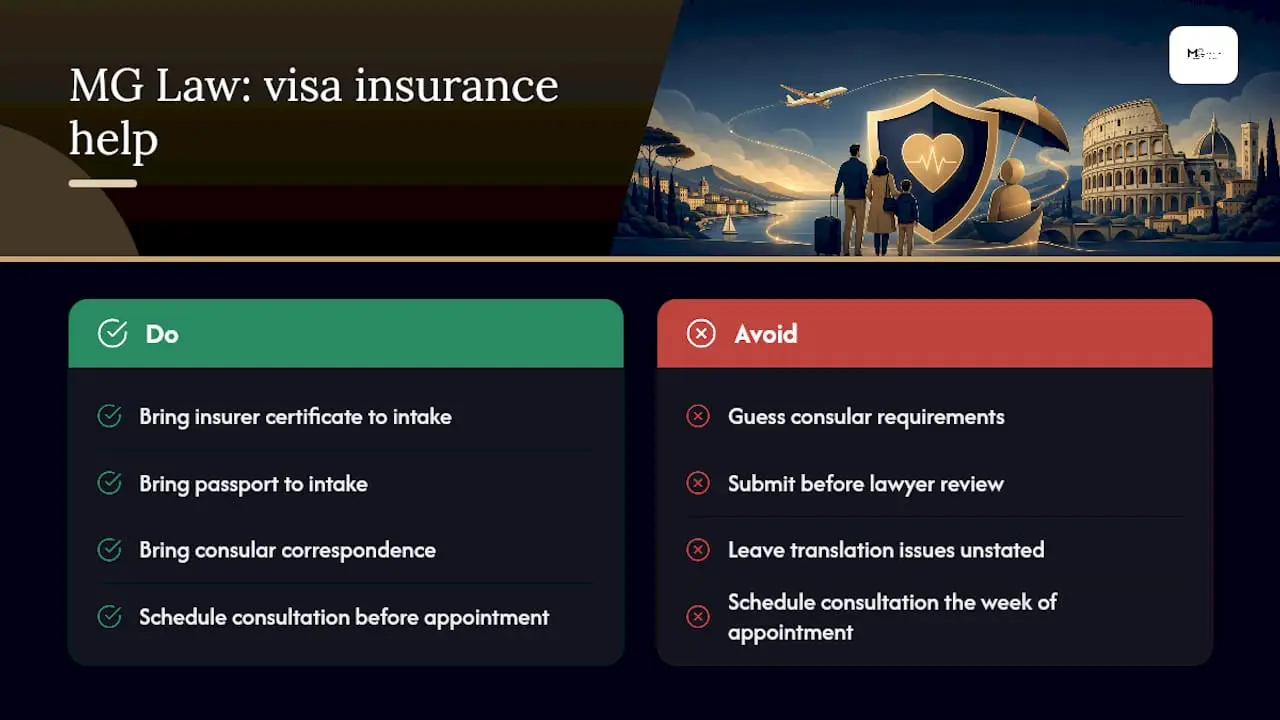
Mglawfirm is the alternative to guessing your way through consular requirements: our multilingual team reviews your insurance certificate against actual Questura and consulate expectations before you submit, not after a rejection letter arrives. We handle document review, translation liaison for Italian-language certificates, Codice Fiscale and ASL registration support, and a full check of your visa application package. Bring your insurer’s certificate, passport, and any consular correspondence to an intake session, and we’ll flag gaps in coverage wording, dates, or missing stamps. For elective residence, digital nomad, or work visa cases where the paperwork carries more weight, schedule a consultation with our English-speaking legal team before your appointment date, not the week of it.
This article is general information, not a substitute for advice from a qualified lawyer. Consult a qualified legal professional about your own circumstances before acting on anything here.
Sources
- Consulate guidance (example) — visa documentation requirements
- Italian health insurance card and foreign citizens — Agenzia delle Entrate
- Ministry of Health: international healthcare links and coverage guidance
- Health Insurance for Italian Visa Types: A Comparison — Italy Handbook
Recommended
- Elective Residency Visa Italy 2026: Requirements & How to Apply
- Moving to Italy from the USA: Requirements 2026
- Golden Visa Italy 2025: Residency by Investment Explained
- Italian Citizenship Lawyer for Foreigners
The information provided here is general in nature and does not replace professional assistance. Reading this content does not create a professional-client relationship.
