
Most Canadians with an Italian-born ancestor can still apply for Italian citizenship through jure sanguinis, though the 2025 reform narrowed eligibility for many people born abroad who have another citizenship. Whether you qualify now depends on your generational distance from the Italian ancestor and whether you fall under one of the reform’s exceptions, both covered in the section below. If you already know you qualify, skip ahead to the document checklist to start preparing your file.
TL;DR:
- Most Canadians with Italian ancestors remain eligible for citizenship through bloodline, but the 2025 reform restricts claims for those with multiple citizenships unless they meet specific exceptions.
- Applying requires long-form documents, apostilles, certified translations, and a timely appointment booking, with fees paid in Canadian dollars.
- Common rejection triggers include incomplete documents, missing apostilles, or unverified naturalization records, making early thorough preparation vital.
- Citizenship grants rights to live, work, and study across the EU and access Italy’s healthcare system, but dual citizenship can trigger tax and reporting obligations in Canada.
- Legal support is especially recommended for complex cases, especially judicial petitions or refusals, with most applications benefiting from early municipal research and document verification.
Table of Contents
- Who qualifies now: ius sanguinis, 1948 exceptions, and the 2025 limits
- Complete document checklist and how to authenticate and translate Canadian records
- Prenot@mi appointment strategy and exact consular fee and payment rules
- Step-by-step of the in-person submission and common rejection triggers
- What to expect after submission: processing times and how to follow up
- Practical benefits of Italian citizenship and key considerations for Canadians
- When to get professional help and what to expect from a citizenship lawyer
- What to do after citizenship is recognized: passports, AIRE, and identity documents
- Firm perspective: lessons from handling Canadian citizenship files
- How MG Law helps Canadians with Italian citizenship applications
- Sources
- FAQ
Who qualifies now: ius sanguinis, 1948 exceptions, and the 2025 limits
Ius sanguinis, or “right of blood,” is the Italian Civil Code principle that citizenship passes automatically through an unbroken line of descent from an Italian citizen, regardless of where a person was born. Most Canadians pursuing this route trace their claim to a grandparent or great-grandparent who never formally renounced Italian citizenship before their children were born.
A separate category, known as 1948 cases, applies when Italian citizenship passed through the maternal line before January 1, 1948. Italian law at the time did not allow women to transmit citizenship, so these claims require a judicial petition in Italy rather than a straightforward consular application.
The 2025 reform changed the picture for many foreign-born descendants who hold another citizenship, such as Canadians. As of March 28, 2025, these applicants qualify only under specific exceptions:
- First or second-degree descendants of an ancestor who held exclusively Italian citizenship at death.
- Applicants who meet other narrowly defined conditions under Article 3-bis of the conversion law.
- Cases falling under transitional provisions tied to applications already in progress before the reform took effect.
Because the exceptions are specific and technical, an early legal review of your family tree can save months of wasted document collection.
Complete document checklist and how to authenticate and translate Canadian records
Consulate checklists, including the one published by the Consulate General of Italy in Toronto, require a specific set of long-form documents, not the wallet-size extracts many Canadians already have on hand.
- Long-form birth, marriage, and death certificates for the applicant and every person in the direct line back to the Italian ancestor.
- A “certified copy of registration” (the full civil registration record, not a commemorative certificate) for each Canadian-born ancestor in the chain.
- Proof the Italian ancestor never naturalized as a Canadian citizen before the birth of the next person in line, or a naturalization certificate showing the date if they did.
- An apostille on every Canadian document, since Canada is now a party to the Hague Apostille Convention for documents used abroad.
- A certified Italian translation of each document, prepared by a translator accepted by the consulate or an Italian court.
Global Affairs Canada’s document authentication guidance explains which Canadian documents need an apostille versus consular legalization, and confirms that certified translations are required whenever a document is not in English or French.
Pro Tip: Order every vital record as a long-form “certified copy of registration” the first time. Reordering later, once a consulate rejects a short-form extract, can add weeks to your timeline.

Prenot@mi appointment strategy and exact consular fee and payment rules
Canadian consulates process jure sanguinis applications through the Prenot@mi booking portal, and slots are scarce. Appointments tend to release at a predictable local time and are claimed within minutes, so applicants should check the portal on multiple days and have their file fully assembled before attempting to book.
The consulate fee for an adult citizenship application is a fixed amount, and it is non-refundable, according to the Ambasciata d’Italia Ottawa. This matters because a rejected or incomplete file still costs you the fee.
Before your appointment, confirm:
- The fee is paid in Canadian dollars at the counter, since the euro amount is converted locally.
- Payment methods differ by consulate: some accept cash only, others allow Canadian debit cards, so call ahead.
- You bring valid photo identification matching the name on every submitted document.
Step-by-step of the in-person submission and common rejection triggers
At the appointment, consular staff verify each document against the checklist, confirm the apostilles and translations are complete, and have you sign the application forms before collecting the €600 fee. Some originals, particularly foreign vital records, may be retained by the consulate for the file, so bring an extra certified copy for your own records.
Common reasons files get turned away at the counter include:
- Wallet-size or short-form birth certificates instead of the required long-form registration copies.
- Missing apostilles on one or more Canadian documents in the chain.
- Translations that were not certified by an accepted translator.
- Gaps in the naturalization record that leave the ancestor’s citizenship status unproven.
What to expect after submission: processing times and how to follow up
Once your file is accepted, the consulate forwards it to the relevant Italian municipality for registration, a step that can take months depending on the municipality’s workload and whether it needs to verify records with other Italian offices. Delays are more common when an ancestor’s exclusive Italian citizenship is hard to document or when a name changed across generations.
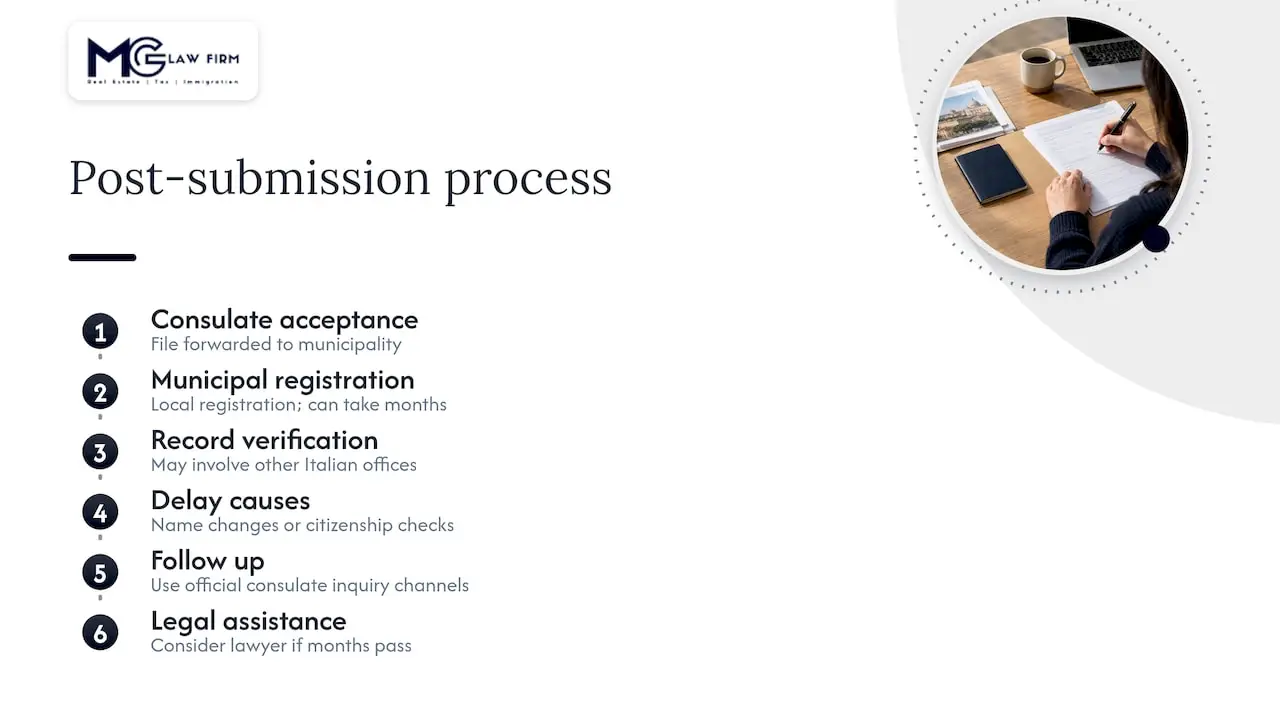
Follow up through the consulate’s official inquiry channels rather than informal calls, and consider legal help if months pass with no update or if the consulate requests additional documentation you cannot easily source from Canada.
Practical benefits of Italian citizenship and key considerations for Canadians
Italian citizenship gives you the right to live, work, and study anywhere in the European Union, voting rights in Italian elections, and access to Italy’s national healthcare system if you become a resident, according to The Local. Unlike a residence permit, citizenship is difficult to lose once granted.
Before applying, weigh these practical points:
- Dual citizenship between Canada and Italy is permitted, so you keep your Canadian passport.
- Moving to Italy can trigger tax residency rules that affect where you report worldwide income.
- Registering with AIRE (the registry of Italians residing abroad) becomes mandatory once you are recognized as a citizen living outside Italy.
- Check how dual citizenship interacts with any Canadian pension or benefit rules tied to residency status.
When to get professional help and what to expect from a citizenship lawyer
Legal representation tends to matter most in 1948 cases requiring a judicial petition, in files where proving an ancestor never naturalized is difficult, and in cases already refused at the consulate. A lawyer handling a Canadian client’s case remotely typically manages municipal record searches in Italy, prepares document requests, and files judicial claims where needed.
Pro Tip: Ask any firm you engage for a clear scope of work, an estimated timeline, and fee guidance in writing before signing an engagement letter.
What to do after citizenship is recognized: passports, AIRE, and identity documents
Recognition is the milestone, but a few administrative steps make the citizenship usable day to day.
- Apply for an Italian passport at the consulate if you remain in Canada, or at a Questura if you have moved to Italy; processing times vary by office.
- Register with AIRE, which is required for citizens living abroad and affects future passport renewals, voting, and certificate requests, per The Local.
- Request a certificato di cittadinanza for use in Italian administrative matters.
- If you relocate to Italy and register as a resident, access to the national health service through your local ASL is restored as part of standard residency registration.
Firm perspective: lessons from handling Canadian citizenship files
The applications that move fastest are the ones where every document was ordered in long form the first time, and where the family tree was checked against the 2025 exceptions before any paperwork began. Municipal research in Italy is often the slowest link in the chain: starting it early, rather than after a consulate flags a gap, is usually what separates a smooth recognition from a year of back and forth.
— Legal marketing team
How MG Law helps Canadians with Italian citizenship applications
MG Law works with Canadian applicants on citizenship by descent, 1948 cases, and judicial petitions, including remote case management for clients who never need to travel to Italy during the process. For an initial consultation, have your family tree, any known ancestor documents, and your consulate jurisdiction ready to discuss.
- Document review and municipal record searches in Italy.
- Guidance on the 2025 exceptions and how they apply to your specific lineage.
- Judicial petition support for 1948 and refused cases.
Sources
Confirm current requirements directly with your jurisdiction’s consulate checklist, the Ambasciata d’Italia Ottawa page, and Global Affairs Canada’s authentication guidance before submitting any file.
This article is general information, not a substitute for advice from a qualified lawyer. Consult a qualified legal professional about your own circumstances before acting on anything here.
- Recognition of Italian citizenship by descent – Ambasciata d’Italia Ottawa
- Recognition of Italian citizenship by descent – Consulate General of Italy in Toronto (checklist PDF)
- Authenticate documents for use outside Canada – Global Affairs Canada
- Riforma della cittadinanza – Ambassade/Consulate notice (2025 reform summary)
- Explained: What are the benefits of having Italian citizenship vs residency? – The Local (2023)
FAQ
How do Canadians get Italian citizenship?
Most Canadians qualify through jure sanguinis if they have an unbroken line of descent from an Italian citizen who never formally renounced their citizenship. Applicants gather long-form vital records, apostille and translate them, then submit the file at a Prenot@mi consular appointment.
Is there a downside to dual citizenship with Italy?
Dual citizenship itself is legal for Canadians, but becoming an Italian resident can trigger Italian tax residency rules and reporting obligations you did not have before. It also requires registering with AIRE and keeping identity documents current in two countries.
What are the new rules for Italian citizenship by descent in 2026?
The governing framework is the 2025 reform, which limits transmission for many foreign-born descendants who hold another citizenship unless they meet one of the specified exceptions under Article 3-bis. Canadians should check whether they qualify as a first or second-degree descendant of an ancestor who held exclusively Italian citizenship before starting the application.
Can I live in Italy as a Canadian citizen?
Yes, Canadians can visit Italy without a visa for short stays, but living there long-term requires a residence permit or, once Italian citizenship is recognized, no permit at all. Recognized citizens gain the right to live, work, and study anywhere in the EU, plus access to Italy’s healthcare system if they establish residency, according to The Local.
Recommended
- Italian Citizenship by Descent Lawyer Guide (2026)
- Italian Citizenship Lawyer for Foreigners
- Palermo Court & Italian Citizenship After Decree 36/2025 (2026)
- Italian Citizenship & Consular Delays: Court of Cassation 2026
The information provided here is general in nature and does not replace professional assistance. Reading this content does not create a professional-client relationship.
