
Yes, non-EU entrepreneurs who meet Italy’s “innovative startup” criteria and can document the required funds can get an Italia Startup Visa. Eligibility rests on two pillars: a qualifying innovative business concept and proof of financial resources. You can apply directly to the Technical Committee or through a certified incubator. Your first move should be downloading the official ISV application form and drafting your presentation deck and business plan.
TL;DR:
- Applicants must provide clear evidence of funding, with at least 50,000 euros for startups or 100,000 euros for joining established ventures.
- The application process involves submitting detailed business and financial documentation either directly or via a certified incubator, with a review period of 30 days.
- Rejected applications often lack sufficient innovation demonstration, proper financial proof, or a business plan aligned with Article 25 criteria.
- Deadlines are strict, requiring applicants to complete the residence permit within 8 days of entry and renew it at least 60 days before expiry.
- Legal support can streamline preparation, corporate structuring, and government communication, reducing delays caused by incomplete documentation.
Table of Contents
- What Is the Italia Startup Visa?
- What Are the Eligibility Requirements for an Italian Startup Visa?
- How Do You Apply for the Startup Visa? Direct vs. Incubator Route
- Documents Checklist: From Application to Residence Permit
- What Are the Official Timelines and Fees?
- Why Do Startup Visa Applications Get Rejected?
- An Honest Look at What This Process Actually Requires
- How Mglawfirm Supports Your Startup Visa Application
- Sources
What Is the Italia Startup Visa?
The Italia Startup Visa is a specialized, fast-track self-employment visa built for non-EU nationals who want to found or join an innovative startup in Italy. Its legal foundation is Decree-Law 179/2012, Article 25, which sets forth the statutory definition of an “innovative startup” under Italian corporate law.
Unlike Italy’s general self-employment visa quota, the Italia Startup Visa runs as a centralized, bilingual, digital procedure administered through the Ministry of Enterprises and Made in Italy, with a dedicated Technical Committee reviewing every application on its merits rather than through a bureaucratic checklist. The program was designed to strip out the paperwork delays that plague other visa categories, placing substantive evaluation in the hands of a committee built from national startup ecosystem associations.
It’s aimed squarely at founders and key team members: people bringing genuine technological or scientific innovation to Italy, not general business investors or standard self-employment applicants.
What Are the Eligibility Requirements for an Italian Startup Visa?
An “innovative startup” under Article 25 has to meet specific statutory markers, not just claim to be innovative. The Technical Committee checks each application against a defined checklist:
- The company must have technological innovation or research and development as its core business object.
- It must be incorporated in a qualifying corporate form (typically an s.r.l.) and registered in Italy’s special startup section of the Business Register.
- It cannot distribute dividends during the qualifying period and must reinvest profits into the business.
- At least one of three innovation markers must apply: a workforce with a defined share of researchers or graduate degree holders, ownership of a patent or registered software, or R&D expenses above a set share of costs or revenue.
On the money side, applicants launching a new company must typically document proven financial resources of at least 50,000 euros to develop the venture, detailed further in this startup business financing guide. Entrepreneurs joining an already-established innovative startup generally face a higher bar, closer to 100,000 euros, reflecting the larger commitment expected when stepping into an existing operation rather than starting from zero.
Acceptable proof of funds includes bank statements, signed investor commitment letters, or a formal undertaking from a certified incubator. Notably, in-kind services from a certified incubator (office space, mentorship, technical support) can count toward part of that financial threshold when properly documented.
How Do You Apply for the Startup Visa? Direct vs. Incubator Route
Two paths lead to the same destination: a Nulla Osta (certificate of no impediment) from the Technical Committee. Which one you choose depends on whether you already have backing from a certified incubator.
Case A: Direct application to the Technical Committee
- Download the official ISV application form from the Italia Startup Visa portal.
- Prepare your presentation deck as a PowerPoint (.ppt or .pptx) file, mapping your project to the Article 25 innovation criteria.
- Draft a full business plan, cover letter documenting your financial resources, and copy of your passport.
- Submit the full packet by email to italiastartupvisa@mise.gov.it, using the subject line format specified in the official guidelines.
- The Technical Committee reviews the file and issues (or denies) the Nulla Osta within 30 days of receiving complete documentation.
- Once approved, collect your visa at the Italian consulate in your jurisdiction within three months of the Nulla Osta issuance.
Case B: Application through a certified incubator
- Secure a signed “undertaking to host” from an Italian certified incubator, confirming its commitment to support your startup.
- Attach the incubator’s documentation, including its certification status, to your ISV submission packet.
- Submit alongside the standard application form, deck, and business plan through the same Committee channel.
- The Committee assesses the incubator’s undertaking and may count its in-kind services toward part of your proof-of-funds requirement.
- Follow the same 30-day review and three-month consular collection window as the direct route.
Submissions can be made in either Italian or English, though documents destined for local Questura review or consular processing are safer translated in advance to avoid last-minute delays.
Documents Checklist: From Application to Residence Permit
Assembling a complete file the first time is the single biggest lever you have over processing speed. Here’s what you need at each stage.
ISV submission packet:
- Completed application form
- Presentation deck (.ppt format)
- Full business plan
- Cover letter documenting financial resources
- Passport copy
- Certified incubator undertaking (if applying via that route)
Consulate appointment (after Nulla Osta issuance):
- Original Nulla Osta certificate
- Valid passport
- Passport-sized photos
- Proof of accommodation in Italy
- Proof of previous-year income (for the health co-payment exemption)
- Proof of residence within the consular district
Post-arrival residence permit (apply within 8 days of entry):
| Requirement | Detail |
|---|---|
| Postal bulletin 1 | a postal bulletin of the required official amount |
| Postal bulletin 2 | a postal bulletin of the required official amount |
| Revenue stamp | a revenue stamp of the required official amount |
| Passport copies | Full copy of all pages |
| Photos | 2 passport-sized photos |
| Renewal document | Visura camerale (company registration extract) |
What Are the Official Timelines and Fees?
Timing drives every decision an applicant makes, from when to submit to when to book a flight. The Italia Startup Visa guidelines set out four hard deadlines that structure the entire journey.
| Stage | Timeframe |
|---|---|
| Committee decision on Nulla Osta | 30 days from complete documentation |
| Visa collection at consulate | Within 3 months of Nulla Osta issuance |
| Entry into Italy | Within 180 days of visa collection |
| Residence permit application | Within 8 days of arrival in Italy |
| Residence permit renewal | No later than 60 days before expiry |
The number that matters most: 30 days. That’s the Committee’s statutory window to decide on a complete file, but the clock only starts once every document is in order, which is exactly why incomplete submissions cost applicants the most time.
Why Do Startup Visa Applications Get Rejected?
Three failure patterns show up again and again in rejected files. The most common is a weak match to the Article 25 innovation criteria: a business plan reads like a standard retail or services concept rather than a technology venture with genuine R&D. The second is inadequate or poorly documented funds, where bank statements don’t clearly show the required amount or investor letters lack the specificity the Committee wants. The third is a business plan that talks about ambition but never demonstrates actual technology, intellectual property, or research work.
The Technical Committee evaluates the “merit” of your application, weighing alignment with innovation criteria over conventional commercial promise. Structure your deck accordingly.
Pro Tip: Open your presentation deck with a single page that maps every element of your project directly to the Article 25 criteria, R&D activity, team qualifications, and any patent or IP plan, so the Committee can match your merits to their checklist in seconds rather than digging for them.
How MG Law supports applicants through this process:
- Reviewing and strengthening business plans to surface R&D and IP evidence clearly
- Handling company incorporation and corporate structuring alongside the visa file
- Liaising with certified incubators on undertaking documentation
- Managing communication with the Questura and consulate on your behalf
An Honest Look at What This Process Actually Requires
Applicants often underestimate how much the Italia Startup Visa rewards specificity. A vague pitch deck, no matter how polished, moves slower through the Technical Committee than a plain document that plainly ties each claim to Article 25. A multilingual legal team can assist across immigration and corporate aspects of these files because the two are rarely separable: a founder’s funding proof often depends on how the company itself is structured.
In practice, the 30-day Committee window is rarely the bottleneck. Delays usually stem from incomplete financial documentation or a business plan that needs a second draft. Our suggested first step is a document checklist review before you submit anything.
— Living
How Mglawfirm Supports Your Startup Visa Application
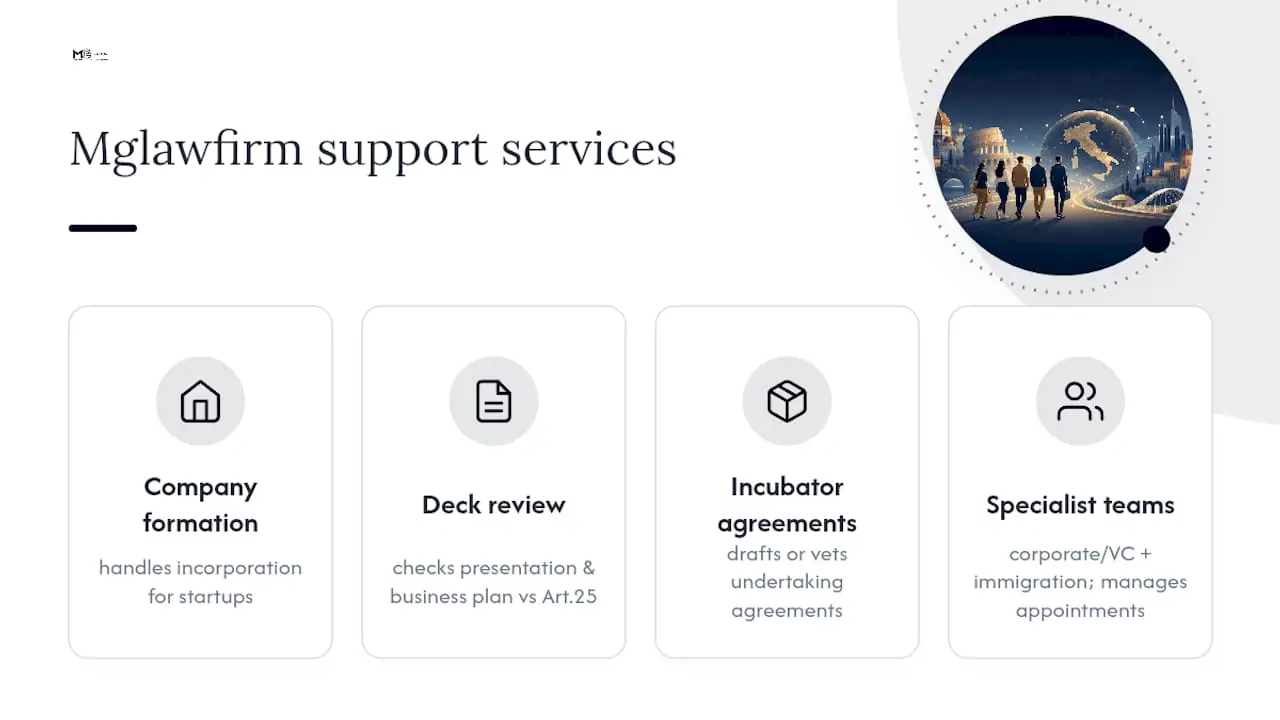
Mglawfirm is the alternative to piecing together your Italia Startup Visa application on your own, with a multilingual legal team that handles incorporation, documentation, and government liaison under one roof instead of leaving you to coordinate lawyers, accountants, and translators separately. We assist with company formation for your innovative startup, review your presentation deck and business plan against the Article 25 criteria before submission, draft or vet incubator undertaking agreements, and manage consulate and Questura appointments once you land in Italy.
If your funding proof depends on investor agreements or corporate structuring, our corporate and venture capital team can help build that documentation correctly the first time. For applicants weighing whether the startup visa fits their broader plans in Italy, our immigration and residency practice can walk you through the full picture.
To get started, request an initial consultation and bring your draft business plan, proof-of-funds documents, and any incubator correspondence you already have. We’ll tell you exactly where your file stands and what needs strengthening before it reaches the Technical Committee.
Recommended
- Italian Golden Visa vs EU Investor Visas
- Golden Visa Italy 2025: Residency by Investment Explained
- Elective Residency Visa Italy 2026: Requirements & How to Apply
- Business Setup in Italy for Foreign Investors: Legal Guide 2026
The information provided here is general in nature and does not replace professional assistance. Reading this content does not create a professional-client relationship.
