
Yes, if you carry out taxable business, agricultural, artistic, or professional activity in Italy, you must register for VAT before you make your first sale. This applies whether you live in Italy or run your business from abroad. There is no revenue threshold that lets you wait and see, and Agenzia delle Entrate’s own guidance treats registration as a precondition for taxable operations, not a formality you handle afterward.
Your first move is to work out which category you fall into, because that decides which paperwork you file:
- Resident individuals or companies file Form AA9/12 (sole traders and freelancers) or AA7/10 (companies) with the Revenue Agency.
- Non-residents either appoint a fiscal representative in Italy or register directly using Form ANR/3.
- EU sellers shipping goods to Italian consumers may only need the One-Stop Shop (OSS) scheme once they cross the €10,000 EU-wide distance-selling threshold, and should confirm any Italian counterpart’s VAT number through VIES before invoicing.
Key Takeaways
Italian VAT registration is mandatory before any taxable supply, and the correct form and route depend entirely on residency status and business structure.
| Point | Details |
|---|---|
| No waiting period | Non-residents face no revenue threshold; register before the first taxable supply in Italy. |
| Match the form to your structure | Use AA9/12 for individuals, AA7/10 for companies, and ANR/3 for direct non-resident registration. |
| Weigh liability before choosing | A fiscal representative shares joint liability; direct registration keeps liability solely with you. |
| OSS covers modest distance sales | Cross the €10,000 EU threshold and OSS in your home state can replace a standalone Italian registration. |
| Get professional support early | Mglawfirm assists with form filing, fiscal representation, ATECO classification, and Entratel access. |
This article is general information, not a substitute for advice from a qualified financial advisor. Consult a qualified financial professional about your own circumstances before acting on anything here.
Table of Contents
- Who Actually Needs Italy VAT Registration
- How to Register: Forms, Channels, and a Step-by-Step Checklist
- Fiscal Representative or Direct Registration: Which Fits Your Business
- Partita IVA Format, VIES, and When OSS Applies
- Life After Registration: Invoicing, Returns, and Deadlines
- Document Checklist and Mistakes That Slow You Down
- Get Your Italian VAT Registration Right the First Time
- Sources
Who Actually Needs Italy VAT Registration
The rule is broader than most people expect. Any resident sole trader, freelancer, or company generating income from a business, agricultural, artistic, or professional activity must open a Partita IVA before invoicing a single client. That covers a graphic designer working from a Milan apartment as much as it covers a restaurant in Palermo.
Non-residents face a lower bar than they usually assume. If you sell taxable goods or services to final consumers in Italy, store inventory in an Italian warehouse, or import goods for resale there, you generally need Italian VAT registration regardless of your revenue. Selling exclusively to Italian VAT-registered businesses can shift the liability to the buyer under reverse charge, removing your need for local registration in some scenarios.
Three cases illustrate the split clearly:
- A UK freelancer relocating to Bologna and invoicing local clients: resident registration, Form AA9/12.
- A US company storing products in a third-party fulfillment warehouse near Bergamo: non-resident registration required, no minimum threshold applies.
- A French online retailer shipping directly to Italian consumers who crosses the €10,000 EU distance-selling threshold: OSS registration in France covers the Italian sales instead of a standalone Italian registration.
How to Register: Forms, Channels, and a Step-by-Step Checklist
- Sole traders and freelancers file Form AA9/12.
- Companies and other entities file Form AA7/10.
- Non-residents registering directly, without a fiscal representative, file Form ANR/3, sent to the Pescara Operational Centre as specified in the ANR/3 instructions.
Submission channels vary by form and filer type. Residents typically use the Entratel or Fisconline online portals, though in-person filing at a local Revenue Agency office and certified email (PEC) remain valid routes. Non-resident direct registrations follow the specific mailing and Entratel procedures set out in the ANR/3 guidance, and the filing must happen before the first VAT-relevant operation, not after.
Before you submit anything, gather:
- Valid ID or passport for individuals; certificate of incorporation and articles of association for companies.
- A VAT or tax certificate from your home country confirming your current registration status.
- A signed power of attorney if you are appointing a fiscal representative.
- Your chosen ATECO activity code, plus any required declarations of activity.
Pro Tip: Take the ATECO code selection seriously. It determines your tax treatment and, for individuals, your social security obligations, and correcting a wrong code after registration can trigger closer scrutiny from the tax authority rather than a quiet fix.
Fiscal Representative or Direct Registration: Which Fits Your Business
Non-residents have exactly two paths into the Italian VAT system: appoint a fiscal representative (rappresentante fiscale) who takes on joint liability for your VAT debts, or register directly using Form ANR/3 without a local intermediary.

| Factor | Fiscal Representative | Direct Registration (ANR/3) |
|---|---|---|
| Liability | Representative shares joint liability with you | You alone remain liable |
| Speed | Faster onboarding for Entratel access in some cases | Depends on document completeness |
| Administrative burden | Lower; representative handles filings | Higher; you manage compliance directly |
| Best suited for | Non-EU entities or those wanting local support | EU entities comfortable managing Italian filings |
Appointing a representative means signing a power of attorney and confirming that person or firm’s existing Italian VAT number, since they will file returns on your behalf. The catch is real: joint liability means your representative can be pursued for unpaid VAT tied to your activity, which affects how much a representative firm may want in fees or guarantees before signing on. That liability exposure should factor into any contract you negotiate with a prospective representative.
Partita IVA Format, VIES, and When OSS Applies
An Italian VAT number, the Partita IVA, always takes the form “IT” followed by 11 digits, and it must appear on every invoice and official commercial document you issue. Get the format wrong, and even a valid registration can cause invoicing headaches with EU counterparts checking your number.
VIES, the EU’s VAT Information Exchange System, lets businesses confirm whether a partner’s VAT number is active for cross-border trade. It queries national databases in real time, but it is a validation tool, not a full commercial registry. An “invalid” result can simply mean the registration hasn’t finalized yet, not that the number is fraudulent.
The OSS threshold decision comes down to a short checklist:
- Are you storing goods physically in Italy? If yes, local registration is almost always required regardless of sales volume.
- Are your combined EU-wide distance sales to consumers under €10,000 annually? If yes, you likely still charge your home-country VAT rate and skip both OSS and Italian registration.
- Have you crossed that €10,000 threshold across the EU? OSS registration in your home member state typically covers your Italian B2C sales without a standalone Partita IVA.
The €10,000 threshold has applied EU-wide since July 2021, replacing the patchwork of national distance-selling limits that used to force sellers into multiple local registrations.
Life After Registration: Invoicing, Returns, and Deadlines
Registration is the start of an ongoing relationship with the Italian tax authority, not a box you check once. Every invoice you issue must display your Partita IVA, and you’ll file periodic VAT returns, monthly, quarterly, or annually depending on your activity and turnover, alongside the corresponding VAT payments.
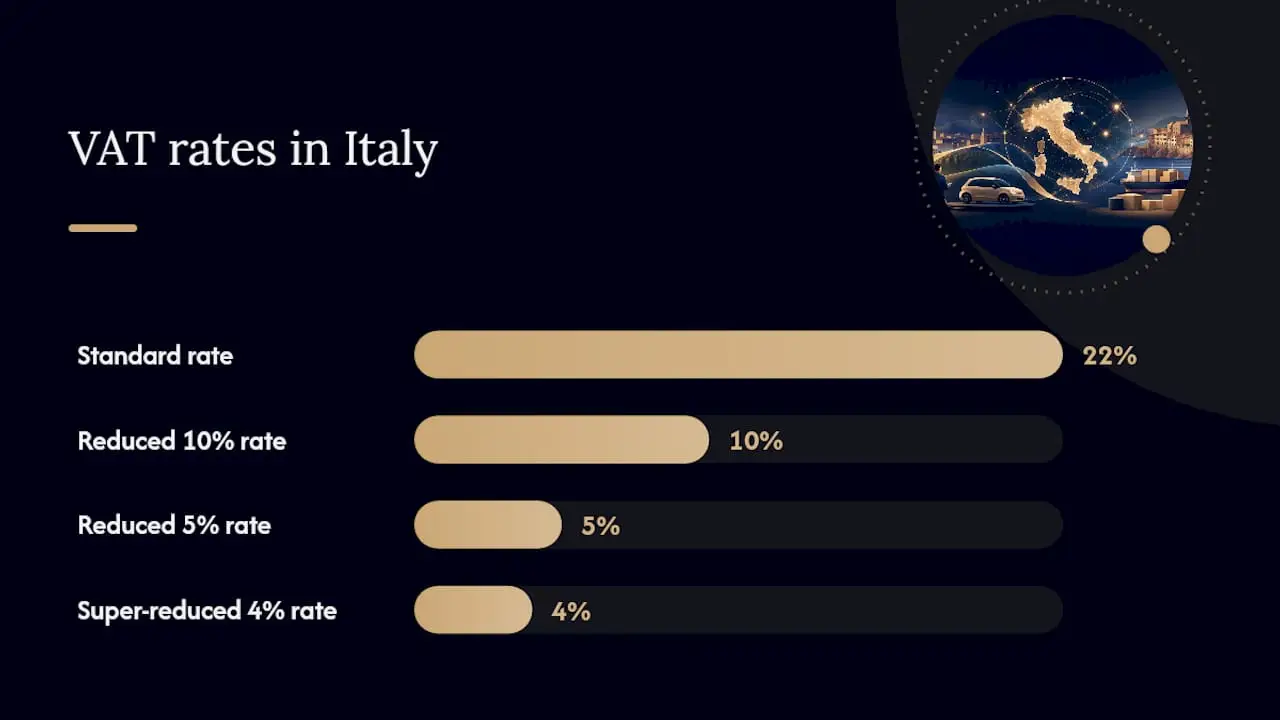
Italy’s standard VAT rate sits at 22%, with reduced rates of 10% and 5% and a super-reduced 4% rate applying to specific goods and services, according to technical VAT reference data. Always confirm the exact rate for your specific supply category, since misclassification creates its own compliance risk.
Keep these obligations on your radar:
- Notify the Revenue Agency of changes to your business details, generally within 30 days of the change.
- Cancel your VAT registration formally when you stop trading; leaving it open invites unnecessary filing obligations.
- Retain OSS or IOSS transaction logs separately if you use either scheme for distance sales.
- Register before your first taxable supply. Retroactive registration after the fact typically brings interest and penalties on top of the VAT owed.
Pro Tip: Build a simple monthly folder for invoices, vendor records, and OSS logs from day one. Reconstructing six months of transactions right before a filing deadline is where most avoidable errors creep in.
Document Checklist and Mistakes That Slow You Down
Before you file anything, assemble your passport or national ID, your foreign tax or VAT certificate, corporate documents (articles of incorporation, certificate of good standing), a signed power of attorney if using a fiscal representative, proof of address, and your chosen ATECO code.
The recurring pitfalls are predictable: filing AA9/12 when your structure actually requires AA7/10, picking an ATECO code that doesn’t match your real activity, submitting a power of attorney missing the representative’s Italian VAT number, or filing late relative to your first taxable transaction.
Pro Tip: If your corporate documents aren’t in Italian, get certified translations ready before you submit. Missing translations are a quiet but common reason applications sit unprocessed for weeks.
Why correct VAT registration matters from where we sit
Getting the registration route wrong rarely surfaces immediately. It shows up months later, as a rejected invoice, an unexpected penalty notice, or a dispute over who owes what under a fiscal representative arrangement. We’ve seen the cost of misclassification fall hardest on foreign entrepreneurs who assumed Italian VAT rules would mirror their home country’s.
Mglawfirm assists with form completion for AA9/12, AA7/10, and ANR/3, fiscal representative arrangements, ATECO code advice, and Entratel onboarding. When your structure raises permanent establishment questions or your OSS volume grows complicated, that’s the point to bring in legal counsel rather than push forward alone.
Get Your Italian VAT Registration Right the First Time
Filing the wrong form, missing a translation, or misjudging whether you need a fiscal representative can cost you weeks and, in some cases, retroactive penalties. Mglawfirm’s multilingual team in Rome, Milan, Palermo, Ostuni, and Noto handles the paperwork end to end, from choosing between AA9/12, AA7/10, and ANR/3 to setting up fiscal representation and Entratel access.
Before reaching out, have a few basics ready: your business structure, expected sales volume in Italy, whether goods will be stored locally, and copies of your corporate or identity documents. From there, Mglawfirm can map the fastest compliant path for your situation and handle the filing directly. If your VAT question ties into a property purchase or business setup in Italy, Mglawfirm’s tax services cover both the registration and the ongoing compliance that follows. Reach out for an initial assessment before your first taxable transaction, not after.
Sources
- Business – VAT registration – VAT registration – Agenzia delle Entrate
- Check a VAT number (VIES) – Your Europe
